Eczema-Prone Skin and Frankincense Oil: What to Know
If you live with eczema or psoriasis, you have probably read that a particular oil is "great for skin" more than once. We love frankincense oil for its warm, resinous scent, and we sell it as an aromatic, not as something to put on a skin condition. So this post does something more useful than a recipe: it tells you what dermatology sources say about fragrance and reactive skin, and how to enjoy the scent without making your skin the test site.

Frankincense Essential Oil
Six single-origin frankincense varieties, steam-distilled and GC/MS verified.
From $12.99 $10.40 with code BLACKFRIDAY
Dermatologist advice for atopic dermatitis comes first
The American Academy of Dermatology says plainly that atopic dermatitis "cannot be cured, but proper treatment can control it," and that dermatologists recommend a moisturizer for everyone who has it, because keeping skin moisturized helps prevent the cracks that can worsen rashes, itch and infection. On the same page, fragrance, perfumes and harsh detergents appear in the list of common triggers, alongside weather extremes, wool and stress. Triggers vary from person to person, which is why a dermatologist builds the plan around you.
That is worth sitting with for a moment. For many people with reactive skin, the fragrance itself is the thing to watch, and an essential oil is a concentrated fragrance.
Why don't boswellic acid studies cover frankincense oil?
If you have seen frankincense linked with inflammation, that work is mostly on boswellic acids from resin extracts, taken by mouth or used in creams. Boswellic acids are heavy, non-volatile molecules, and the Tisserand Institute reports that they "do not show up in GC-MS analysis of Frankincense oils." A steam-distilled oil like the six we sell is a different material from a resin extract, so those studies do not describe it. Our posts on boswellic acids and resin versus essential oil explain the distinction.
The US National Center for Complementary and Integrative Health says there is not enough high-quality evidence to determine whether boswellia is useful for any health condition, and that boswellia may be safe to use topically or for aromatherapy. Those two statements sit together: general safety is one question, and benefit for a skin condition is another that has not been answered.
Are essential oils riskier for eczema-prone skin?
DermNet NZ lists people with atopic dermatitis among those at higher risk of allergic contact dermatitis to essential oils. The reaction is the delayed kind, generally appearing 24 to 72 hours after exposure, which means a patch that looks fine on day one can still become a problem on day three. DermNet also notes that the allergen may be an oxidised component of the oil, a good reason to keep bottles closed and cool (see our storage post).
Because a new contact reaction on eczema can look like more eczema, it is hard to tell the two apart yourself. That is our reasoning rather than DermNet's wording, but it is the main reason we suggest bringing a clinician into the decision.
Missing frankincense oil scent without guilt
Before the practical list, one thought from us as people who love this scent. It is easy to feel that you are missing out when you hear that a fragrance is best kept away from your skin. You are not. A great deal of the pleasure of frankincense is in the smelling, and smelling does not need skin at all.
- Skin that is flaring, cracked, weeping or under prescription treatment: keep essential oils off it and ask the dermatologist who is managing it.
- A rash nobody has examined: get it looked at first. A diagnosis shapes everything that follows.
- Clear skin and a love of the scent: enjoy it in the air. The Tisserand Institute suggests diffusing 30 to 60 minutes on and 30 to 60 minutes off, with some fresh air in the room, and keeping it off the skin is the gentlest way to start.
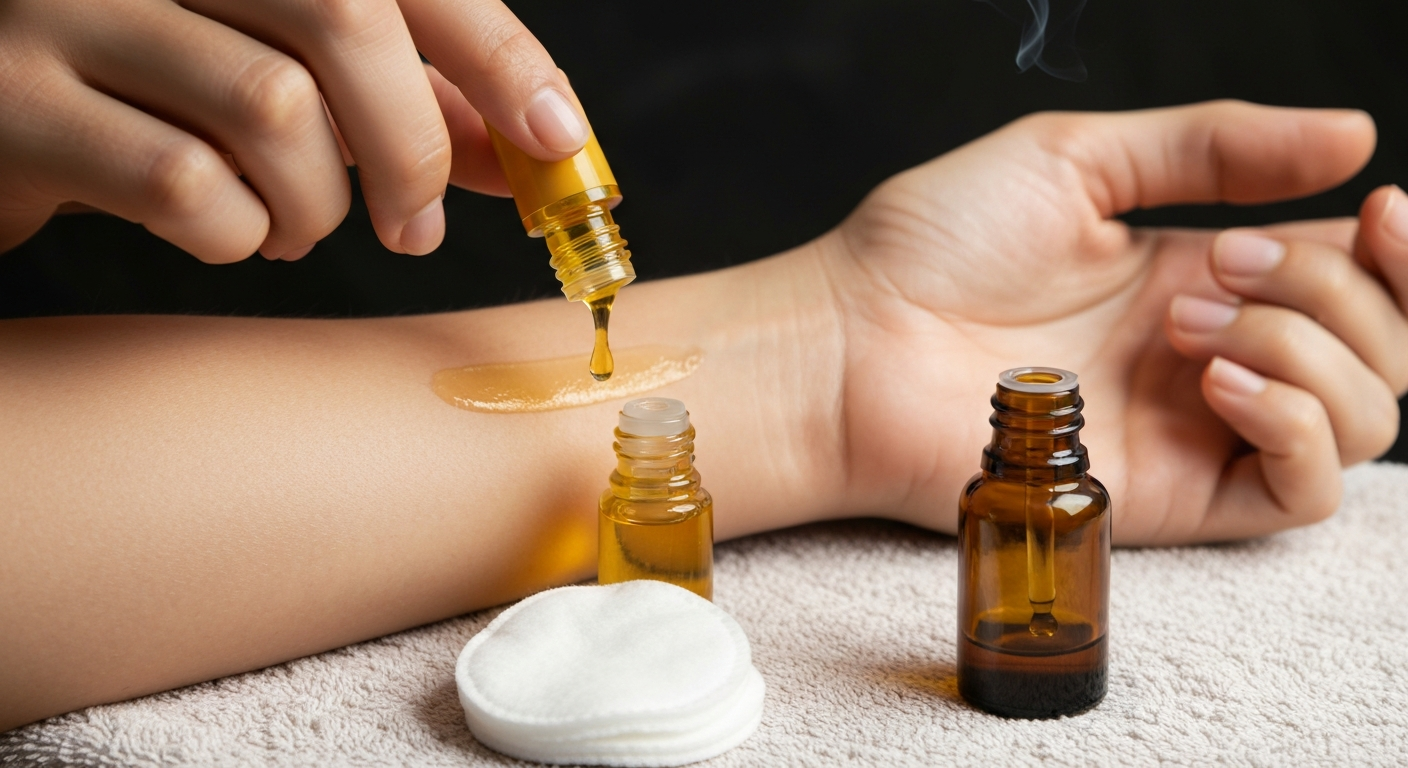
- A decision, with your dermatologist's agreement, to try it on skin: the Tisserand Institute places "sensitivity issues, impaired skin" in its lowest dilution range, 0.2 to 1%, and advises introducing oils in very low concentrations. Test a small patch, watch for redness or irritation over 24 hours at the least, and for longer given the delayed pattern above.
We sell our oils neat, so any dilution is yours to work out; our dilution guide shows the arithmetic. Our disclaimer says to patch test before topical use and to check with a healthcare provider first if you are pregnant, nursing, taking medications or have a medical condition, and that holds doubly here.
Ways to enjoy the scent without your skin
- The bottle itself. Open it, hold it a few inches away and take one slow breath. Cap it again. That is a complete experience.
- A paper strip. Put a drop on a strip of plain paper and leave it on a shelf across the room, away from anything you touch.
- The diffuser. Keep to the short on and off rhythm, and place it where you are not sitting right next to it.
Wash your hands after you handle the bottle, and keep oily fingers away from irritated skin, since a drip on the outside of a bottle is an easy way to get oil where you did not intend.
Fragrance-free creams for dry, itchy skin
The AAD's own advice for dry skin is a cream or ointment rather than a lotion, with ingredients such as glycerin or petrolatum, in products labelled fragrance-free. It is a good reminder that the best skin routine for eczema-prone skin is probably unscented, and that a scent habit can live separately in your diffuser. If you do want to try a very gentle formula later on, your dermatologist is the person to ask about what suits your skin.
Loving an aroma and caring for sensitive skin are not in conflict, they just live in different places.
If your skin is calm one month and cranky the next, be patient with it and with yourself. Scents will still be there when your skin is ready for a conversation with your dermatologist.
Frankincense Essential Oil
Serrata, carterii, sacra, frereana, neglecta and rivae: steam-distilled, GC/MS verified, in sizes from 0.5 oz to bulk.
From $12.99 $10.40 with code BLACKFRIDAY
Sources & Further Reading
- American Academy of Dermatology. Eczema types: Atopic dermatitis diagnosis and treatment.
- DermNet NZ. Allergic contact dermatitis to essential oils.
- NCCIH. Boswellia: Usefulness and Safety.
- Tisserand Institute. Does Frankincense oil contain boswellic acid?
- Tisserand Institute. Dilution for essential oils.
- Tisserand Institute. How to Use Essential Oils Safely.