Frankincense Oil and Acne: What the Oman Lab Study Found
Somewhere in your search results is a line saying frankincense oil fights acne bacteria, and it is not made up: a lab in Oman did measure something real. It is also a long way from what happens on a face, and the distance between the two is the interesting part.

Frankincense Essential Oil
Six single-origin frankincense varieties, steam-distilled and GC/MS verified.
From $12.99 $10.40 with code BLACKFRIDAY
Boswellia sacra fractions tested on bacteria in Oman
Researchers distilled resin from three kinds of Boswellia sacra (the Najdi, Sahli and Houjri cultivars) into three successive fractions, then dripped the oils onto bacteria growing in a dish to find the weakest dose that stopped growth. Two of the second-fraction oils, Sahli and Houjri, held back Propionibacterium acnes at 0.264 and 0.66 milligrams per millilitre. That bacterium is the one dermatology textbooks link to breakouts, so the headline writes itself.
Look at who the authors say the work is for, though. Their closing line frames it as another tool against microbes and antibiotic resistance, especially outside clinics, with farms and food processing as their examples. A broth in a flask has no skin oil, no pores and no inflamed tissue. A result that a substance slows bacteria there tells you the substance is active chemistry, which is true of plenty of kitchen herbs. It does not tell you what a diluted oil does to a blemish, and nobody in that paper tried.
Does one bacterium explain acne?
When you read how the American Academy of Dermatology describes acne care, the first thing you notice is how many different tools are involved. A dermatologist can recognise acne just by looking at the breakouts, and different types call for different care. Plans often combine several medicines, among them retinoids, benzoyl peroxide, topical antibiotics, salicylic acid and azelaic acid, since each goes after a different cause. Pills enter the picture for harder cases. Even with the right plan, the AAD says it takes at least 6 to 8 weeks before you see fewer breakouts, and preventing scars is one of the listed goals of treatment.
That breadth is our reason for not treating a bacteria-in-a-dish number as a plan. Reasoning from it, a product aimed at one factor was never going to be the whole answer, and we would rather say so than let a scent do a medicine's job. If your skin is painful, deep, or not settling, the useful step is an appointment.
Diluting frankincense oil for facial scent
Plenty of people enjoy a resinous, lemony-woody aroma, and that is a fine reason to own a bottle. We sell our six frankincense oils neat, which means the dilution is yours to make, so it helps to know the ranges that safety authorities use. The Tisserand Institute lists 0.2% to 1% for sensitive or impaired skin and 0.5% to 1.2% for facial products. The same page has a much higher 2% to 10% band for short-term spot treatments, with a note that stronger mixes raise the chance of a skin reaction. None of those numbers is specific to frankincense, and none says the oil does anything for a blemish. Our own view, reasoning from skin that is already irritated, is to stay at or below the facial range and never go near that spot-treatment band.
Practical habits matter more than the percentage. Patch test a small area first and wait, because anyone can react to any essential oil. Keep it away from your eyes and from broken skin. If you already use a prescription or over-the-counter acne product, check with your dermatologist or pharmacist before adding anything scented, since layering products is an easy way to irritate skin. And since a reaction to an oil can look like a flare-up, tell your dermatologist about everything you put on your face. Our guide to putting frankincense oil on the face walks through the patch test and technique, and the safety guide collects the dilution ranges in one place.
Diffuser or tissue: frankincense scent away from skin
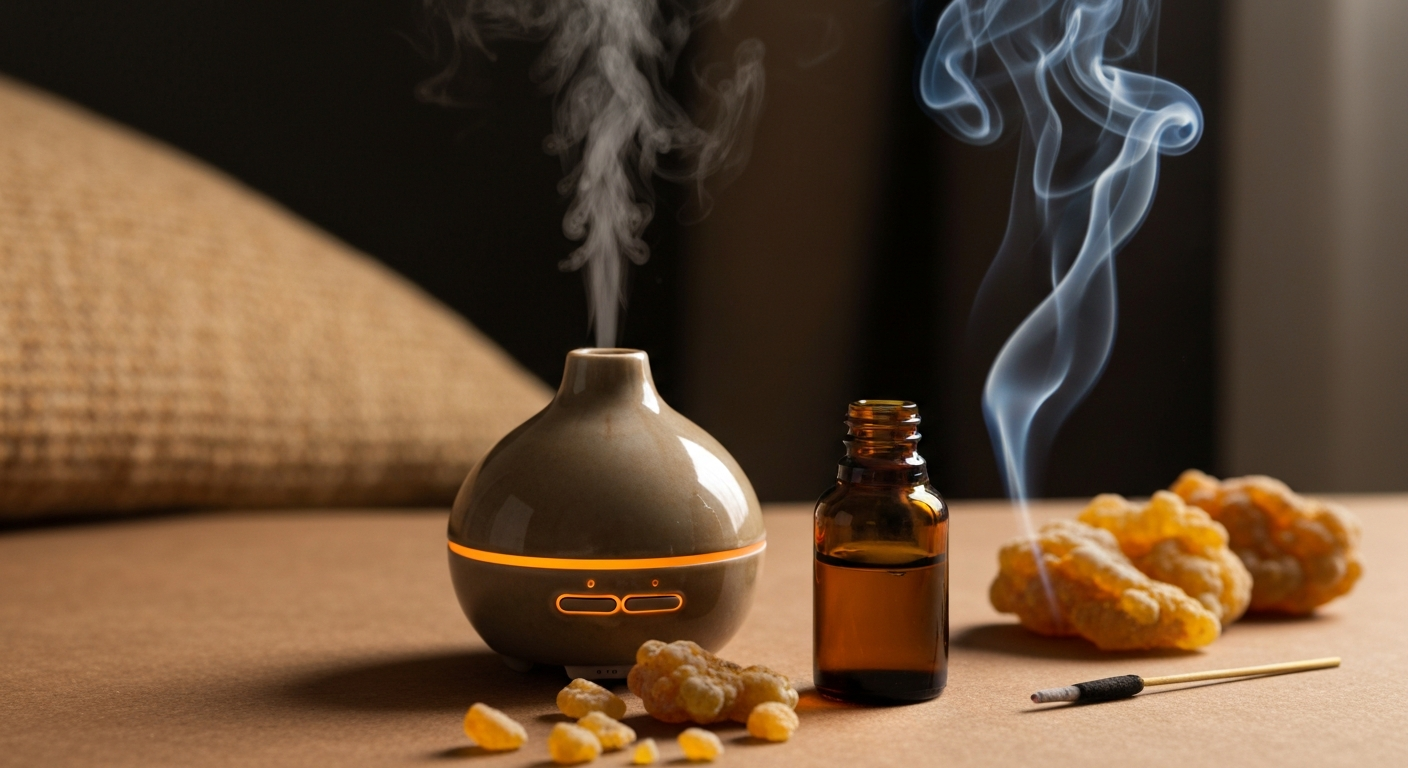
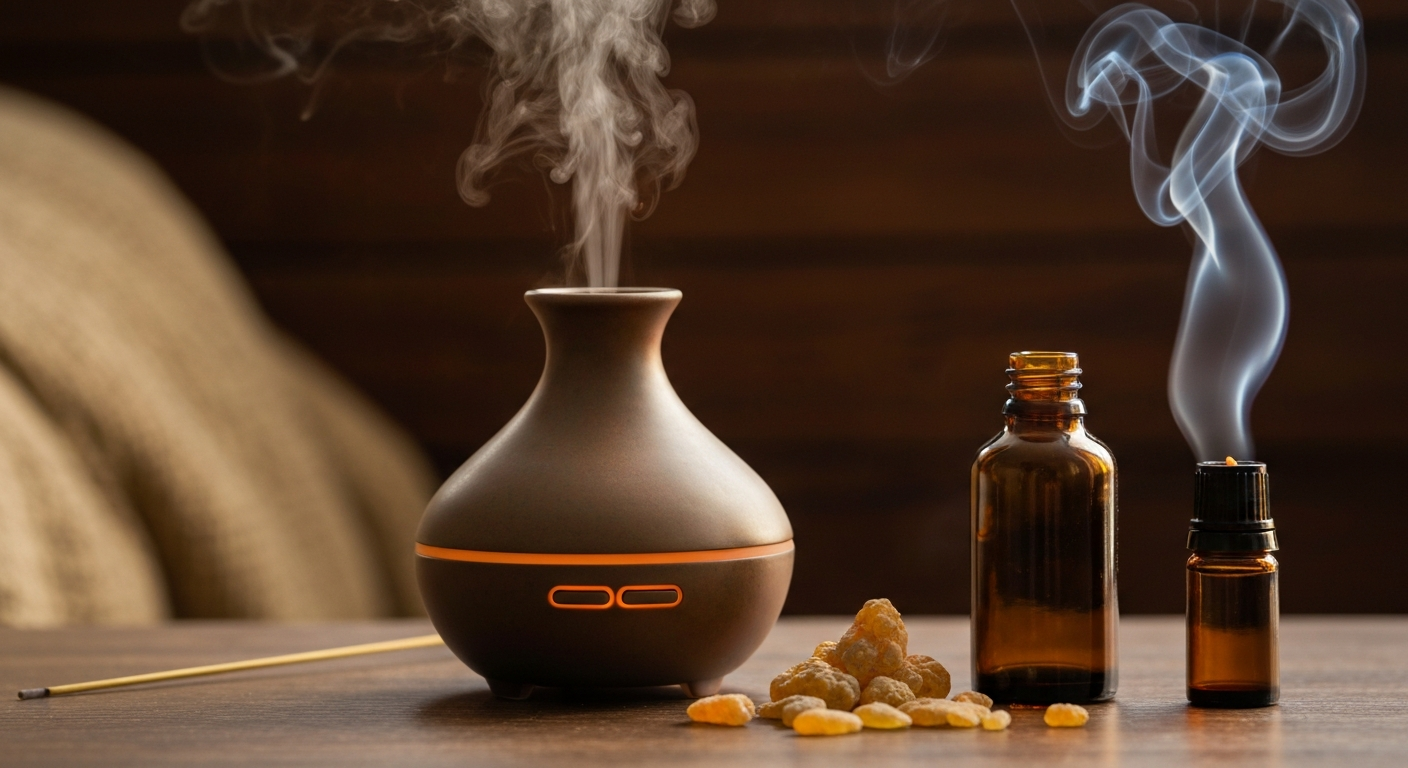
Simple is a good principle. If you are already following a plan from your dermatologist, you probably do not want a new variable on your face. Enjoy the scent where it cannot get in the way: a drop on a tissue or cotton pad set across the room, or a diffuser run according to its manual with a window open.
That way you keep the warm, lemony-woody pleasure of frankincense, and your skin keeps the routine that someone qualified has chosen for it.
How should acne lab study headlines be read?
Three questions cover most claims of this kind. Was it tested in people, or in a dish? Which bacterium or cell was it, and is that the whole condition? And what was the material: a lab-distilled fraction from one cultivar, or the oil you can buy? On the first, we ran a title search of Europe PMC on 5 November 2026 for frankincense, Boswellia or olibanum together with acne and found no matches, so we have no human study to point you to. Our companion piece on what lab studies do and do not show takes the same questions further.
The FDA makes a related point on its aromatherapy page: how a product is regulated depends largely on what it is claimed to do, and a plant origin does not exempt a product from being treated as a drug. That is why you will not find us promising a result for a skin condition. We sell a fragrant oil, and the best help for breakouts comes from someone who can look at your skin.
Frankincense Essential Oil
Serrata, carterii, sacra, frereana, neglecta and rivae: steam-distilled, GC/MS verified, in sizes from 0.5 oz to bulk.
From $12.99 $10.40 with code BLACKFRIDAY