Frankincense Oil Chemistry: What Distillation Keeps
A lump of frankincense resin and a bottle of frankincense oil share a name and a tree, but they are not the same material. Resin is mostly resin and gum. The oil is the small, fragrant, volatile part that steam can lift out of it. Once you see how little of the resin makes the trip, a lot of confusing frankincense advice starts to make sense.

Frankincense Essential Oil
Six single-origin frankincense varieties, steam-distilled and GC/MS verified.
From $12.99 $10.40 with code BLACKFRIDAY
Resin tear composition before the still
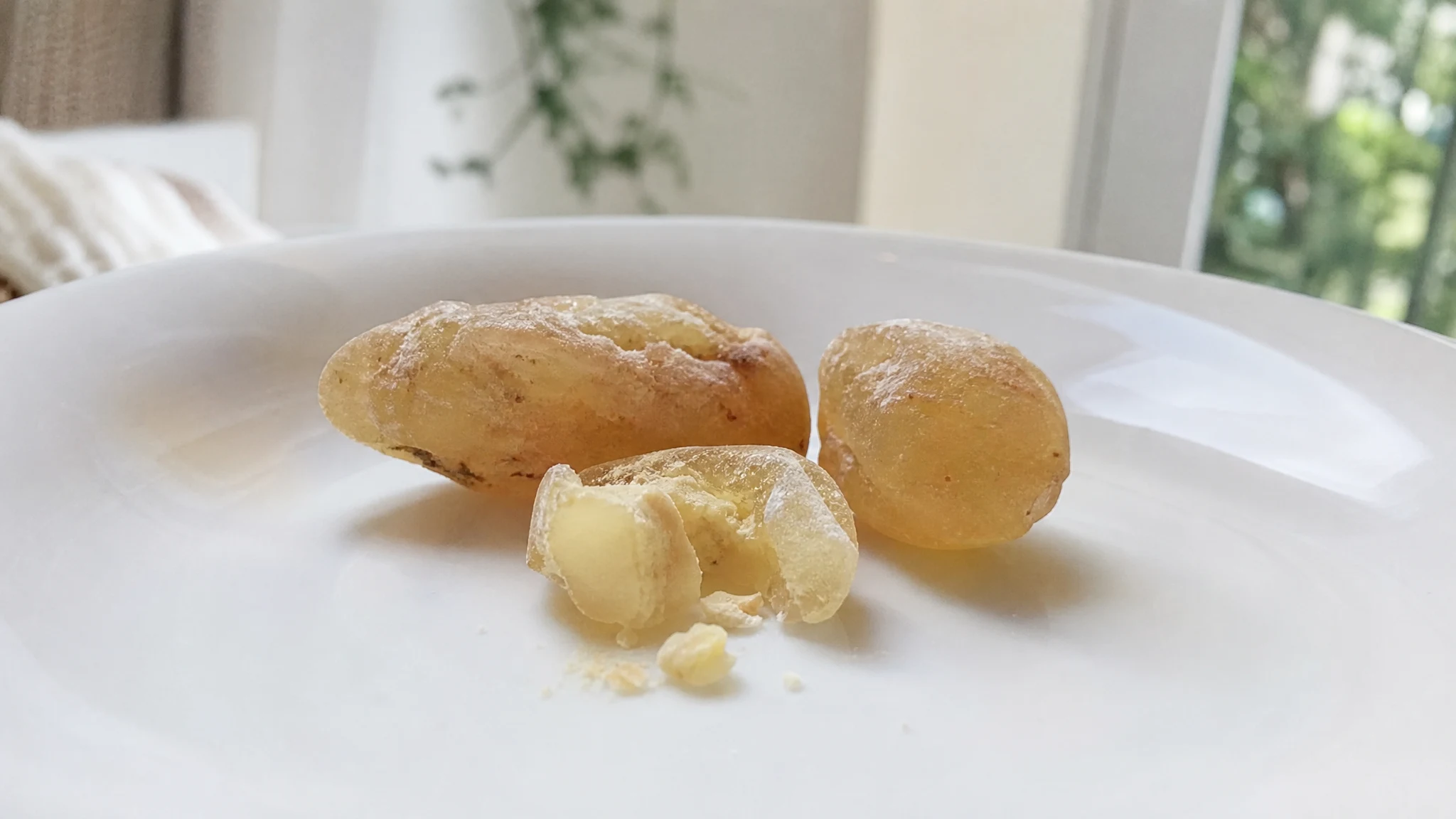
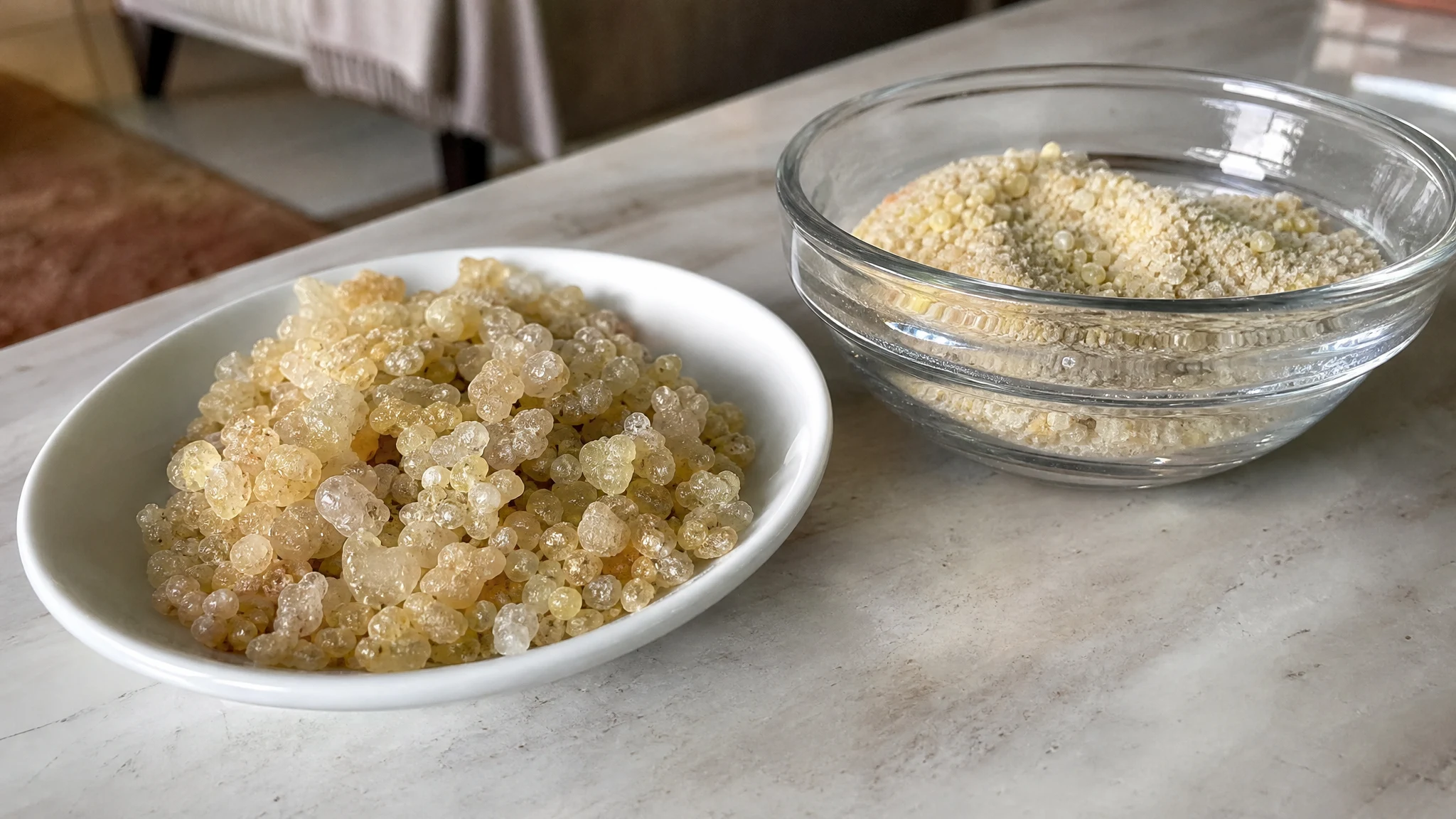
We find the best way into this subject is to picture a tear of resin in your hand. It is waxy and a little sticky, it smells piney and sweet when you warm it between your fingers, and yet it looks nothing like the thin, pale oil that ends up in an amber bottle. The journey from one to the other is really a story about what gets left behind.
Frankincense is an oleo-gum-resin, a natural mixture of three broad parts. A 2024 review in Naunyn-Schmiedeberg's Archives of Pharmacology puts the oleo-gum resin of Boswellia species at roughly 30 to 60% resin, 5 to 10% volatile oil and 25 to 30% gum. The resin part holds the large triterpenoid molecules, the boswellic acids among them. The volatile oil is a blend of small terpenes. The gum is built from sugars. These are ranges for the genus, and they shift with species and harvest.
Steam can only carry what is volatile enough to travel with it. That means the oil, the 5 to 10%, and not the gum or the heavy resin acids. It is a gentle sort of selection, and it explains why our oil smells of bright, resinous terpenes and not of the sticky material you find in a piece of resin.
What comes over first in frankincense distillation?
The fragrant fraction does not arrive all at once. A 2020 study in Antibiotics hydrodistilled finely ground sacra resin from three Omani cultivars and collected the oil in three stages, at two, four and six hours. Most of it arrived early. For the Najdi cultivar the first stage yielded 9.32% of the resin's weight, the second 2.20% and the third 0.68%.
The character changed as well. In the Najdi oil, alpha-pinene (the bright, piney lead compound) fell from 79.59% in the first stage to 64.45% in the last, while heavier sesquiterpenes such as beta-elemene and gamma-cadinene rose. So a distiller's cut shapes the oil. A short run gives a lighter, more piney oil, and a longer one pulls in the deeper, woodier notes. We can describe each of our oils by aroma, and we cannot place a bottle on that curve without a report for its lot, which you can ask us for in writing through our contact page.
Heavy molecules that stay in the still
It helps to think about this as a kitchen would. When you simmer a stew, the steam carries the smell of the dish through the house, but the stew itself stays in the pot. Distilling resin works on a similar principle: the aroma travels and the body of the material does not. That picture will not give you any numbers, but it makes the rest of this article easier to hold in your head.
The compounds people most associate with frankincense in the wellness world, the boswellic acids, are described in the same 2024 review as pentacyclic triterpenes extracted from the gum resin of Boswellia serrata and Boswellia carteri. They are part of the resin, which is why Boswellia extracts are made from the gum resin or bark, as the National Center for Complementary and Integrative Health describes. The review describes the volatile oil as a mix of mono-, di- and sesquiterpenes instead. Reasoning from those two descriptions, boswellic acids are resin constituents and not something you should expect a steam-distilled oil to be rich in. Our boswellic acids article follows that thread, and our resin versus oil guide shows what each is best at.
The same pattern shows up in a detailed analysis of one Omani sacra oil from 2008, which found monoterpenes made up 97.3% of it and sesquiterpenes 2.7%, with E-beta-ocimene and limonene the main compounds, and no diterpenes at all. The famous resin compound incensole acetate is a diterpene, and the 2008 FASEB Journal study on it tested it in mice and in cell lines, not as an inhaled oil in people. We would not read any resin-compound claim onto a distilled oil.
Which monoterpene leads each frankincense species?
The volatile fraction of frankincense oil is mostly monoterpenes, but which one leads depends on the species. A 2012 comparison found Omani sacra averaged 68.2% alpha-pinene and Somali carterii 37.3%, with carterii richer in alpha-thujene, myrcene and limonene. Our types guide covers the differences among all six. The one Certificate of Analysis we publish is for a serrata batch and lists density, refractive index and optical rotation, so it describes physical constants and not the compounds above.
Oxidised monoterpenes and skin irritation risk
Monoterpenes react with air, and the products can irritate skin. A 2021 review in Contact Dermatitis found that air-oxidized monoterpene hydroperoxides are a common cause of contact allergy in the population. Neither that review nor our other sources are about frankincense in particular, so this is reasoning from composition: a monoterpene-rich oil is worth keeping tightly capped and away from heat and light, and a bottle that has begun to smell sharp or flat is worth retiring. Our storage guide has the details.
Using the chemistry when you smell
You do not need a lab to put this to work. When you compare two bottles, give each one a moment with the cap off and breathe in gently, then wait a minute and smell again. The first impression is the lightest, most volatile part, and what is left a minute later is a little deeper and rounder. Noticing that shift is a tiny, free version of what the distiller's cut is all about, and it is a lovely way to learn what you like.
Write down a few words for each one, such as warm, bright, woody or smoky. Your own words will stick far better than anything we could tell you.
Frankincense oil as the volatile fraction only
- The oil is the volatile fraction, a small share of the original resin.
- Boswellic acids belong to the resin, not the oil.
- Distillation time changes the oil, so a species name is only part of the story.
- Any composition number is a fact about a sample. Unless it is a report for your lot, treat it as background.
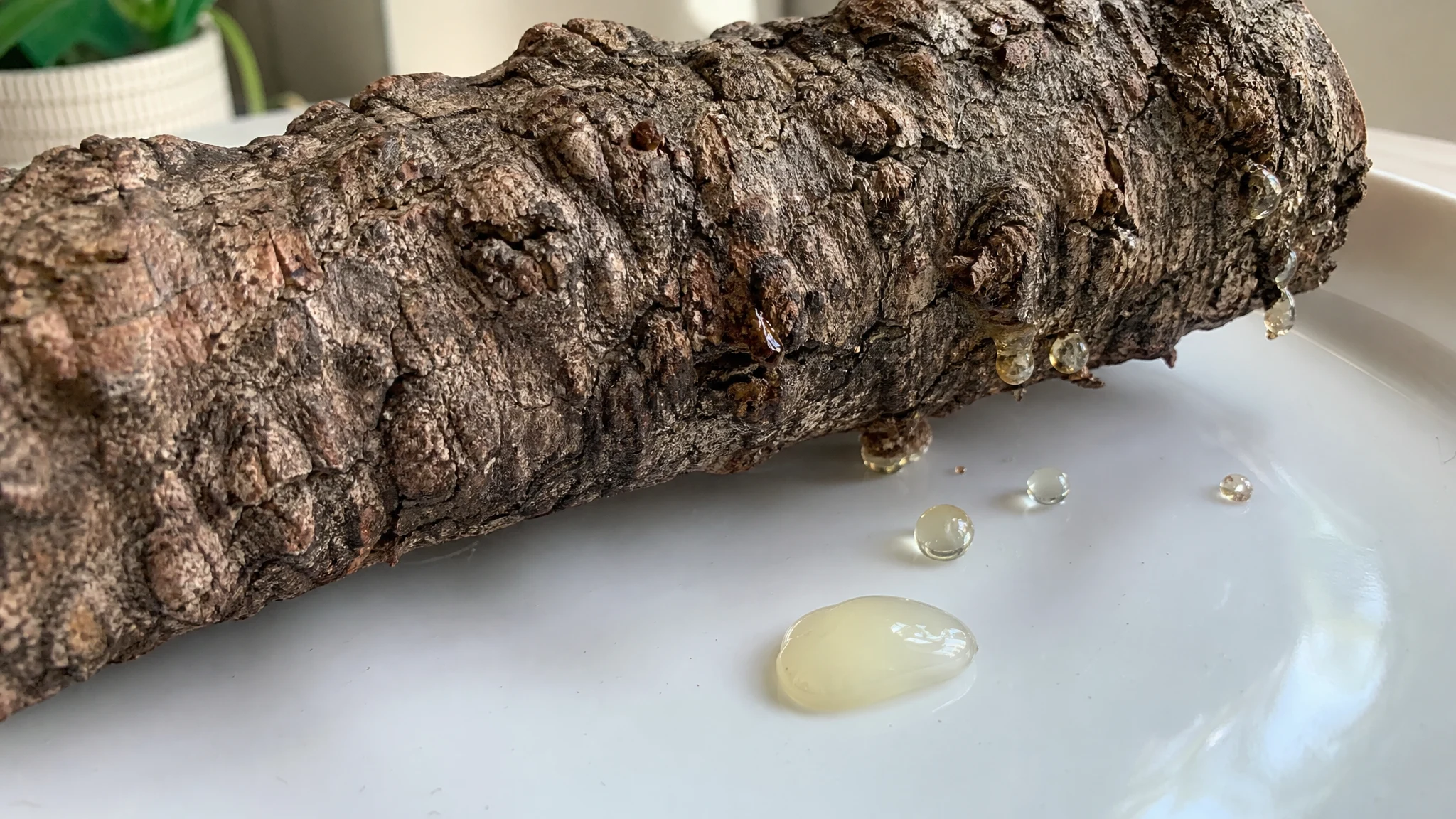
It is a satisfying way to think about a little amber bottle: a tree's slow-weeping resin, and the aromatic essence that steam coaxes out of it.
Frankincense Essential Oil
Serrata, carterii, sacra, frereana, neglecta and rivae: steam-distilled, GC/MS verified, in sizes from 0.5 oz to bulk.
From $12.99 $10.40 with code BLACKFRIDAY
Sources & Further Reading
- Ragab EA et al., 2024. The journey of boswellic acids from synthesis to pharmacological activities. Naunyn Schmiedebergs Arch Pharmacol.
- Di Stefano V et al., 2020. In Vitro Antimicrobial Activity of Frankincense Oils from Boswellia sacra Grown in Different Locations of the Dhofar Region (Oman). Antibiotics.
- Al-Harrasi A, Al-Saidi S, 2008. Phytochemical analysis of the essential oil from botanically certified oleogum resin of Boswellia sacra (Omani Luban). Molecules.
- Moussaieff A et al., 2008. Incensole acetate, an incense component, elicits psychoactivity by activating TRPV3 channels in the brain. FASEB J.
- Woolley CL et al., 2012. Chemical differentiation of Boswellia sacra and Boswellia carterii essential oils by gas chromatography and chiral gas chromatography-mass spectrometry. J Chromatogr A.
- Karlberg AT, Lepoittevin JP, 2021. One hundred years of allergic contact dermatitis due to oxidized terpenes: What we can learn from old research on turpentine allergy. Contact Dermatitis.
- NCCIH. Boswellia: Usefulness and Safety.