Types of Frankincense Oil: Our Six Varieties Compared
Ask ten people what frankincense smells like and you will get ten answers, because "frankincense" is really a family of different trees, from different places, that happen to share a name. We sell six of them as separate single-species oils, and each has its own personality. Here is how we would introduce them if you walked in and asked where to start.

Frankincense Essential Oil
Six single-origin frankincense varieties, steam-distilled and GC/MS verified.
From $12.99 $10.40 with code BLACKFRIDAY
Origins and aromas of six frankincense varieties
These are the aroma descriptions and origins we list for each oil.
- Serrata (Boswellia serrata). We list the origin as Rajasthan, India, and describe it as warm and slightly woody with subtle citrus and pine top notes. It is the one we call our everyday oil.
- Carterii (Boswellia carterii). We list the Cal Madow mountains of Somalia and describe it as warm, woody and slightly citrusy with classic resinous depth. This is the traditional "church frankincense" character.
- Sacra (Boswellia sacra). We list Dhofar, Oman, and describe it as deep, balsamic and honeyed.
- Frereana (Boswellia frereana). We list the Maydi region of northern Somalia and describe it as bright and fresh, with a lemon-pine character.
- Neglecta (Boswellia neglecta). We list the Kenya and Ethiopia drylands and describe it as smoky and slightly fruity, with subtle citrus-pine top notes over a dry resinous base.
- Rivae (Boswellia rivae). We list the Ogaden region of Ethiopia and the Somali borderlands and describe it as fresh, herbaceous and lightly sweet, with green-resinous undertones. Lots are small and can sell out in a harvest season.
Are carterii and sacra really one species?
You will often see carterii and sacra treated as one species. A 2012 study in the Journal of Chromatography A went looking for differences. It compared Somali carterii with Omani and Yemeni sacra and found sacra averaged about 68.2% alpha-pinene against 37.3% for carterii, with carterii carrying more alpha-thujene and myrcene. The optical rotation (how a sample bends polarized light) was positive for sacra and negative for carterii, and the authors concluded the two are distinct species. That is one study's conclusion, and we simply sell the two as separate oils with separate aromas.
Published chemistry across Boswellia species
You do not need the decimals to see the pattern. Alpha-pinene leads in most frankincense oils, but the supporting cast changes the character. A 2014 study of Ethiopian resins found neglecta oil led by alpha-pinene, with terpinen-4-ol and alpha-thujene behind it, and rivae oil led by alpha-pinene with p-cymene and limonene as the next group. Another group analyzed 46 mostly commercial resins and oils from four species and found that their volatile profiles separated cleanly by species, which is a good reminder that the name on the label means something chemically.
Inside one species, the numbers still move. A study that distilled Omani sacra in fractions over six hours found the lighter alpha-pinene fraction fall, from 79.59% in the first two hours to 64.45% in the last stretch for one cultivar, while heavier sesquiterpenes rose. So a bottle's scent depends on the resin, the place and how the distillation was run. These are results for the samples in those studies, and they do not describe our bottles.
Which frankincense oils come with a lab report?
The one Certificate of Analysis we publish is for a serrata batch. It gives relative density, refractive index and optical rotation, and no compound data. For a report on another variety or lot, ask us in writing through our contact page and get it in writing before relying on it. Our GC/MS guide shows what to look for.
Blotter strips for comparing six bottles
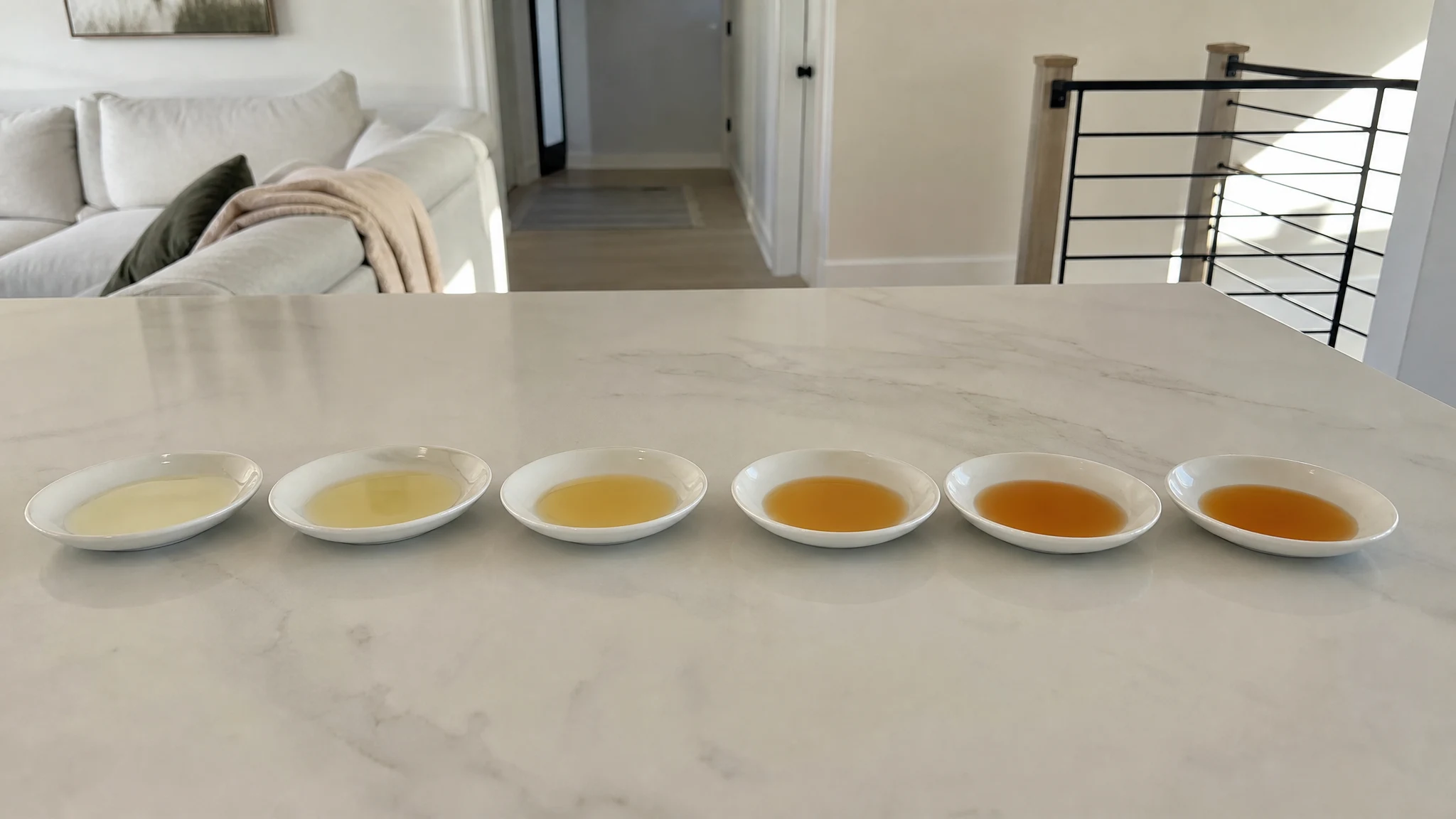
If you have more than one bottle, a little method makes the comparison fun instead of confusing. Put a drop of each oil on its own strip of plain paper, label the strips, and hold them about a hand's width from your nose rather than right under it. Come back after a few minutes, because the first impression and the settled one are often different.
Do not try all six in a row. Two or three is plenty before your nose gets tired, and a breath of plain air, or the crook of your own elbow, helps reset it. Then write down a word or two for each, because the notes you jot down will say more than your memory will tomorrow.
Choosing among six frankincense oils by smell
Start with the smell you want, since that is the one thing the six truly differ on. Sacra if you want a rounder, balsamic note; frereana for brightness; serrata or carterii for a classic warm, woody frankincense; neglecta for smoke; rivae for something green. Buy the smallest size of one, and see how it sits beside the scents you already love. If you plan to formulate with it, our wholesale page explains sample bottles. Our serrata, carterii and sacra comparison goes deeper on three of them, and our blending guide shows how each behaves with other oils.
Choose by aroma rather than for a health reason. The National Center for Complementary and Integrative Health says there is not enough high-quality evidence to determine whether boswellia is useful for any health condition, and the studies it describes mostly involve oral resin extracts, not distilled oils. We sell cosmetic aroma oils only. Boswellia papyrifera, which people ask about, is not among them.
As people who love these oils, we would rather you end up with the one you reach for than the one with the grandest name or the rarest label.
Six trees, six moods. The fun is in smelling the difference.
Frankincense Essential Oil
Serrata, carterii, sacra, frereana, neglecta and rivae: steam-distilled, GC/MS verified, in sizes from 0.5 oz to bulk.
From $12.99 $10.40 with code BLACKFRIDAY
Sources & Further Reading
- Woolley CL et al., 2012. Chemical differentiation of Boswellia sacra and Boswellia carterii essential oils by gas chromatography and chiral gas chromatography-mass spectrometry. J Chromatogr A.
- Bekana D et al., 2014. Comparative Phytochemical Analyses of Resins of Boswellia Species (B. papyrifera (Del.) Hochst., B. neglecta S. Moore, and B. rivae Engl.) from Northwestern, Southern, and Southeastern Ethiopia. ISRN Analytical Chemistry.
- Niebler J, Buettner A, 2016. Frankincense Revisited, Part I: Comparative Analysis of Volatiles in Commercially Relevant Boswellia Species. Chem Biodivers.
- Di Stefano V et al., 2020. In Vitro Antimicrobial Activity of Frankincense Oils from Boswellia sacra Grown in Different Locations of the Dhofar Region (Oman). Antibiotics.
- NCCIH. Boswellia: Usefulness and Safety.