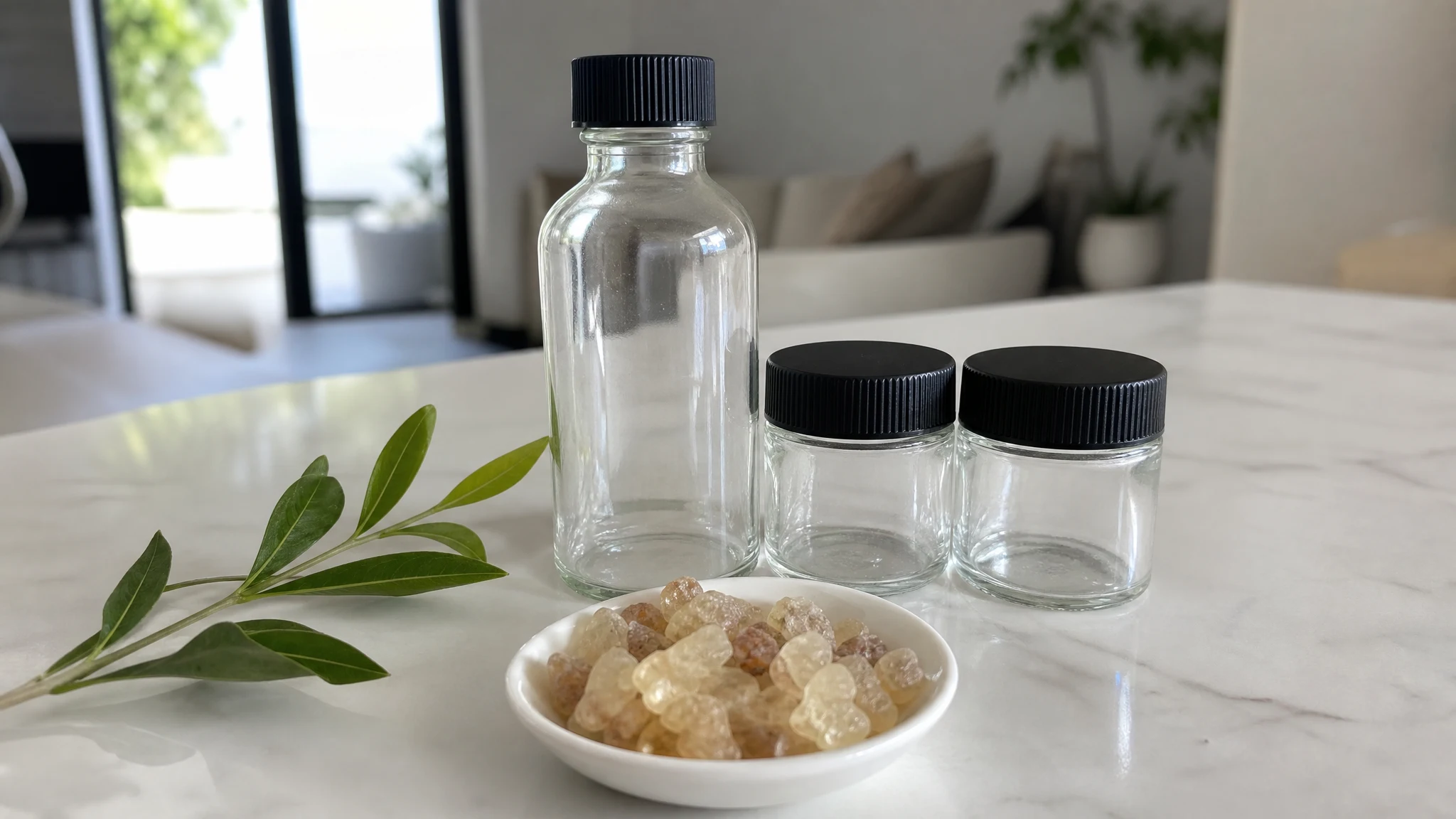
How to Blend Frankincense Oil Without Burying It
Frankincense is one of the easiest oils to blend and one of the easiest to bury. Its resinous, faintly citrus-and-pine character sits comfortably under almost anything, and it can quietly hold a blend together, but a heavy hand turns every blend into the same smoky haze. A few decisions made before you reach for the bottle do most of the work.

Frankincense Essential Oil
Six single-origin frankincense varieties, steam-distilled and GC/MS verified.
From $12.99 $10.40 with code BLACKFRIDAY
Air, fabric or skin: picking the blend's job
Air, fabric and skin are three different jobs with three different rulebooks. A diffuser blend only needs to smell good at a distance. A fabric mist needs a water-friendly formula and a hidden-corner test. A skin blend has to be diluted into a carrier, and the percentage belongs to the whole blend, not to each oil. If your blend is 1% total and you use three oils, all three together make up that 1%. Because we sell our frankincense neat and publish no dilution rate of our own, check the current IFRA standards for your finished product, and see our dilution and safety guide before you work out a skin formula.
The arithmetic is simple and worth doing on paper first. One percent of 100 ml is 1 ml of oil. Droppers vary, but a rough convention is about 20 drops to the milliliter, so that is around 20 drops for the whole blend across every oil in it.
Which frankincense oil suits which blend partner?
We sell six single-species frankincense oils, and they do not all play the same role. These are our own aroma descriptions, and the pairings that follow are suggestions based on them:
- Serrata, warm and slightly woody with citrus and pine top notes, is the easygoing everyday base.
- Carterii, warm, woody and slightly citrusy with classic resinous depth, is the familiar church-incense note.
- Sacra, deep, balsamic and honeyed, wants warm woods and spices alongside it.
- Frereana, bright and fresh with a lemon-pine lift, is the one to reach for when you want a blend to feel airy.
- Neglecta, smoky and slightly fruity over a dry resinous base, adds an outdoor-fire edge.
- Rivae, fresh, herbaceous and lightly sweet, brings a green note.
Our guide to the six species sets these side by side with the published chemistry.
Frankincense oil as a third of the drops
A good starting suggestion, not a rule: in your first trial, give frankincense about a third of the drops and let one or two partners take the rest. You can always add more. Taking some out is much harder. Use a paper blotter strip, wave it a few seconds, and smell it again after a minute, because resins and citrus fade at different speeds and the blend you smell first is not the blend you will live with.
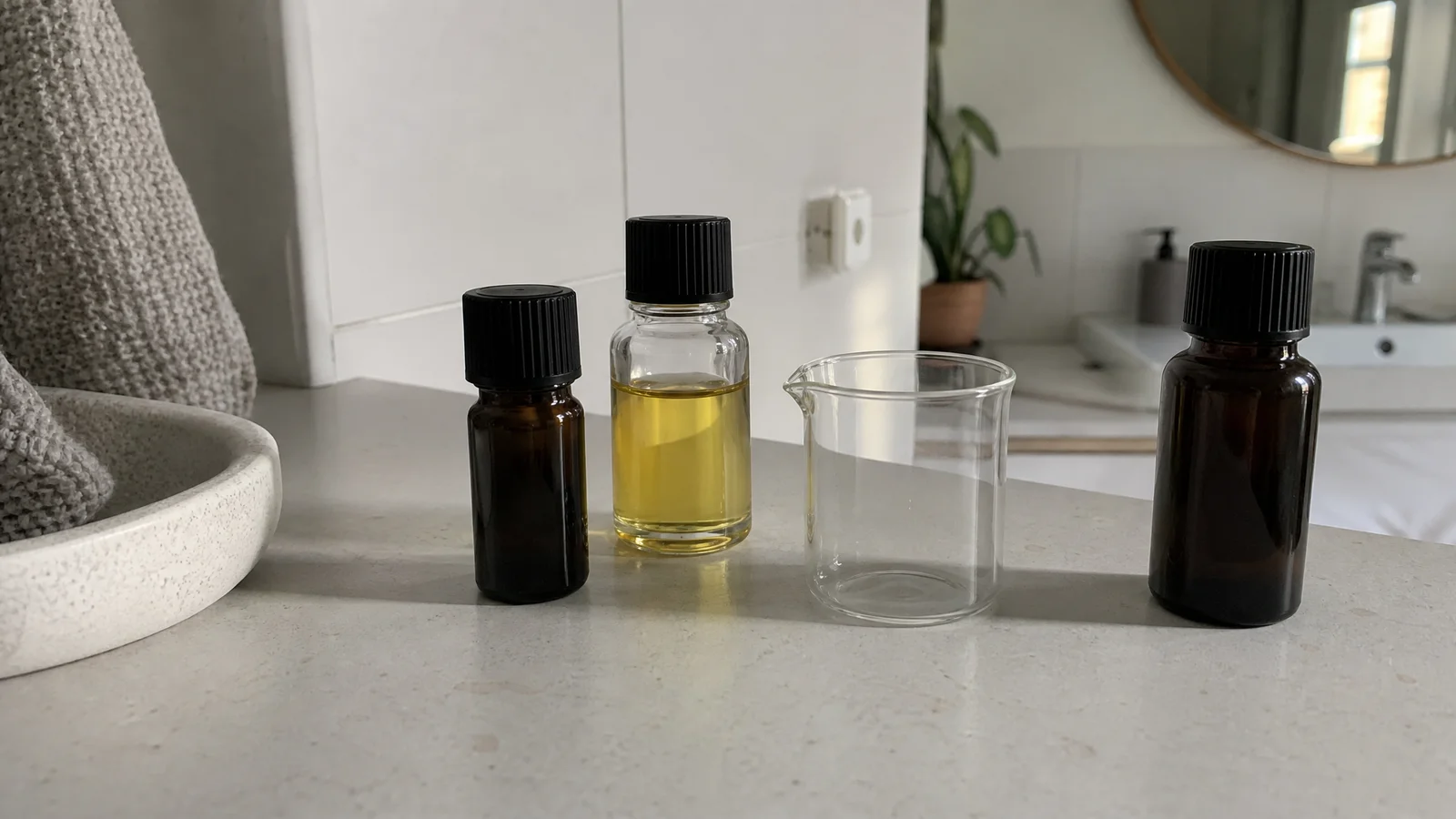
We do not sell the partner oils, carriers or containers, so those come from a craft supplier, pharmacy or grocery. Remember that each partner oil has its own safety profile. Frankincense's limits do not cover your lavender or your orange, so look each one up before you blend.
Smelling two bottles before you combine them
The most enjoyable part of blending is the quiet minute before you start. Open two bottles, hold one in each hand, and ask what each would add to the other: a bright lemon-pine lift, a honeyed depth, a smoky edge. Then waft a blotter strip past each bottle in turn and smell them together. If you find yourself smiling at the combination, you are on the right track. If one note fights the other, change the partner, not the whole idea.
Write down what you liked even if the blend is only half right. A scribbled line such as "more frereana, less orange" is worth more next month than a perfect memory is today.
Oxidized terpenes in aging essential oil bottles
Terpenes react with air. A 2005 patch-test study of 1,511 dermatitis patients in six European centers found that limonene, linalool and caryophyllene are not allergenic in themselves but readily form allergenic products after air exposure, and that about 1.3% of patients reacted to oxidized linalool. Those are common components of many popular partner oils. In practice, a bottle that has sat half-empty for years and smells flat or sharp is a bottle to retire, whatever it is called. Our storage guide covers what helps.
Does a frankincense diffuser blend need many oils?
Every oil you add puts more different compounds into the room, so more variety is not automatically better. A chamber study of ultrasonic diffusers found that they release both volatile compounds and fine particles, and that the type of water made a difference: with eucalyptus oil, tap water produced about five times the fine-particle emission of deionized water. Keep sessions modest and the room ventilated. Our diffuser guide covers timing, and the American Academy of Allergy, Asthma and Immunology advises that anyone with asthma use diffusers with caution and ask their physician first.
Repeatable frankincense blend steps from blotter to batch
- Name the job: air, fabric or skin.
- Pick one frankincense by its aroma, and one or two partners you know well.
- Test on a blotter strip, then make a small batch.
- Write down the drop counts so you can repeat or adjust.
- Patch test anything for skin, as our disclaimer asks, and keep it away from eyes and out of children's reach. If you are pregnant, nursing or on medication, ask your provider first.
The best blends we can imagine are the ones you can write on a card in four lines and repeat next month. Start small, change one thing at a time, and let the frankincense do what it does best: tie the other notes together.
Frankincense Essential Oil
Serrata, carterii, sacra, frereana, neglecta and rivae: steam-distilled, GC/MS verified, in sizes from 0.5 oz to bulk.
From $12.99 $10.40 with code BLACKFRIDAY
Sources & Further Reading
- Matura M et al., 2005. Selected oxidized fragrance terpenes are common contact allergens. Contact Dermatitis.
- Schwartz-Narbonne H, Du B, Siegel JA, 2021. Volatile organic compound and particulate matter emissions from an ultrasonic essential oil diffuser. Indoor Air.
- AAAAI. Essential oil diffusers and asthma (reviewed October 2026).