How to Diffuse Frankincense Oil: Drops and Timing
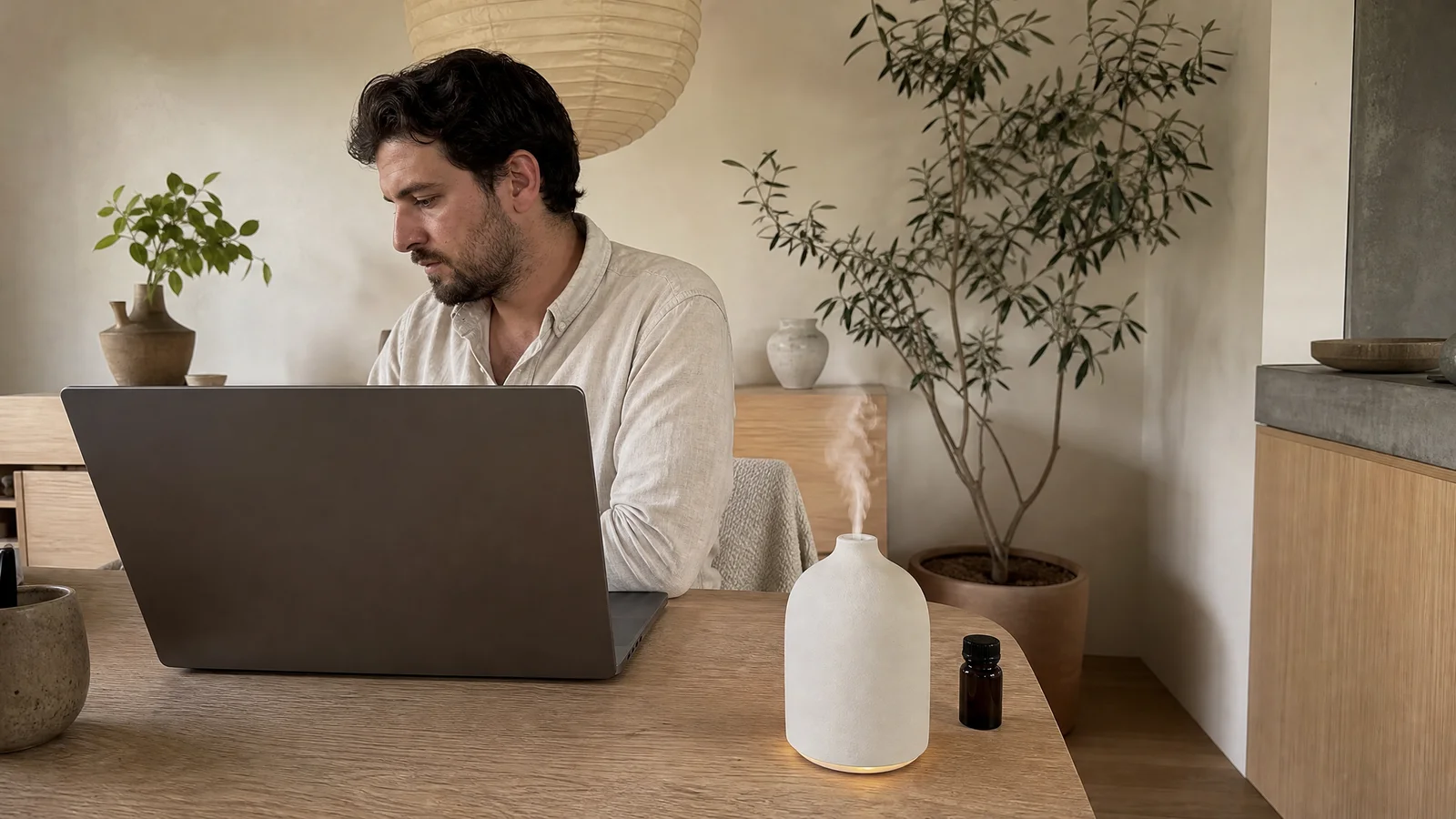
Frankincense is one of those scents that does not need much help. A few drops in a diffuser fill a room with something warm, woody and resinous, and more drops rarely make it better, only louder. So the question to ask is less "how much can I add?" and more "what is the faintest amount I still enjoy?" Here is how we would set up a diffuser, drop by drop and hour by hour.

Frankincense Essential Oil
Six single-origin frankincense varieties, steam-distilled and GC/MS verified.
From $12.99 $10.40 with code BLACKFRIDAY
Which diffuser types suit frankincense oil?
Machines differ in what they put into the air. Ultrasonic diffusers, which the Tisserand Institute describes as adding drops of oil to a reservoir of water that the unit agitates with ultrasonic sound waves, are the most common. The Merck Veterinary Manual notes that active diffusers, both nebulizing and ultrasonic, release oil microdroplets that can settle on surfaces and fur, while passive ones such as reed diffusers do not. Reasoning from that, a nebulizer, which uses oil without water, puts the most oil into the room per minute, so short sessions and a light hand matter most there. Our diffuser comparison goes through the machine types.
Drop counts for a small diffuser reservoir
Your diffuser's manual is the authority on how much oil its reservoir takes, and we would start at its lowest suggestion. The arithmetic below is only to give you a sense of scale. With about 20 drops per ml as a rough convention and the 0.838 relative density on the Certificate of Analysis we publish for one serrata batch, three drops come to about 0.15 ml, or roughly 0.13 g. Spread through a 100 ml reservoir, that is a very small proportion. Other varieties have no published density, and droppers vary, so treat the figures as approximate.
Here is a trick we like: start the diffuser, wait ten minutes, step out of the room and come back in. The scent you meet at the door is close to what a visitor will notice. If it is strong, you used too much.
Diffuser timing with 30-minute on and off cycles
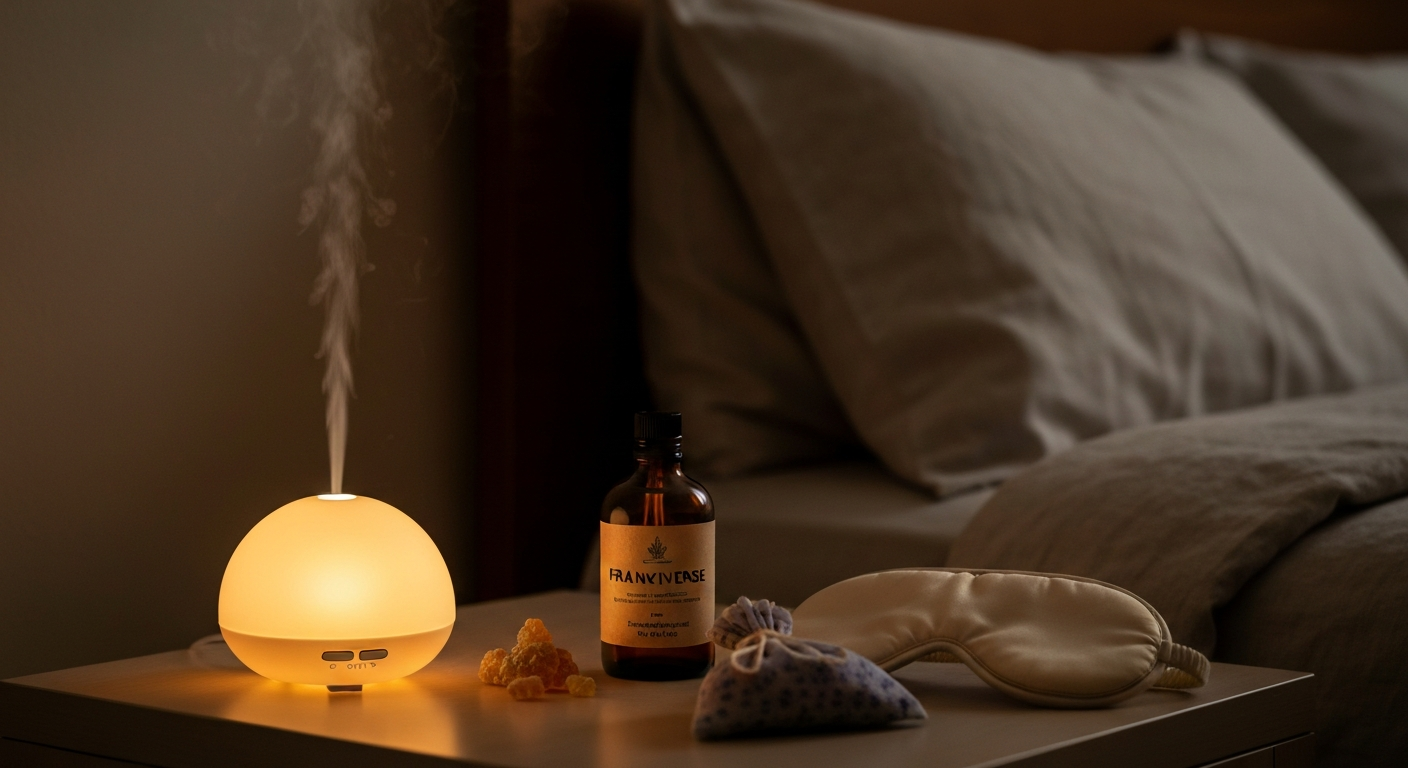
The Tisserand Institute's guidance is to diffuse for 30 to 60 minutes on, then 30 to 60 minutes off, and not to directly and intensively inhale essential oils for longer than 15 to 20 minutes. It also says some fresh air is advisable whenever you diffuse. A timer makes this easy. If you would like more scent, repeat the cycle rather than stretching one session. We would also skip running a diffuser all night in a closed bedroom: no study we know of has examined it, and a long continuous session in a small space is simply more than the guidance describes.
What does a diffuser actually put in the air?
A chamber study in Indoor Air ran an ultrasonic diffuser for 15 minutes with lemon, lavender, eucalyptus and grapeseed oils. Each oil gave off its own volatile compounds and its own particle profile, and the modelling suggested that ordinary use can add substantially to fine particles indoors. One practical finding stood out: using tap water rather than deionised water raised particle emissions about fivefold with eucalyptus oil. Frankincense was not tested, so we cannot give numbers for it, but the lesson carries over in a modest way: use the water your manual specifies, and keep the room ventilated.
For people with asthma, the American Academy of Allergy, Asthma and Immunology says no published studies have specifically examined diffused essential oils and asthma, that diffusing lavender, eucalyptus and tea tree oils released terpenes, toluene and benzene among other compounds, and that patients with asthma should use diffusers with caution. Check with the physician who manages asthma before diffusing anything, and see our respiratory health article for what research on frankincense covers.
Are cats and birds safe around a diffuser?
- Cats, dogs and birds. The Merck Veterinary Manual says cats are more sensitive than dogs because they lack the enzyme glucuronyl transferase, that birds have a particularly sensitive respiratory tract, and that pets should be kept out of the room while a diffuser runs, which should be for under 30 minutes, followed by ventilation. Our pets article has more.
- Babies and young children. We do not advise on diffusing around infants, so please ask your pediatrician. Keep bottles out of children's reach, as the Tisserand Institute advises.
- Pregnancy. Our pregnancy and breastfeeding article gathers what the guidance says, and the decision belongs with your OB/GYN or midwife.
- Housemates and colleagues. Preferences differ a great deal. Ask before you scent shared spaces.
Best moments to start a frankincense diffuser
A diffuser is nicest when the room is ready for it. Start it while you are tidying up, cooking or settling in with a book, and let the scent build while you are busy with something else. Your nose adapts quickly, so a scent you stopped noticing after twenty minutes is not necessarily gone. Stepping out of the room and back in is the best way to check, and it keeps you from adding more oil than you need.
Short frankincense diffuser session with a cracked window
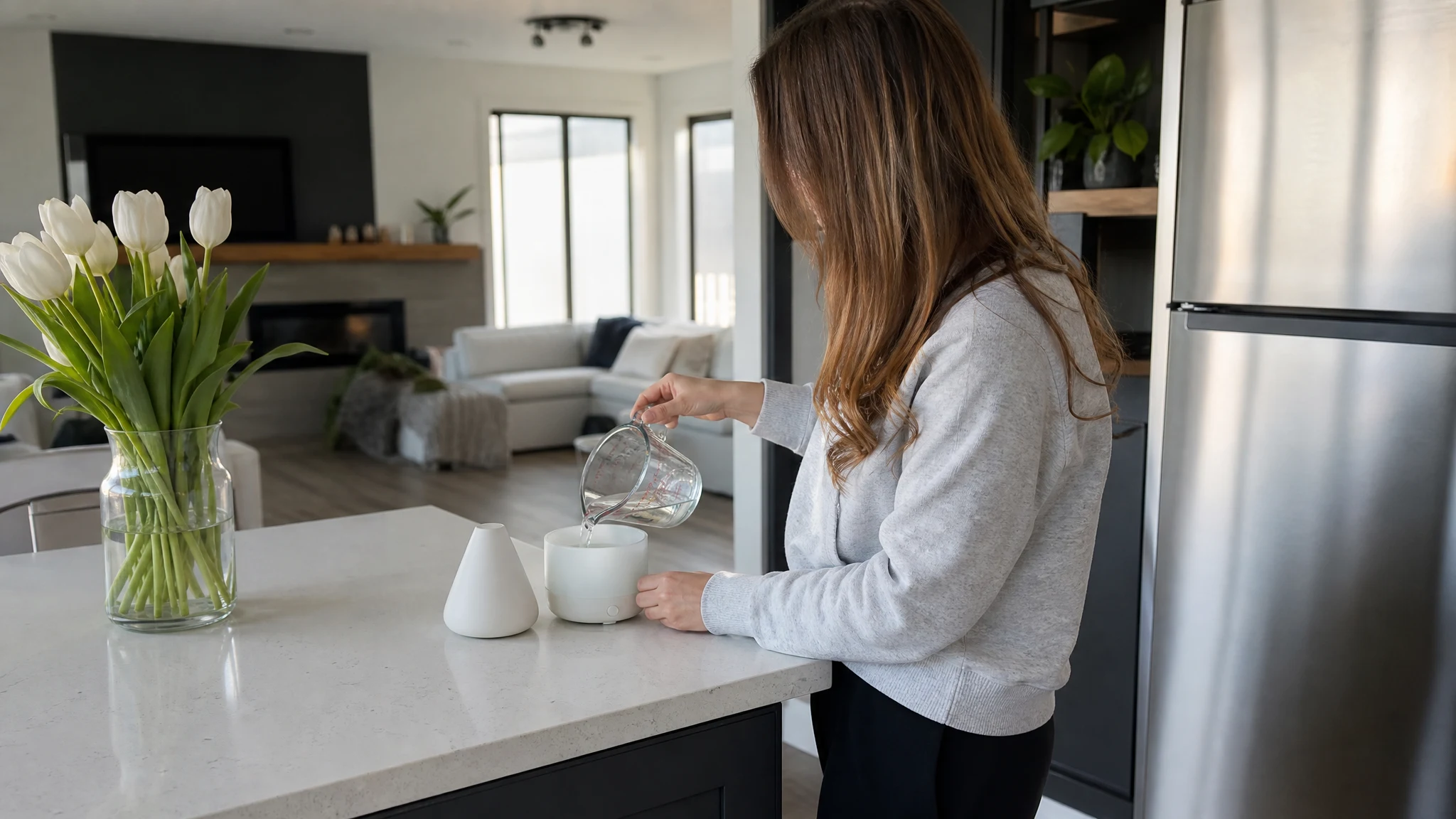
Fill the reservoir with the water your manual specifies, add the smallest suggested number of drops, run it for 30 minutes with a window cracked, then switch it off for at least as long. Rinse and wipe the unit when you are done so it does not sit with residue, which is common-sense upkeep rather than a sourced rule. Cap the bottle and keep it cool and dark; our storage post explains why.
Our serrata is warm and slightly woody with subtle citrus and pine top notes, and our frereana is bright, fresh and lemon-pine, so a diffuser is a good place to hear the difference between them. Our species overview lines up all six.
Lean light, take breaks and let the room breathe, and a few drops will do everything a diffuser can.
Frankincense Essential Oil
Serrata, carterii, sacra, frereana, neglecta and rivae: steam-distilled, GC/MS verified, in sizes from 0.5 oz to bulk.
From $12.99 $10.40 with code BLACKFRIDAY
Sources & Further Reading
- Tisserand Institute. How to Use Essential Oils Safely.
- Tisserand Institute. A Beginner's Guide to Essential Oils Part 2: How to Use Essential Oils.
- Schwartz-Narbonne H, Du B, Siegel JA, 2021. Volatile organic compound and particulate matter emissions from an ultrasonic essential oil diffuser. Indoor Air.
- AAAAI. Essential oil diffusers and asthma.
- Merck Veterinary Manual. Toxicoses From Essential Oils in Animals.