Frankincense Infused Oil vs Essential Oil in a Carrier
If you want frankincense character in a carrier oil, there are two quite different routes, and it helps to know which you are on. One is to steep resin in oil. The other is to stir a few drops of frankincense essential oil into a carrier. They give you different things, and only one of them lets you know your percentage.

Frankincense Essential Oil
Six single-origin frankincense varieties, steam-distilled and GC/MS verified.
From $12.99 $10.40 with code BLACKFRIDAY
Infused oil, essential oil and resin: three products
Frankincense essential oil is the volatile fraction of the resin, captured by steam distillation, and it is what we sell in our shop. An infused oil is a fatty carrier that has sat with resin. A resin extract is something else again. The Tisserand Institute explains that boswellic acids, the compounds behind most of the supplement research, are heavy triterpenes that boil at roughly 500 to 600 degrees C, so they do not travel into oil made by normal distillation. They are found in the resin and in extracts. So an infused oil sits closer to the resin end of the spectrum, and an essential oil in a carrier sits at the aroma end. We do not sell resin or carrier oils, so for the infusion you will buy both elsewhere.
Javed 2026 study on infusing frankincense resin
We found one paper that describes infusing frankincense resin in a carrier and examining the result. Javed and colleagues, in 2026, ground resin and macerated it in sweet almond oil, with a second batch in rosewater, and ran qualitative tests. They described the oil infusion as showing triterpenoid and boswellic-type features, and in a test-tube antioxidant assay one sample scored 71% inhibition at the concentration tested. The authors call it preliminary and say future work should include quantitative analysis, skin permeation studies and formal safety testing. So the fair reading is simple. Some resin-derived material ends up in the oil, and nobody has yet measured how much, or what it does on skin.
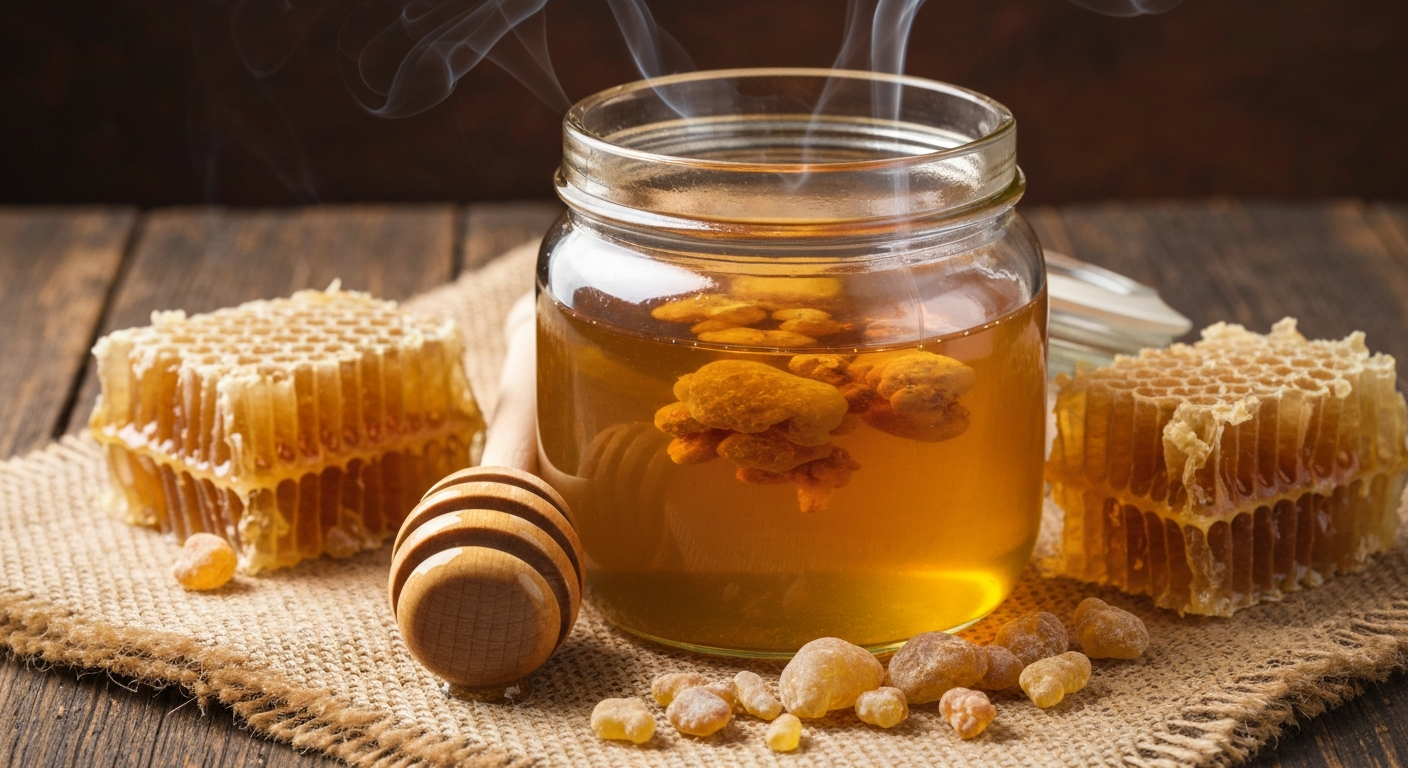
Warm infusion of frankincense resin in carrier oil
This is a formulation built from the study's approach and our own arithmetic, not a tested protocol. For about 100 g of finished oil:
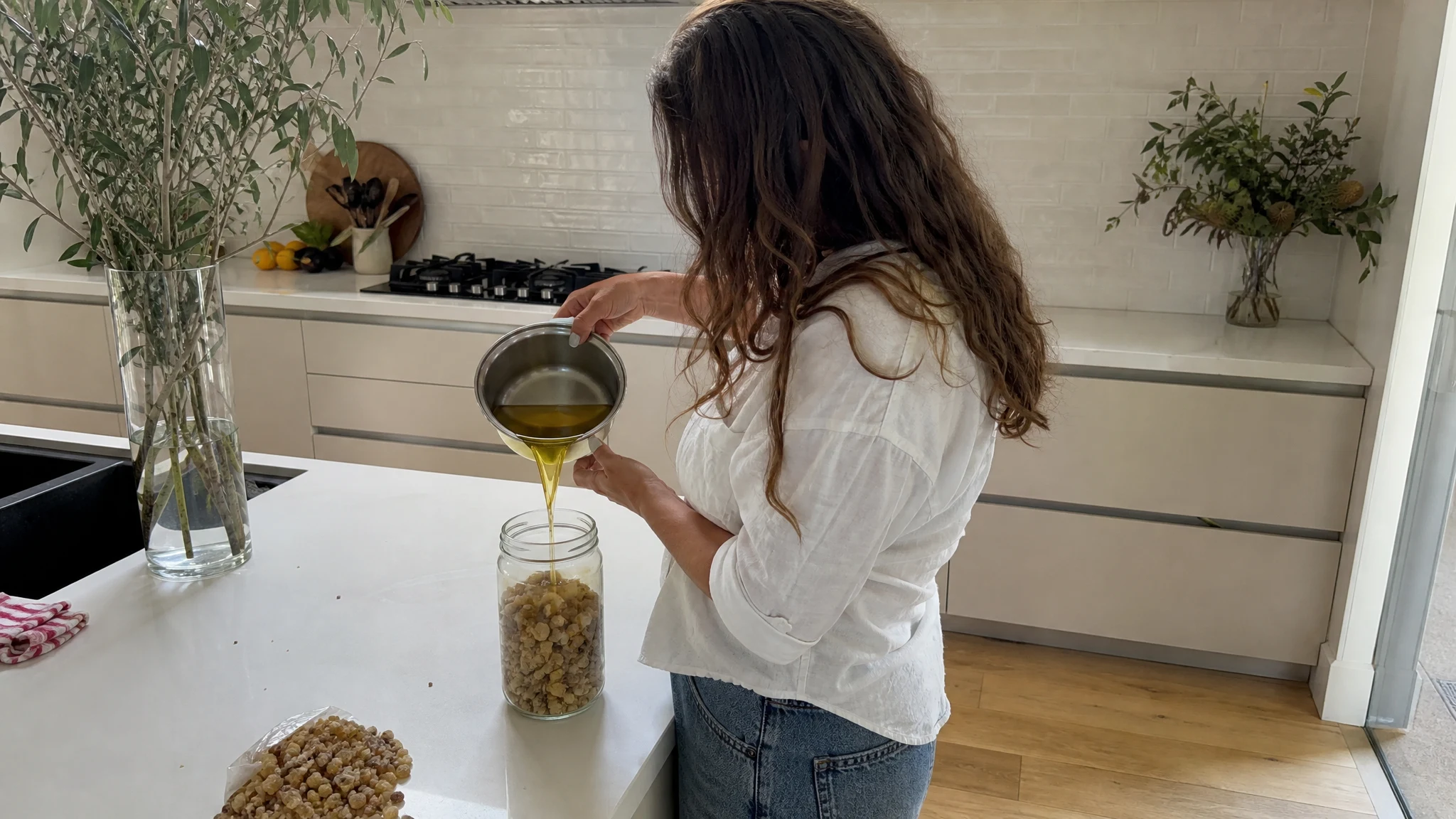
- Weigh 20 g of clean, completely dry resin tears and 80 g of carrier oil, a 1 to 4 ratio by weight. That ratio is our suggested starting point.
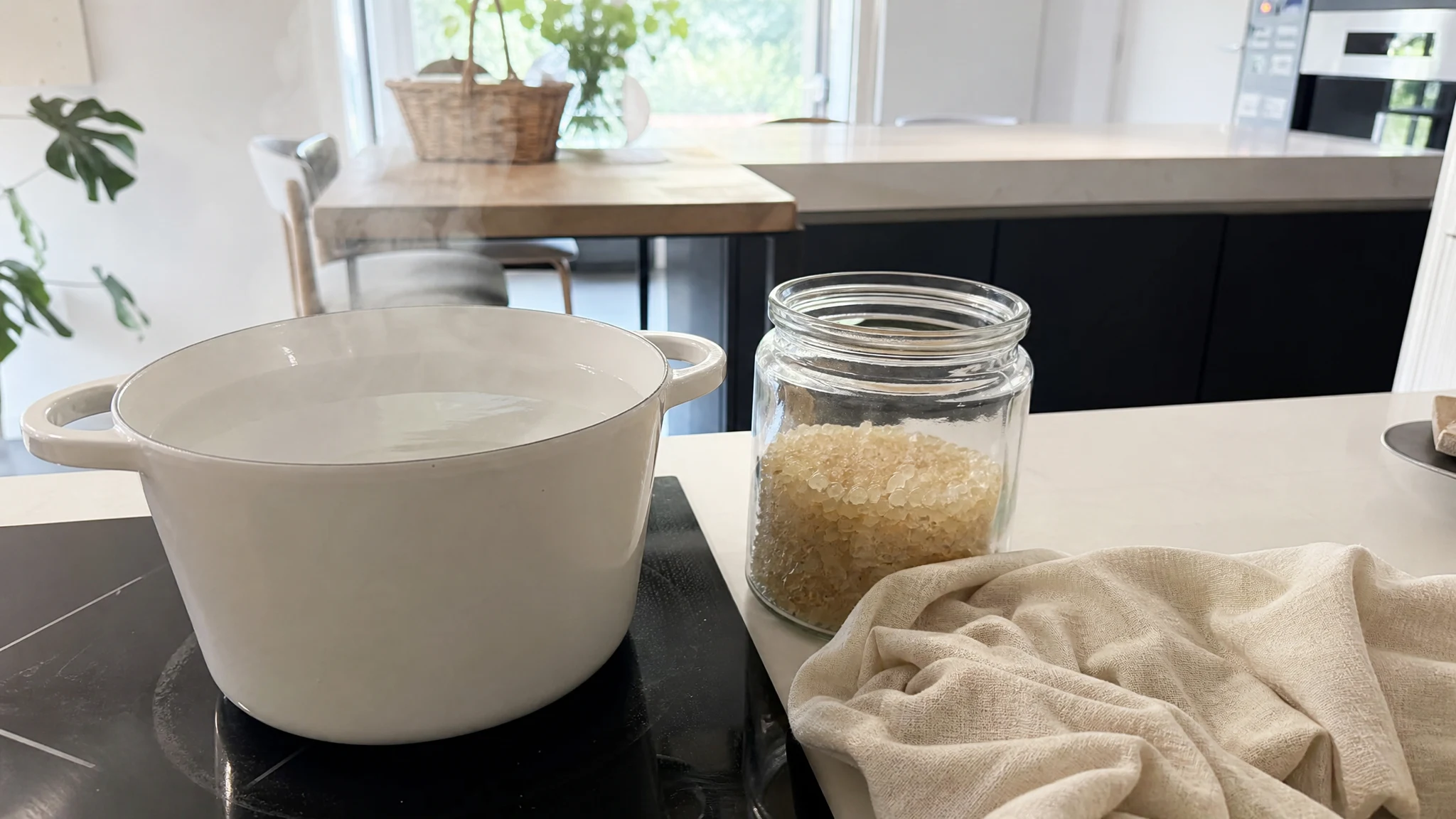
- Crush the resin coarsely, put both in a clean, dry heatproof jar and stand it in a pot of hot water, never directly on the heat. Keep every drop of water out of the jar.
- Warm it gently for an hour or so, stirring now and then. Hotter is not better: the Tisserand Institute lists heat as one of the three causes of oxidation, along with oxygen and light.
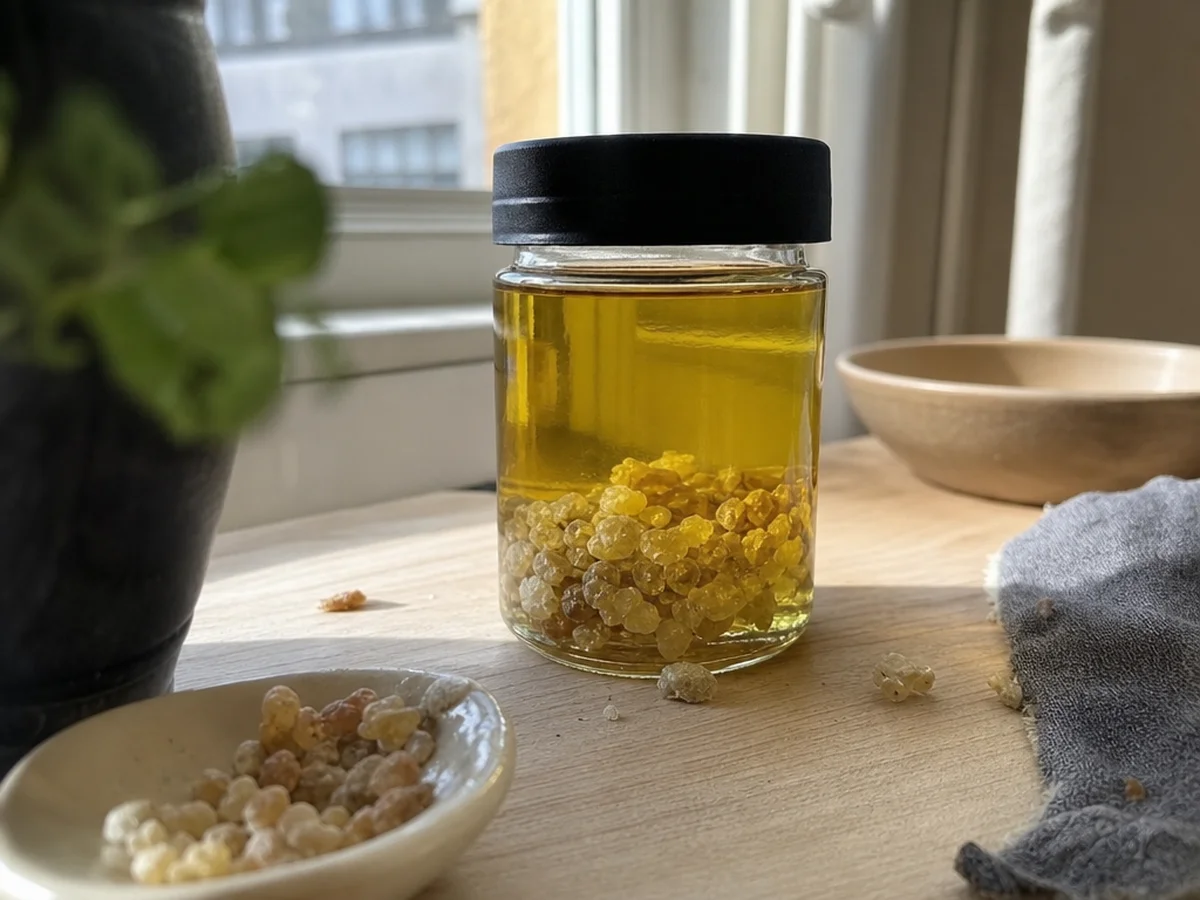
- Let it rest for a few days at room temperature, then strain through muslin or a fine coffee filter. Resin is sticky, so expect some oil to stay behind.
- Pour into dark glass, label with the date and keep it somewhere cool and dark.
Cold infusion in a daily-shaken jar
Use the same ratio and the same dry-equipment rule, but skip the heat. Seal resin and oil in a clean jar, give it a shake each day, and strain when the oil smells of resin. We have no source that gives a time, so go by smell and clarity. A cold infusion avoids heat, and a cupboard avoids light. Expect a fainter result than the warm method.
Weighing essential oil into a carrier instead
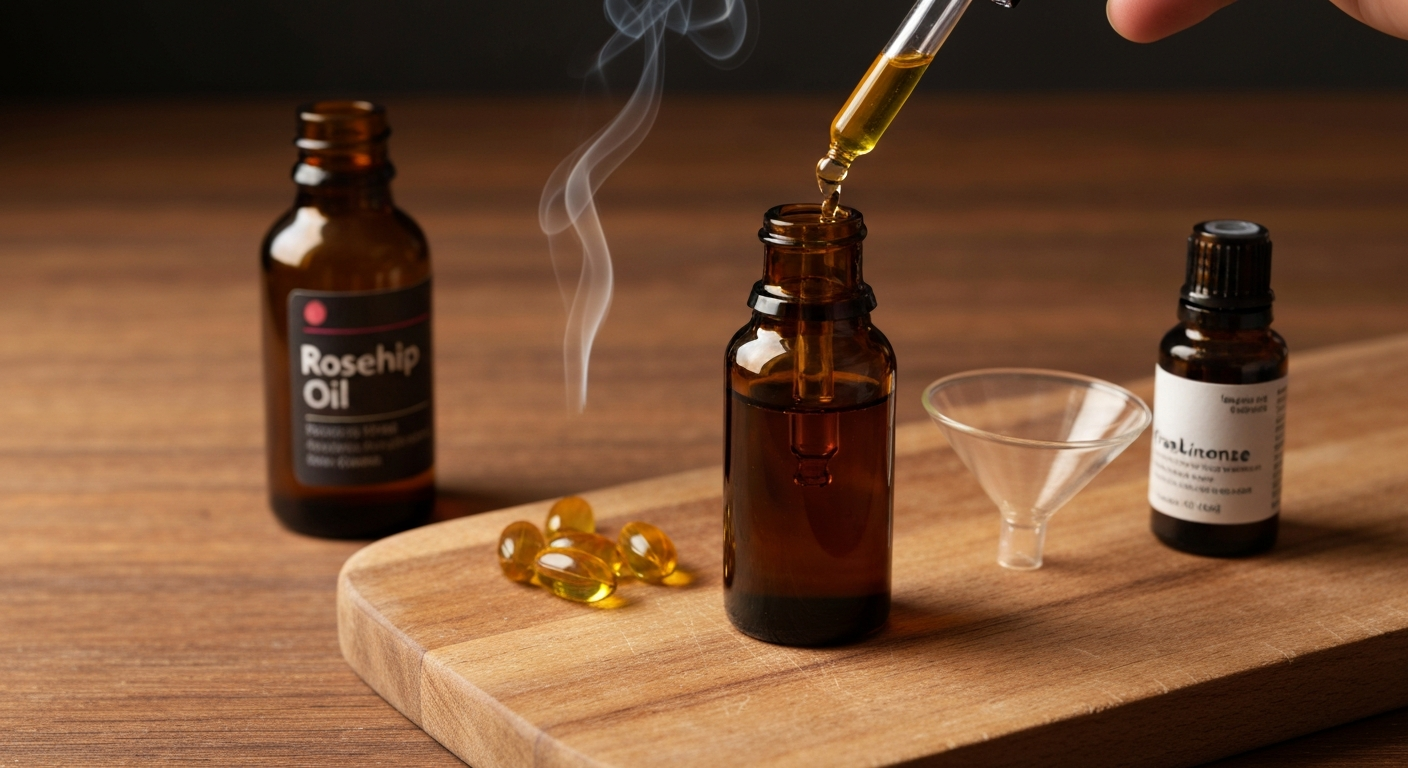
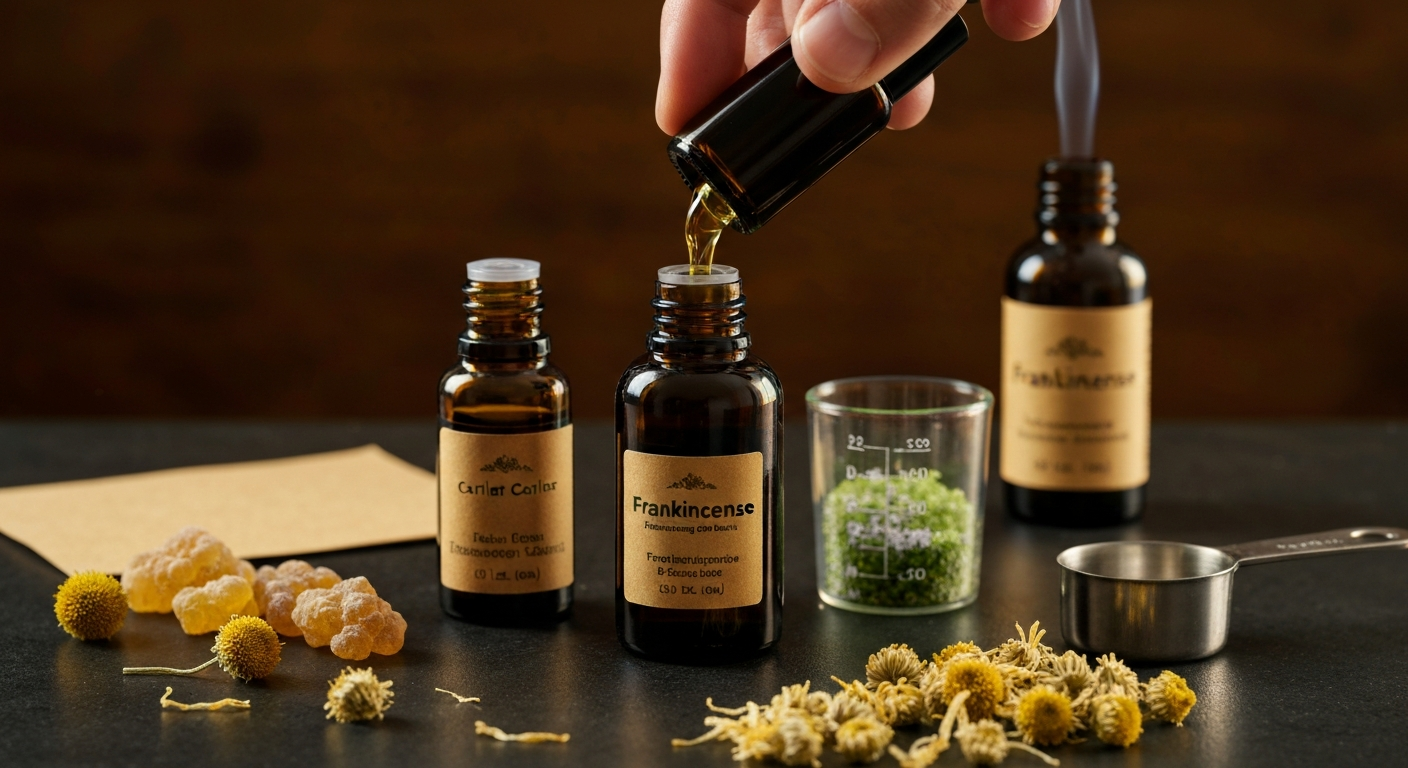
If scent is the goal, weigh the essential oil into a carrier. This is the only route where you know the percentage, and it takes two minutes. The Tisserand dilution guide gives 0.2 to 1% for sensitive skin, 0.5 to 1.2% for facial cosmetics and 1 to 3% for body oils. By weight, 1 g of essential oil in 100 g of carrier is 1%. For the serrata batch on our Certificate of Analysis, relative density is 0.838, so 1 g is about 1.19 ml, roughly 24 drops at the rule-of-thumb 20 drops per ml. We have no density published for the other varieties, so weigh those. Our carrier oil guide compares bases.
Why label date, ratio and carrier?
Whichever route you take, write the date, the ratio and the carrier on the bottle before you put it away. Six weeks from now you will not remember which jar was which, and a clear label also tells you when to use it up.
How do you keep infused oil microbe-free?
- No water. The FDA notes that water can introduce microorganisms, that warm or damp conditions help some of them grow faster, and that dipping fingers into a product lets contamination in. A pump or dropper bottle is better than an open jar.
- No fresh ingredients. The University of Maine Cooperative Extension's bulletin on homemade infused oils calls dried ingredients the safest, because fresh produce can carry Clostridium botulinum spores that thrive in oil. That is food guidance and resin is not a herb, but it is the closest published warning, so we keep resin dry and skip fresh additions entirely.
- Use it up. The same bulletin says not to store homemade infused oils for more than three months. It is written for food, but we would borrow three months as a ceiling for a cosmetic oil and discard sooner if it smells off.
- Patch test. Our disclaimer asks for one before topical use, and the Tisserand Institute notes that anyone can be allergic to any essential oil.
Our infused oil is not a food and nothing here is a health claim. For a worked use of the finished oil, our salve article shows how wax and oil ratios fit together, and the boswellic acids article goes deeper on the extract side.
If you already have the oil and a carrier, route three is quicker and more precise. Infusion earns its place when you love resin character and are happy with a result nobody can put a number on. If you need more oil for route three, our guide to buying frankincense essential oil in bulk explains how larger orders work.
Frankincense Essential Oil
Serrata, carterii, sacra, frereana, neglecta and rivae: steam-distilled, GC/MS verified, in sizes from 0.5 oz to bulk.
From $12.99 $10.40 with code BLACKFRIDAY
Sources & Further Reading
- Javed S et al., 2026: Qualitative phytochemical profiling, antioxidant activity, and development of a water-in-oil cream containing combined oil and water infusions of frankincense resin (Boswellia spp.): a preliminary in vitro study.
- Tisserand Institute: Does Frankincense oil contain boswellic acid?
- Tisserand Institute: Oxidation and the Shelf Life of Essential Oils
- Tisserand Institute: Dilution for essential oils
- US Food and Drug Administration: Microbiological Safety and Cosmetics
- University of Maine Cooperative Extension: Bulletin #4385, Safe Homemade Flavored and Infused Oils