Distilling Frankincense at Home: What to Expect
Frankincense oil has a way of changing character while you watch it come over. The first oil to drip into a collection vessel smells different from what arrives hours later, and that small fact is the most interesting thing about distilling resin at home. If you are curious enough to try it, here is what a published small-scale run looked like, what the hours do to the oil, and how to keep a long afternoon at the stove uneventful.

Frankincense Essential Oil
Six single-origin frankincense varieties, steam-distilled and GC/MS verified.
From $12.99 $10.40 with code BLACKFRIDAY
Omani Boswellia sacra small-run distillation, step by step
The best template we have found is a laboratory study of Omani Boswellia sacra resin from three Dhofar cultivars called Najdi, Sahli and Houjri. The researchers ground 250 g of resin, added it to 2,500 mL of distilled water in a 5,000 mL flask, and heated it in a mantle at atmospheric pressure with a Clevenger-type apparatus. They collected oil after 2 hours, then again from the same resin at 4 and 6 hours.
It is hydrodistillation, with the resin sitting in boiling water, rather than the steam-through-a-basket arrangement of a commercial still, and it is lab glassware rather than a kitchen project. Still, it gives us something concrete to picture.
Frankincense resin gives up most oil early
The yields were large for an aromatic plant material. Sahli resin gave 14.48% of its weight as oil in total, Najdi 12.20% and Houjri 11.12%, and the first two hours delivered the bulk of it (12.0% of the 14.48% for Sahli). Scaled down by simple arithmetic, a 100 g charge would give very roughly 11 to 14 g of oil if it behaved like those samples. That is a projection from one study on ground market resin, not a promise for a pot still, coarser tears or older resin.
Commercial runs are longer. The Tisserand Institute notes that most commercial distillation of frankincense runs for 6 to 7 hours, so an honest plan for an evening is a full afternoon of attention, not a quick two-hour job.
Does distillation time change frankincense oil aroma?
This is the part we find most fun. As the study moved from hour two to hour six, the lighter monoterpenes (alpha-pinene, camphene, beta-pinene, delta-3-carene) fell and heavier sesquiterpenes such as beta-elemene and gamma-cadinene rose in all three cultivars. Alpha-pinene led every sample, from 71.09% to 79.59% of the first-stage oils, and it declined in the later fractions.
In plain terms, early oil is bright and piney and late oil is heavier and rounder. Pour all the fractions into one bottle and you have a blend decided by your stopwatch. Keep them in separate bottles and you can smell the whole curve, which is a nicer way to learn what resin does than any chart. Those percentages describe the lab oils, not any oil we sell.
Why boswellic acids stay in the still
Many people hope to capture boswellic acids, the compounds behind most of the resin-extract research. They are heavy, non-volatile molecules. The Tisserand Institute reports that they "do not show up in GC-MS analysis of Frankincense oils, but may be present in trace amounts that will show up with HPLC analysis," and that traces were found in an oil distilled for 56 hours, a length that is not commercial practice. A home still makes a fragrant volatile oil, and the supplement literature on resin extracts does not describe it. Our posts on boswellic acids and resin chemistry go through the difference.
Safety points for a home essential-oil still
We have not found a published safety guide for home essential-oil stills, so these points are common-sense reasoning from how the equipment works, not citations.
- Keep the vapour path open. The study ran at atmospheric pressure. A sealed vessel of boiling water is a pressure vessel, so the route from pot to condenser should never be blocked.
- Respect the steam. Hot glass and steam are the main hazards over six hours. Keep children and pets out of the room.
- Stay close. A pot that boils dry scorches the resin and spoils the batch.
- Handle the result as a concentrated oil. The Tisserand Institute says undiluted essential oils should not be applied to skin. Our dilution guide covers the ranges it gives.
Smelling each distillate fraction as it drips
If you do try a run, set out a few small clean jars and a notepad. Smell each fraction as it comes and write down a plain word or two: bright, sweet, piney, rounder. By the end of the afternoon you will have a record of how the scent moves, and that record is the real reward. Label each jar with the time so you can line them up on a table and smell them in order.
It is the kind of hobby that rewards patience, and it suits people who like the slow part as much as the finished oil.
Is home frankincense distilling right for you?
Home distilling is a rewarding hobby for someone who enjoys the process, has proper glassware and wants to smell the oil develop. It is a less natural fit if you need a predictable oil, a confirmed species or a known composition, because a home batch comes with no analysis. Resin is also sold by many suppliers with different labelling, so the species you distil is only as certain as the label on the bag. We sell oil, not resin; our species overview shows how much the six Boswellia species differ in aroma.
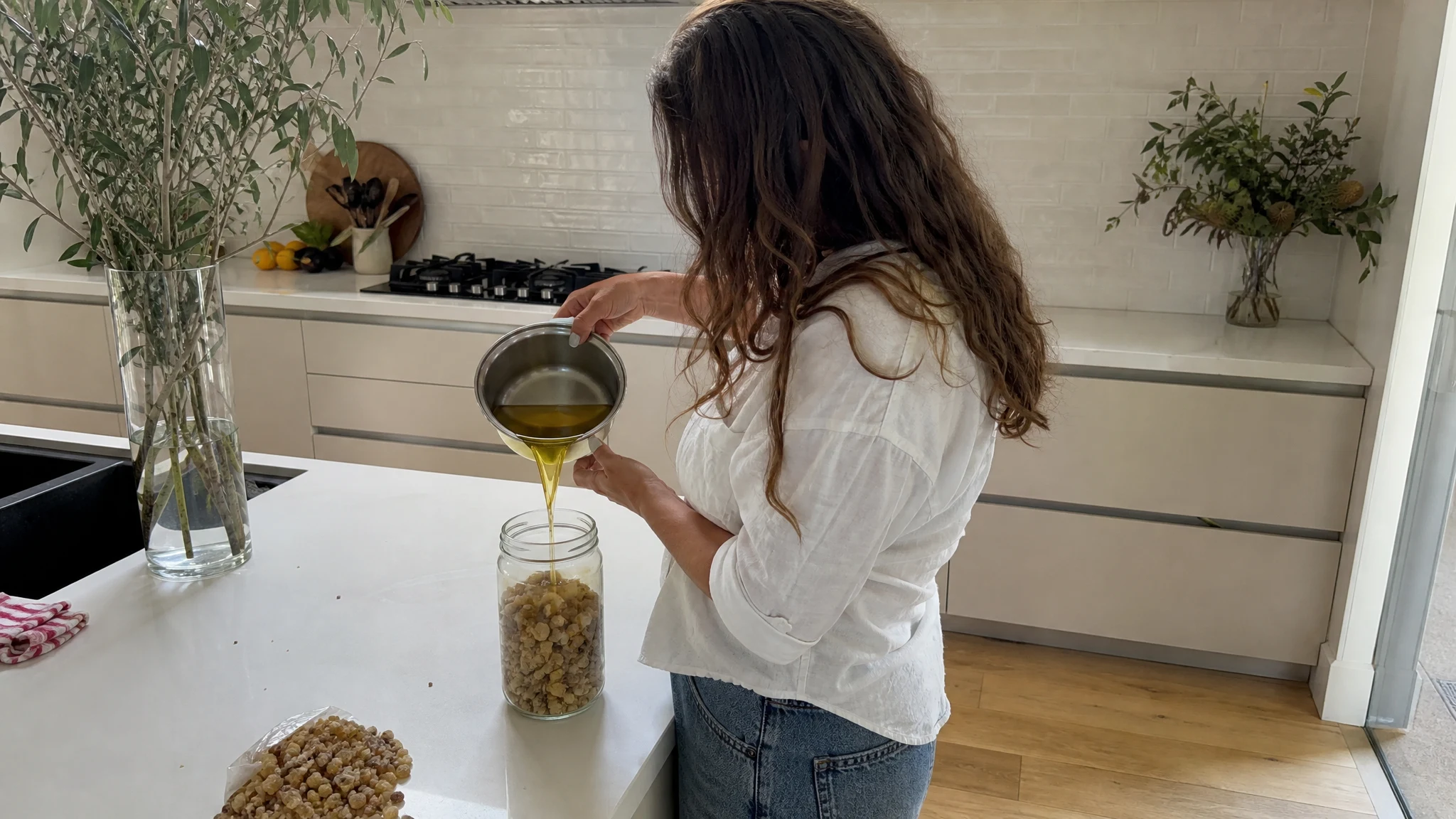
If what you love is the smell of resin itself, burning resin or making an infused oil asks for far less equipment than a still.
Either way, the first drops of a fresh distillation are a lovely thing to smell.
Frankincense Essential Oil
Serrata, carterii, sacra, frereana, neglecta and rivae: steam-distilled, GC/MS verified, in sizes from 0.5 oz to bulk.
From $12.99 $10.40 with code BLACKFRIDAY