Frankincense vs Patchouli: Which Earthy Oil Is Which?
Put frankincense and patchouli on the same shelf and they get filed together as the "earthy" oils. Pour them into a lab instrument and they turn out to be near opposites: one rotates polarised light to the right, the other strongly to the left, and one is a good deal heavier than the other. That is what you would expect from an oil distilled from hardened tree resin set against one distilled from dried shrub leaves.

Frankincense Essential Oil
Six single-origin frankincense varieties, steam-distilled and GC/MS verified.
From $12.99 $10.40 with code BLACKFRIDAY
Patchouli ISO standard versus a serrata certificate
The patchouli oil standard, ISO 3757, covers oil from the leaves of Pogostemon cablin. Alongside it, here is the one batch of ours that carries numbers: the Certificate of Analysis we publish is for a Boswellia serrata batch and lists density, refractive index and optical rotation.
| At 20 C | Patchouli, ISO 3757 | Our serrata batch |
|---|---|---|
| Relative density | 0.952 to 0.975 | 0.838 |
| Refractive index | 1.5050 to 1.5150 | 1.459 |
| Optical rotation | -60 to -40 degrees | +29.12 degrees |
Patchouli is the denser, more light-bending oil, and it rotates the other way. In practice that means a bottle sold as patchouli with a density near 0.84 does not fit its own standard, and the check costs almost nothing. Reasoning from the two columns, these are different kinds of liquid, not two variations on a theme.
Why can one serrata batch not represent frankincense?
We sell six frankincense varieties, and a serrata batch speaks for serrata only. A published comparison of oils from Oman and Yemen with oils from Somalia (Woolley and colleagues, 2012) measured an optical rotation of +30.1 degrees for the Boswellia sacra group and -13.3 degrees for the Boswellia carterii group. Same family of oil, and the sign flips. So when you compare any frankincense with another oil, compare the variety you are actually holding, and keep in mind that species figures from the literature describe the species in that study, not our bottles.
What can density and rotation numbers prove?
Density, refractive index and rotation are quick checks. They can show a liquid is not what its label claims, as the table above does. They cannot show that it is what it claims, because plenty of oils share a few constants by coincidence. Only a chromatogram for the exact lot shows what the molecules are, and the Certificate of Analysis we publish does not include one. If you are buying frankincense for formulation or for resale and need GC/MS or species confirmation, ask us in writing through our contact page for the report for the exact variety and lot, and get the answer in writing before you rely on it. Our guide to reading a GC/MS report covers what to look for, and it works for patchouli too.
Smelling patchouli and frankincense on paper strips
You do not need a lab to feel how unlike these two are. Put a drop of each on its own strip of plain paper, wave them once, and smell them straight away, then again after ten minutes, then after an hour. You will notice that frankincense tends to open lifted and bright before it settles into resin, while patchouli starts low and stays low, like damp earth and old wood. How a scent changes as it dries tells you more than the first sniff ever will. Keep a pen handy and jot a word or two beside each strip, because by the third bottle your nose will have forgotten the first.
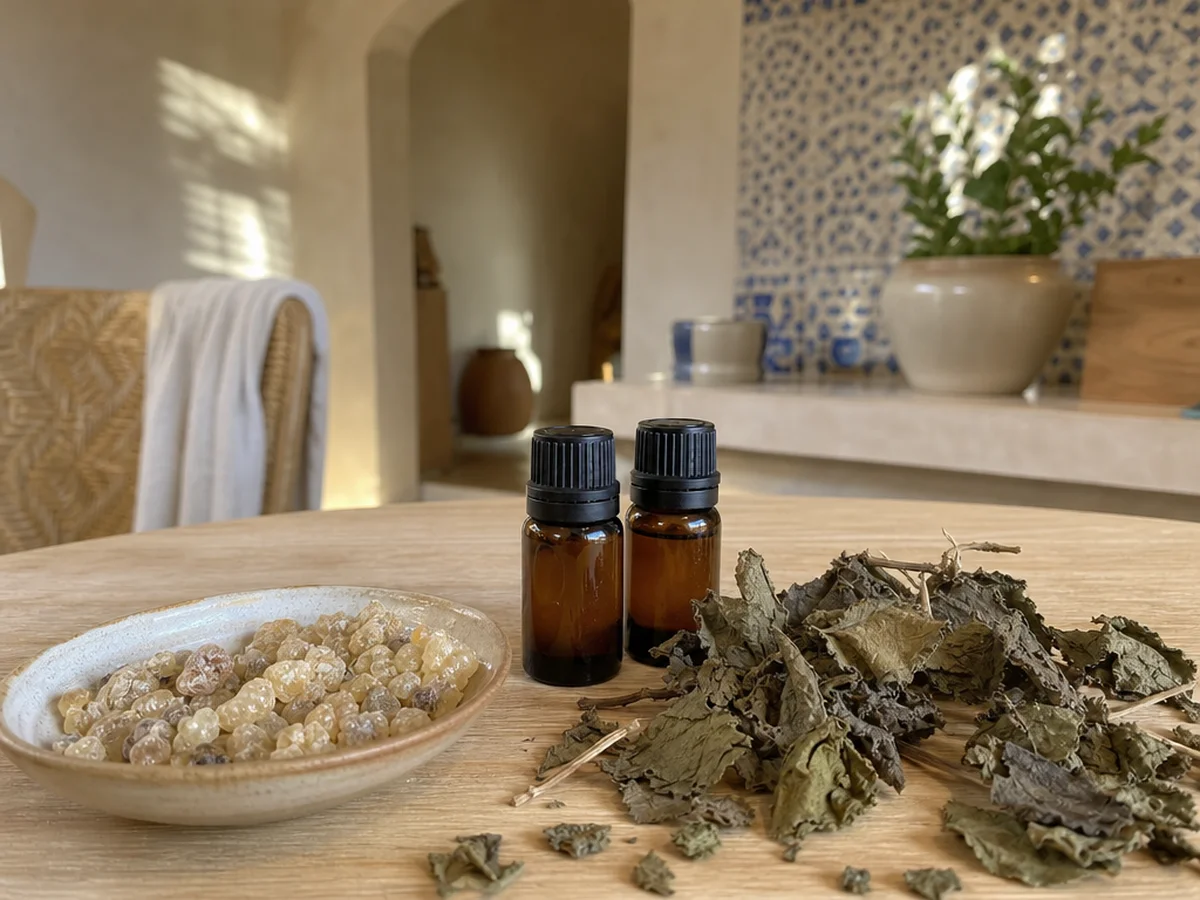
Choosing patchouli or frankincense by nose
Because these oils are so different, this is a choice of ingredient, not a swap, and it is best made by nose. We describe our serrata oil as warm and slightly woody with subtle citrus and pine top notes, our sacra as deep, balsamic and honeyed, our frereana as bright and lemon-pine, and our neglecta as smoky and slightly fruity. Patchouli we leave to patchouli suppliers, since we do not sell it, but sampling both side by side is the surest way to hear how they sit together. If you are working out a combination, our blending guide walks through building one in small, recorded steps, and our varieties overview helps you pick which frankincense to start with.
Safe dilution for patchouli and frankincense oils
Both are strong essential oils and both belong in a carrier, not on skin neat. The Tisserand Institute's general bands are 0.2 to 1% for sensitive skin, 0.5 to 1.2% for facial products and 1 to 3% for body oils, and it calls undiluted use neither sensible nor necessary. Our dilution guide shows the arithmetic. As our disclaimer says, patch test before topical use, keep oils away from eyes and mucous membranes and out of children's reach, and ask your healthcare provider first if you are pregnant, nursing, on medication or have a medical condition. We sell frankincense for its aroma and make no health claim for either oil.
A habit we recommend
Smell with a clear head. Skip the coffee and the scented candle beforehand, step to a window for a breath of plain air between bottles, and give yourself a few minutes. Strong earthy oils tire the nose quickly, and the second bottle always seems quieter than the first for no reason other than that.
The two share a reputation for depth, but on the instrument they could hardly be less alike, which is a good reason to enjoy each for what it is. For more on what sits inside a frankincense oil, our resin chemistry post is a good next read.
Frankincense Essential Oil
Serrata, carterii, sacra, frereana, neglecta and rivae: steam-distilled, GC/MS verified, in sizes from 0.5 oz to bulk.
From $12.99 $10.40 with code BLACKFRIDAY
Sources & Further Reading
- ISO 3757:2002 - Oil of Patchouli Quality Standards - Pogostemon cablin (iTeH Standards)
- Chemical differentiation of Boswellia sacra and Boswellia carterii essential oils by gas chromatography and chiral gas chromatography-mass spectrometry (Woolley et al., 2012, PubMed)
- Dilution for essential oils (Tisserand Institute)