Frankincense and Myrrh Blend: Ratios to Start With
The pairing is famous, but the two oils are not equal partners. Myrrh is the heavier, slower, more insistent voice, and in a blend it tends to talk over frankincense unless you give it fewer drops. Getting the ratio right is most of the job.

Frankincense Essential Oil
Six single-origin frankincense varieties, steam-distilled and GC/MS verified.
From $12.99 $10.40 with code BLACKFRIDAY
Why isn't a frankincense myrrh ratio 1:1?
Frankincense oils are generally led by light monoterpenes such as alpha-pinene; one published comparison put alpha-pinene at an average of 68.2 percent in Boswellia sacra oils and 37.3 percent in Boswellia carterii oils. Myrrh oil is built differently. An analysis of Commiphora myrrha oil found it led by heavier compounds, with furanoeudesma-1,3-diene at 34.9 percent, followed by lindestrene, curzerene and germacrone. Those are figures for the species in those studies, not for any bottle of ours.
Our reasoning from that: heavier molecules evaporate more slowly and tend to read as deeper and more lingering, so a little myrrh goes a long way. That is why we would start frankincense-heavy and add myrrh drop by drop. Our comparison of the two resins covers the chemistry in more depth.
Three drop ratios for frankincense and myrrh
Myrrh is not something we sell. We sell six frankincense essential oils, so you would find the myrrh at a craft or supply shop. Each blend below totals eight drops for a diffuser; check your machine's manual and scale down if it asks for less.
- 3:1, frankincense in front: 6 drops frankincense, 2 drops myrrh. The frankincense still leads and myrrh gives it a resinous floor. This is where we would start.
- About 5:3, a fuller pairing: 5 drops frankincense, 3 drops myrrh. Noticeably darker and slower.
- 1:1, an even match: 4 drops of each. Expect myrrh to dominate the room after a while; you may like that or may not.
Which frankincense matters too. We describe our sacra as deep, balsamic and honeyed, which stands up to myrrh and makes a rounder blend. Our frereana, bright with a lemon-pine lift, keeps the pair lighter, and serrata, warm and slightly woody, sits in between. Our guide to the six aromas helps you choose.
Skin percentage across both oils combined
Essential oils go into a carrier at a percentage of the whole blend, and that percentage covers every oil together. We recommend 0.5% to 2% in a carrier for general skin use, and the Tisserand Institute lists lower bands for particular uses: 0.2 to 1% for sensitive or impaired skin and 0.5 to 1.2% for facial products, with 1 to 3% for body oils. We stay at the low end. Myrrh safety data is something to check for yourself in a safety reference or the current IFRA standards for your finished product, since we have not set out a limit for it here.
Using about 20 drops per ml as a rough convention, 30 ml of carrier at 1 percent holds 0.3 ml of essential oil, or about 6 drops in total. A 2:1 split is then 4 drops frankincense and 2 drops myrrh. At 0.5 percent it is 3 drops, so 2 and 1. Droppers vary, so treat these as approximate, patch test first, and keep it away from eyes and mucous membranes. Our carrier oil guide helps with the base, and the dilution basics post covers the rest.
If you are pregnant, nursing, on medication or have a medical condition, ask your healthcare provider before using either oil. Our post on pregnancy and nursing explains what authorities say. These are aroma and cosmetic oils, and nothing here is a remedy.
Diffuser and salve uses for frankincense myrrh
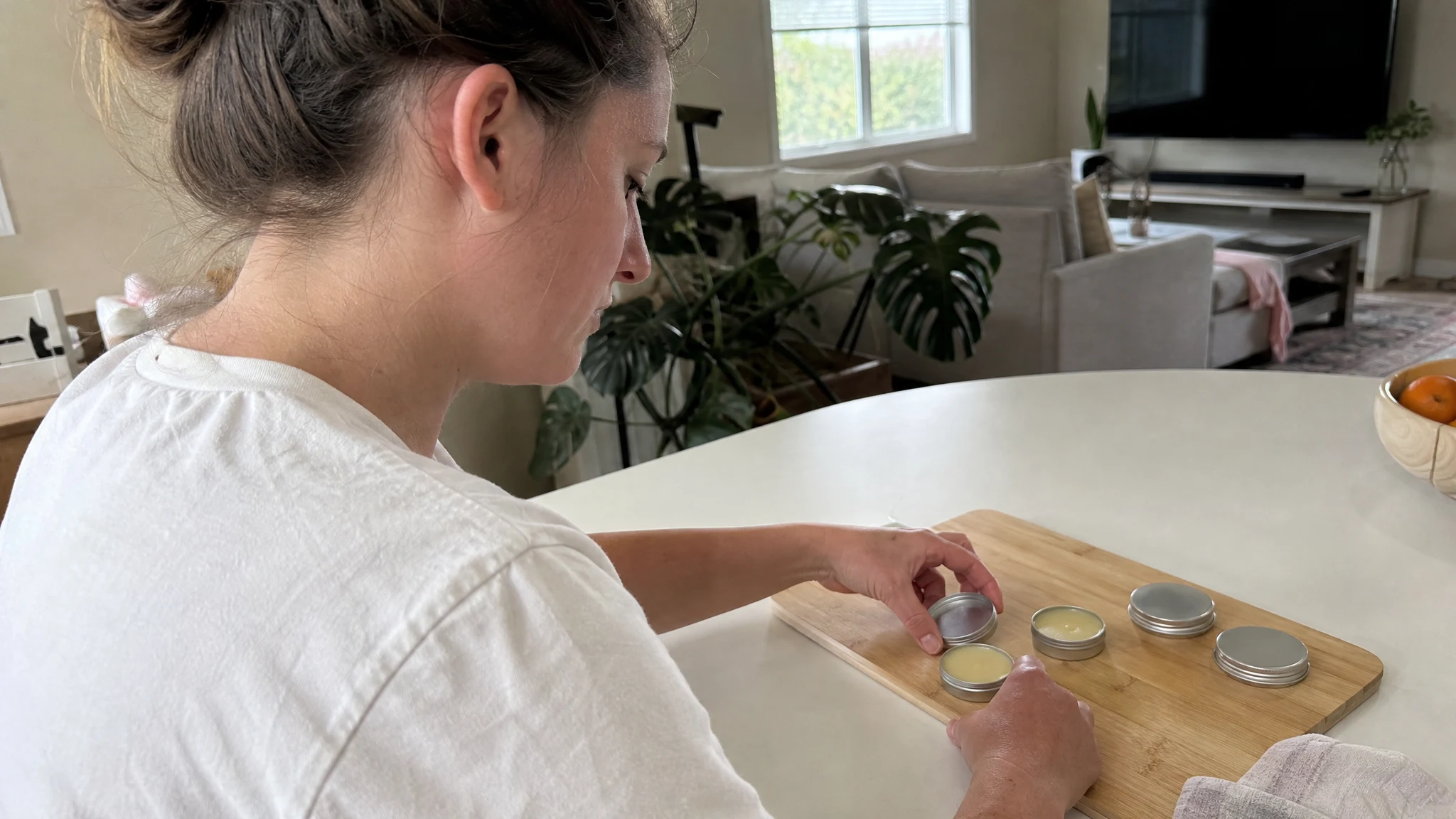
In a diffuser, the eight-drop versions above are enough. In a salve, a wax and butter base does the work and the oils are the scent; our salve recipe shows the arithmetic by weight. In both cases the same rule applies: add myrrh slowly, because you cannot take a drop back out.
The old stories pair these two for a reason, but a good blend is about balance, not tradition. Start at 3:1, notice what you want more of, and move one drop at a time.
Frankincense Essential Oil
Serrata, carterii, sacra, frereana, neglecta and rivae: steam-distilled, GC/MS verified, in sizes from 0.5 oz to bulk.
From $12.99 $10.40 with code BLACKFRIDAY
Sources & Further Reading
- "Chemical differentiation of Boswellia sacra and Boswellia carterii essential oils by gas chromatography and chiral gas chromatography-mass spectrometry" (PubMed 22835693)
- "Chemical composition of the essential oil and supercritical CO2 extract of Commiphora myrrha (Nees) Engl. and of Acorus calamus L." (PubMed 16190653)
- Tisserand Institute, "Dilution for essential oils" (tisserandinstitute.org/safety/dilution)