Frankincense Sugar Scrub: A Simple Dry Recipe
A sugar scrub is about as simple as body care gets: sugar to buff away dry surface cells, oil to carry it, and a little frankincense for the scent. This version is a formulation worked out from published dilution guidance and kitchen-scale arithmetic. The aim is skin that feels soft and smooth for a day, which is what rubbing off a layer of dry cells does, and a scent you will enjoy in the shower.

Frankincense Essential Oil
Six single-origin frankincense varieties, steam-distilled and GC/MS verified.
From $12.99 $10.40 with code BLACKFRIDAY
Is a sugar scrub right for dry skin?
The American Academy of Dermatology's guide to exfoliating at home is a useful reality check. It says mechanical exfoliation, meaning a scrub or tool that physically removes dead cells, may be too irritating for dry, sensitive or acne-prone skin. It advises people with darker skin tones, or dark marks left by burns, bites or acne, to avoid strong exfoliation, and it says never to exfoliate open cuts, wounds or sunburn. It also notes that exfoliating may worsen dryness or breakouts in people using retinoids or benzoyl peroxide.
So this scrub is for body skin that handles scrubbing well, such as elbows, knees, feet and shoulders. We would not make it a face scrub, since the facial dilution range is lower than the body range and the face is where mistakes cost most.
Sugar scrub formula weighed for a 100 g batch
Weigh everything on a kitchen scale, because cups and spoons vary too much to control a percentage. For a 100 g batch:
| Ingredient | Amount | Where to find it |
|---|---|---|
| Plain granulated sugar | 70 g | Grocery store |
| Carrier oil such as jojoba or sweet almond | about 29 g | Cosmetic supplier |
| Frankincense essential oil | 0.5 g to 1 g (0.5% to 1%) | Our shop |
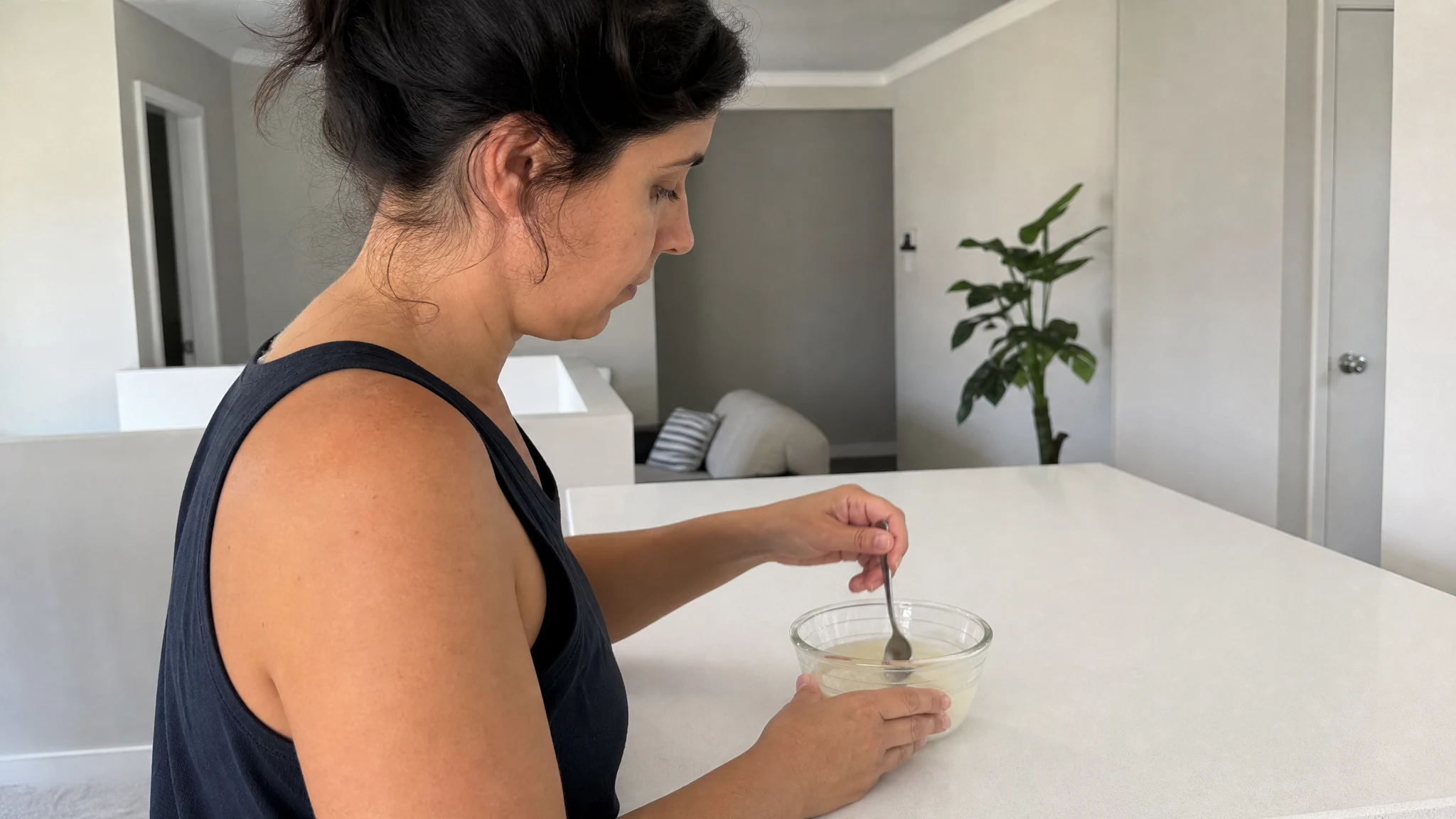
Stir the carrier oil into the sugar until it looks like wet sand, then add the frankincense last so it spreads evenly. If it looks dry, add a gram of oil at a time; if oil pools, add sugar. To scale up, multiply every figure by the same factor, so a 250 g jar at 1% needs 2.5 g of frankincense. We do not sell carrier oils or sugar, and our carrier oil guide helps with choosing one.
If you prefer counting drops, our Certificate of Analysis for a serrata batch gives a density of 0.838, so 1 g of that batch is about 1.19 ml. At the rough convention of 20 drops per ml, which varies by dropper, 0.5 g is about 12 drops and 1 g about 24. We have no density for our other five oils, so weigh those.
Why is 1% frankincense oil the scrub ceiling?
The Tisserand Institute lists 1% to 3% for body oils and lotions, 0.5% to 1.2% for facial products, and 0.2% to 1% for sensitive or impaired skin. It does not cover scrubs, and it reports reactions to frankincense oils applied undiluted. Those are general figures for essential oils, and we have no frankincense-specific rate of our own to add. We stop at 1% because a scrub rubs against skin that is being gently abraded, and our reasoning is that this makes irritation a little more likely than a plain lotion at the same strength. Begin at 0.5%.
Preventing water contamination in a dry scrub jar
This is a dry formula with no preservative, so it relies on staying dry. The FDA's guidance on microbiological safety in cosmetics lists contaminated water and dipping fingers into a product among the common routes of contamination, says warm, damp storage can speed microbial growth, and advises against adding water to cosmetic products. In practice:
- Keep the jar out of the shower stream and dry the lid and your hands before opening it.
- Scoop with a dry spoon, not fingers.
- Make small batches, write the date on the jar, and discard it if it smells off, shows any spot of colour or mold, or gets wet.
Recipes that call for water, liquid soap or fruit puree need a preservative system designed by a cosmetic chemist, which a home recipe cannot supply.
Glass jars and dating for homemade scrubs
Choose a wide-mouth glass jar so a dry spoon fits easily, and wash and dry it completely before you start. Stir the oils through the sugar slowly, then let the jar sit for a few minutes before the first use so everything settles together. Write the date and the percentage on the lid. When you come back to it in a month, you will be glad you did.
Scent and texture expectations from a finished scrub
The scent is strongest the moment you open the jar and in warm, steamy air. The sugar feels coarse at first and softens as it meets water, so go gently and let the crystals do the work. If the aroma seems faint, resist the urge to add more oil; the percentage above is the limit, and a lighter scent is a perfectly good scent.
Patch test and rinse routine for scrubs
Patch test first by rubbing a little on your inner forearm, rinsing and waiting a day. The American Academy of Dermatology describes applying a scrub gently in small circles for about 30 seconds, rinsing with lukewarm water and moisturising straight afterwards. Once a week is a sensible starting point for a coarse sugar scrub; that frequency is our suggestion, not theirs. Stop if skin turns red or stings. Because the mix is mostly oil, expect a slippery tub floor, and rinse it after.
Which frankincense variety suits a sugar scrub?
This is a scent decision. Serrata is warm and slightly woody with citrus and pine top notes, carterii is warm, woody and resinous, sacra is deep and balsamic, and frereana is bright and lemon-pine. Our species overview compares them side by side, and the article on frankincense and myrrh covers pairing with other resin scents. If composition matters to you, ask us in writing through the contact page for the report on the exact variety and lot.
That is the whole recipe: sugar, a carrier oil, a measured amount of frankincense and a dry jar. Keep it simple and the scent does the rest.
Frankincense Essential Oil
Serrata, carterii, sacra, frereana, neglecta and rivae: steam-distilled, GC/MS verified, in sizes from 0.5 oz to bulk.
From $12.99 $10.40 with code BLACKFRIDAY
Sources & Further Reading
- How to safely exfoliate at home (American Academy of Dermatology)
- Dilution for essential oils (Tisserand Institute)
- Microbiological Safety and Cosmetics (FDA)