Frankincense for Pain: What the Research Really Shows
Ask whether frankincense helps with aches and you get two honest answers at once. Yes, there is real research on Boswellia and knee pain. And no, none of it involves the kind of oil we sell. Both are true because the studies tested something different from a bottle of steam-distilled essential oil, and sorting out which is which is the whole story.

Frankincense Essential Oil
Six single-origin frankincense varieties, steam-distilled and GC/MS verified.
From $12.99 $10.40 with code BLACKFRIDAY
Swallowed Boswellia trials in knee osteoarthritis
Every human study below used a swallowed product, mostly in knee osteoarthritis. The most favourable is a 2020 meta-analysis that pooled seven trials, 545 patients in all, comparing Boswellia or its extract with placebo or standard medicine. It reported improvements in pain, stiffness and function scores, and its authors concluded the extract may be an effective and safe option, suggesting at least four weeks of use. Pooled small trials inherit the limits of the small trials, though, and the NCCIH's page on osteoarthritis, last updated in 2016, reads an earlier 2014 evaluation more cautiously: Boswellia serrata may produce slight improvements in pain and function, so slight that patients might not find them meaningful.
A 2023 trial shows why it pays to read past the headline. Healthy adults over 40 with persistent knee discomfort took a Boswellia serrata extract (29 people), an omega-3 product (31), both (30) or placebo (30) for eight weeks. The statistically significant pain reduction in the abstract belongs to the omega-3 product, while the Boswellia group's reported gain was in sleep latency. In a 2026 pilot, 12 healthy volunteers took 300 mg of extract twice a day for 28 days while pain was triggered with capsaicin, and spontaneous pain did not differ from placebo (43 versus 47, p = 0.539). The authors saw trends and asked for larger trials, which is a fair reading of a pilot that small. Back in 2008, a BMJ systematic review of seven extract trials across several conditions summed up the whole field as encouraging but not compelling, and that still feels about right.
Do boswellic acids appear in frankincense oil?
The compounds extract makers aim for are boswellic acids, the heavy resin molecules usually offered to explain these results. The Tisserand Institute says they are not seen in GC-MS analyses of frankincense oils, that there is no reliable report of them in oil from normal distillation, and that some extracts are sold with up to 60%. So the compound class behind the trials is, on that account, not what steam distillation carries into a bottle. Reasoning from this, carrying an extract result over to an oil is an inference with no study behind it, and we would not ask your knee to test it. Our resin versus oil guide and the boswellic acids article explain the chemistry more fully.
What about oil on skin? The NCCIH says topical frankincense has been studied for conditions including osteoarthritis, but that there is not enough evidence to show it is an effective treatment, and that boswellia may be safe to use topically or for aromatherapy. That is a statement about how likely harm is and about the lack of proof of benefit, and it is all the topical record we can cite. We sell six single-species oils and no creams, balms or capsules, we make no pain claim for them, and the one certificate of analysis we have, for a serrata batch, gives density, refractive index and optical rotation only.
Reading studies-show claims about frankincense pain
When a page says "studies show," a few plain questions go a long way. What did people actually take, and how? Was it the same thing you are holding in your hand? How many people were in the trial, and what was it compared with? Who were they, and what were they being treated for? You do not need a science degree to ask these, and a headline that cannot answer them has not told you much.
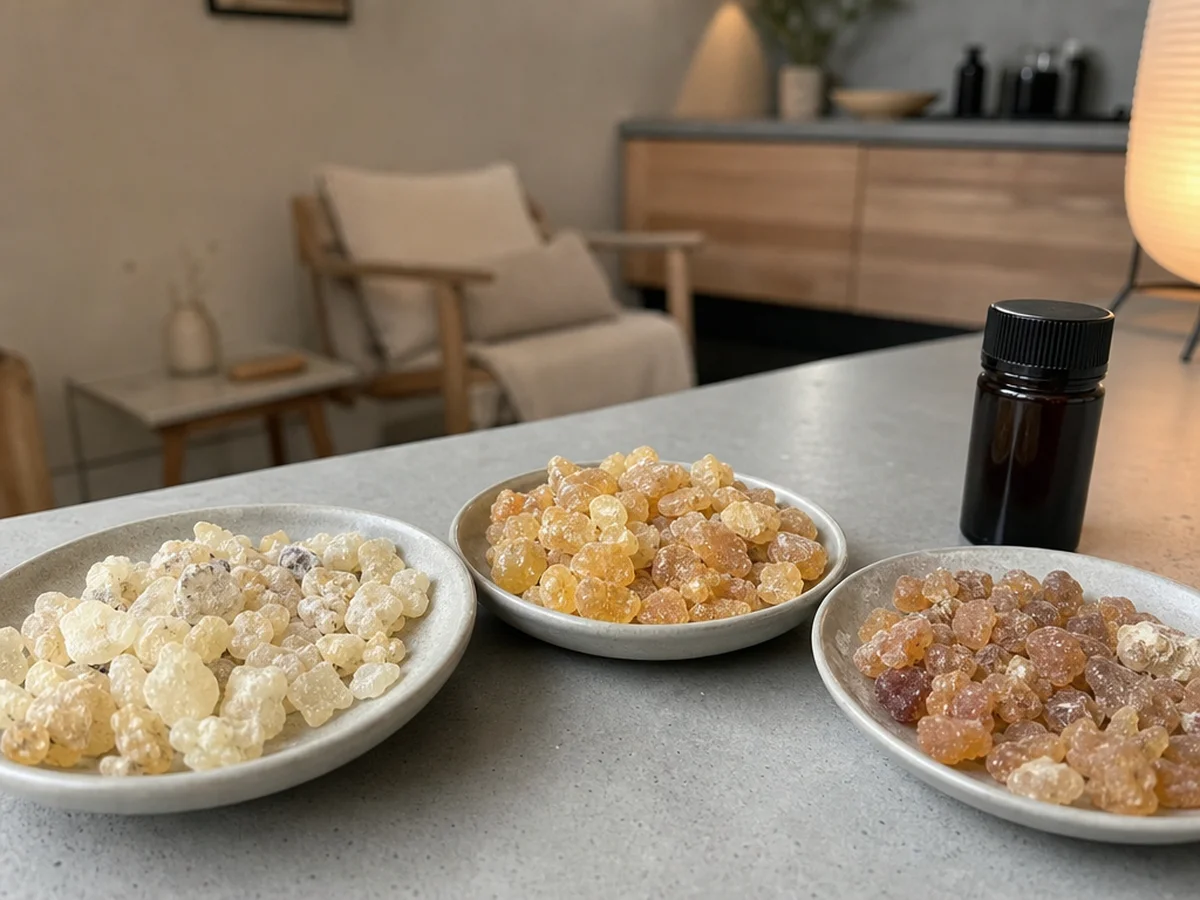
We put these questions to every page we write, including this one. It is why we keep the extract trials in one corner and the bottle of oil in another.
Trial design needed to test frankincense oil
We like to name our own exit. We would happily revisit this if a trial tested a steam-distilled frankincense essential oil at a stated concentration and route, against placebo or a comparator, in people with a defined condition, with pain as the pre-announced main outcome and the oil's chemistry reported by GC-MS. Until then, the extract studies are one body of evidence and the oil is another with nothing in it yet, and anyone offering a pain claim for an oil is borrowing the first to describe the second.
When should joint pain see a physician?
- Joint pain that lingers or worsens: it deserves a physician's assessment, and the NCCIH describes osteoarthritis care as a combination of approaches that may include exercise and weight management. A bottle does not stand in for a diagnosis.
- Curious about a Boswellia capsule: ask a pharmacist or physician, because the NCCIH says some supplements and medicines can interact in harmful ways. We do not sell capsules, and our medications FAQ gathers the questions.
- Drawn to the scent after a busy day: that is a lovely reason to own frankincense. Dilute any oil that goes on skin, patch test, and stop at any irritation; the general ranges are in our safety guide.
- Thinking about swallowing it: please do not, and see our ingestion article; extract trials do not justify it.
If you are weighing frankincense against other options, we compare it with turmeric and CBD, and our piece on fibromyalgia looks at a pain condition where the inflammation story does not apply. For us, frankincense is about aroma, and we are glad to keep it honest.
Frankincense Essential Oil
Serrata, carterii, sacra, frereana, neglecta and rivae: steam-distilled, GC/MS verified, in sizes from 0.5 oz to bulk.
From $12.99 $10.40 with code BLACKFRIDAY
Sources & Further Reading
- Effectiveness of Boswellia and Boswellia extract for osteoarthritis patients: a systematic review and meta-analysis.
- Osteoarthritis: In Depth | NCCIH
- Efficacy of Boswellia serrata Extract and/or an Omega-3-Based Product for Improving Pain and Function in People Older Than 40 Years with Persistent Knee Pain: A Randomized Double-Blind Controlled Clinical Trial.
- Effect of Boswellia serrata on Pain Intensity, Central and Peripheral Sensitization, and Pain Modulation in Healthy Volunteers-A Randomized, Double-Blind, Placebo-Controlled, Cross-Over Pilot Trial.
- Frankincense: systematic review.
- Boswellia: Usefulness and Safety | NCCIH
- Does Frankincense oil contain boswellic acid? - Tisserand Institute