Frankincense Oil and Medications: What to Ask a Pharmacist
Nobody can tell you from a web page whether frankincense essential oil suits your particular medicines, and a page that claims to is guessing. What exists is mostly laboratory work on Boswellia resin extracts, plus cautionary lines in clinical monographs. This guide lays out what was actually tested so you can walk into a pharmacy with good questions.

Frankincense Essential Oil
Six single-origin frankincense varieties, steam-distilled and GC/MS verified.
From $12.99 $10.40 with code BLACKFRIDAY
Could frankincense oil interact with prescription drugs?
Possibly, but the interaction picture has not been mapped for the essential oil. Here is the whole evidence base, with each piece labeled for what it tested.
- Lab enzyme work on resin extracts. Frank and Unger (Journal of Chromatography A, 2006) found that extracts of the gum resin of Boswellia carteri, frereana, sacra and serrata were equally potent, non-selective inhibitors of major drug-metabolizing cytochrome P450 enzymes. This was an enzyme test in the laboratory, using resin extracts rather than essential oil.
- A twist inside that study. The boswellic acids were moderate to potent inhibitors, but the authors say they are not the major CYP-inhibiting principle of frankincense. So whatever drives the effect in resin is not mainly the compound the capsule trials are built on, and the paper does not say whether the volatile compounds in a distilled oil share it.
- Clinical monographs. Memorial Sloan Kettering notes that boswellia extracts can inhibit platelet aggregation and may increase bleeding risk with anticoagulant or antiplatelet drugs, adding that clinical significance has yet to be determined. It also lists in vitro transporter effects whose clinical relevance is unknown.
- NCCIH. Its boswellia page advises talking with your health care provider before using any herbal product if you take medicine, and singles out asthma medicines.
Put together, that is a plausible mechanism in the lab and a cautionary line in a cancer-center monograph. It is a reason to ask, not a documented problem.
Blood thinners and oral boswellia extracts
This is the question we would treat most carefully. The only sourced statement is the Memorial Sloan Kettering one, and it concerns boswellia extracts taken by mouth. We found no source describing bleeding from inhaling or topically using frankincense oil. Reasoning from that gap, diffusing may carry little risk and swallowing the oil is simply unknown. If you take warfarin, a direct oral anticoagulant or an antiplatelet drug, tell your prescriber or anticoagulation clinic that you use essential oils, name frankincense, and ask if they want any extra monitoring. Timing and stopping rules are decisions for the person managing your anticoagulation.
Why do pharmacists care about liver CYP enzymes?
Those CYP enzymes help clear many common drugs, which is why pharmacists perk up at the Frank and Unger result. Two limits apply: the samples were gum-resin extracts and no steam-distilled oil was run, and inhibiting an enzyme in a dish does not tell you whether the amount absorbed from diffusing or from a diluted skin application would change drug levels in a person. Four of our six species appear in that study (carterii, frereana, sacra and serrata); neglecta and rivae do not.
Evidence gaps for NSAIDs, steroids and immunosuppressants
We found no source that tests these combinations for frankincense oil, and the NCCIH and MSK pages describe no interaction with them. That is a statement about the literature, not about you. If you take an immunosuppressant after a transplant or for an autoimmune condition, any new plant product is a conversation for your specialty team, and the same goes for asthma controllers.
Do diffusing and diluted skin use carry less exposure?
As reasoning rather than a tested conclusion, the amount reaching the bloodstream from a few minutes of diffusing or a diluted skin application is plausibly far less than from a capsule, and the capsule is where the cautionary lines apply. Skin has its own consideration: the MSK monograph lists allergic skin reactions and cites case reports of contact dermatitis after a boswellia oil and a boswellia cream. If you use any essential oil on skin, dilute it and patch test. Our safety guide shows the arithmetic, and the ingestion article covers swallowing.
Pharmacist checklist for frankincense oil users
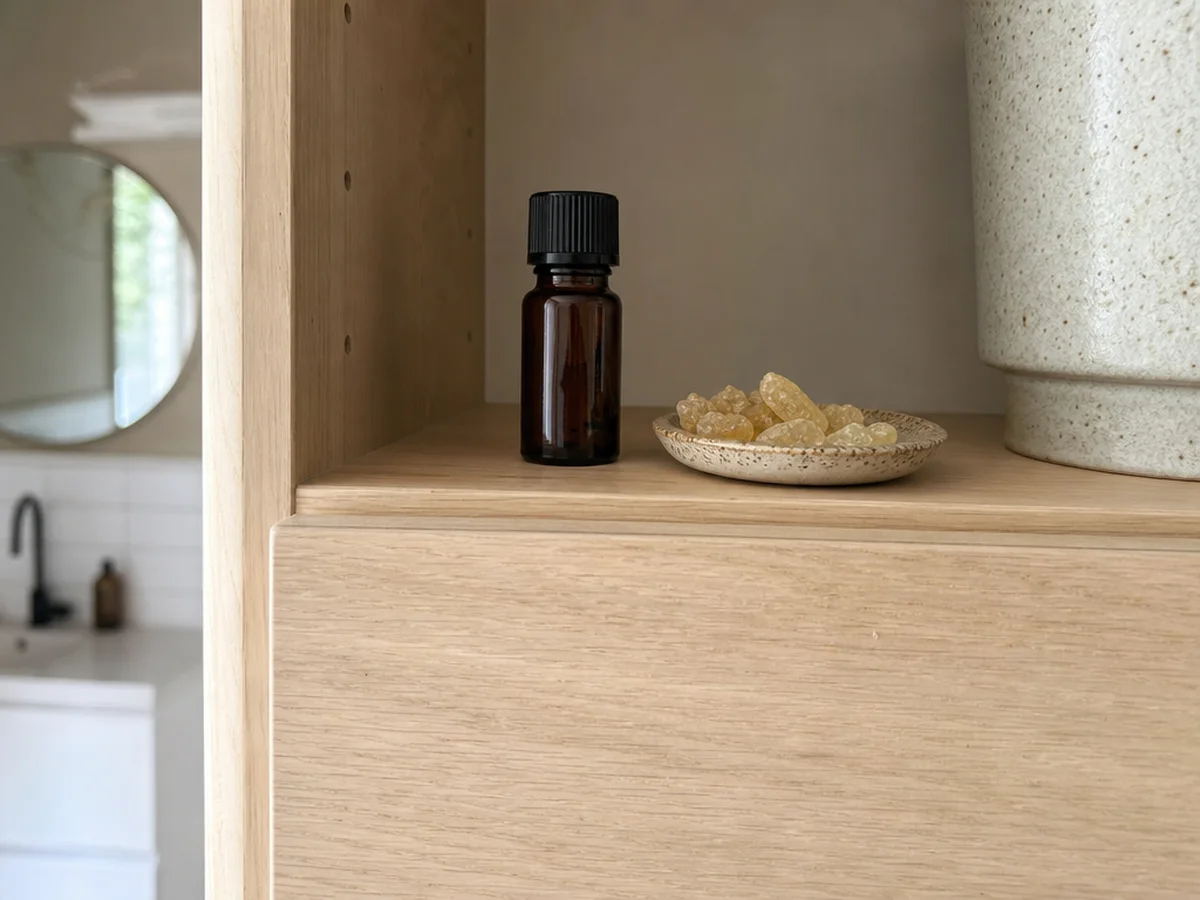
Bring the bottle or a photo of the label. The useful details are the species (ours are serrata, carterii, sacra, frereana, neglecta and rivae), how you use it (diffused, diluted on skin or by mouth), how often, and your full list of medicines and supplements, including over-the-counter ones. Ask whether anything on your list is cleared by the enzymes the lab studies flagged, whether your bleeding or immune status changes the answer, and whether they want you to stop before a procedure. A pharmacist can often answer the first within minutes. For people and animals this article does not cover, see our posts on pregnancy and breastfeeding and pets.
Making the conversation easy
Pharmacists are busy, and a clear note helps them help you. Before you go, write down the oil, how you plan to use it and the full list of what you take, with doses. Put the note on your phone or on a card in your wallet. If you change anything later, such as a new medicine or a different way of using the oil, update the note first. It takes five minutes, and it means the answer you get is about your real situation, not a guess from a web page.
Emergency signs after frankincense oil exposure
Poison Control says any allergic reaction that includes difficulty breathing should be treated as a medical emergency, and that if someone swallows an essential oil you should use its online tool or call your poison center at 1-800-222-1222. For anything that worries you about a medicine you take, call your prescriber or pharmacist that day.
Spacing rules and half-life claims without sources
You will see pages offering spacing rules between a drug and an oil, half-lives for frankincense compounds, or risk statements for older adults. We looked for tested sources for each and did not find one, so we do not repeat them. As reasoning, a spacing rule can only address contact in the gut, while the lab finding concerns enzymes that act after absorption, so a timing rule borrowed from another herb could give false comfort. If you have impaired liver or kidney function or take many medicines, the pharmacist review is the first step.
We sell six steam-distilled, single-species frankincense essential oils, neat and undiluted. If a drug interaction matters to you, ask us in writing through the contact page for the GC/MS report for the exact variety and lot, and hand it to your pharmacist. Nothing here says an oil is safe with a medicine, and your pharmacist is the right person to say that.
Whatever you decide, keep the scent a pleasure and keep your medicine questions with the people trained to answer them.
Frankincense Essential Oil
Serrata, carterii, sacra, frereana, neglecta and rivae: steam-distilled, GC/MS verified, in sizes from 0.5 oz to bulk.
From $12.99 $10.40 with code BLACKFRIDAY
Sources & Further Reading
- Frank A, Unger M, 2006. Analysis of frankincense from various Boswellia species with inhibitory activity on human drug metabolising cytochrome P450 enzymes using liquid chromatography mass spectrometry after automated on-line extraction. J Chromatogr A.
- Memorial Sloan Kettering Cancer Center. Boswellia.
- NCCIH. Boswellia: Usefulness and Safety.
- Poison Control. Essential oils: Poisonous when misused.