Frankincense Oil vs CBD Oil: Not the Same Thing
Frankincense oil and CBD oil sometimes land in the same search for pain, and they are easy to mistake for two answers to the same question. They are not. CBD is a cannabis compound that has been studied as a drug. Frankincense essential oil, which is what we sell, is a steam-distilled aromatic that we offer for its scent, with no pain trial of its own. Sorting out which evidence belongs to which saves a lot of confusion.

Frankincense Essential Oil
Six single-origin frankincense varieties, steam-distilled and GC/MS verified.
From $12.99 $10.40 with code BLACKFRIDAY
Cannabidiol and frankincense essential oil defined
CBD (cannabidiol) is a compound from cannabis, usually sold dissolved in a carrier oil. Frankincense essential oil is the volatile part of Boswellia resin, carried over by steam and made up mostly of small terpenes. The two are different materials with different regulatory standing, different research and different cautions.
FDA approval and cautions around CBD products
The FDA states that it has approved one CBD product, a prescription medicine for seizures linked to Lennox-Gastaut syndrome, Dravet syndrome and tuberous sclerosis complex. Its consumer update also says CBD can cause liver injury, can affect how other drugs you take work, and that unapproved CBD products have not been evaluated by the FDA for effectiveness, dosage or safety.
On pain, the evidence concerns cannabinoids as a group. The National Center for Complementary and Integrative Health describes a 2018 review of 47 studies that found a small benefit for chronic pain: 29% of people using cannabis or cannabinoids reported at least a 30% pain reduction, compared with 26% on placebo. NCCIH notes the difference may be too small to matter to patients, and that side effects were more common with cannabinoids. It adds that over-the-counter CBD products may contain more or less CBD than their labels say.
The practical reading is that cannabinoid medicines have some controlled-trial support in chronic pain, with side effects worth taking seriously, and that a retail CBD oil of unknown content is a different thing from the medicines in those trials.
Oral Boswellia serrata extract trials and pain
The studies behind frankincense and pain used oral extracts of Boswellia serrata resin. A BMJ systematic review found seven randomised trials of those extracts across several conditions and called the evidence "encouraging but not compelling." NCCIH goes further and says there is not enough high-quality evidence to determine whether boswellia is useful for any health condition.
Those extracts are not our oil. The Tisserand Institute finds no reliable report of boswellic acids in any frankincense oil made with normal distillation, so extract trials are poor evidence for a steam-distilled oil. We make no pain claim for ours. Our articles on pain and inflammation and on frankincense versus turmeric go through the extract evidence in more detail.
Why scrutinize pain claims on aroma oil pages?
The FDA's aromatherapy page lists claims such as easing pain among examples of drug claims, and says that coming from a plant does not keep a product from being regulated as a drug. That is why we sell frankincense oil for its aroma and say nothing about pain. If a page promises relief from a bottle of essential oil, that promise belongs to a different kind of product.
How to read frankincense and CBD bottle labels
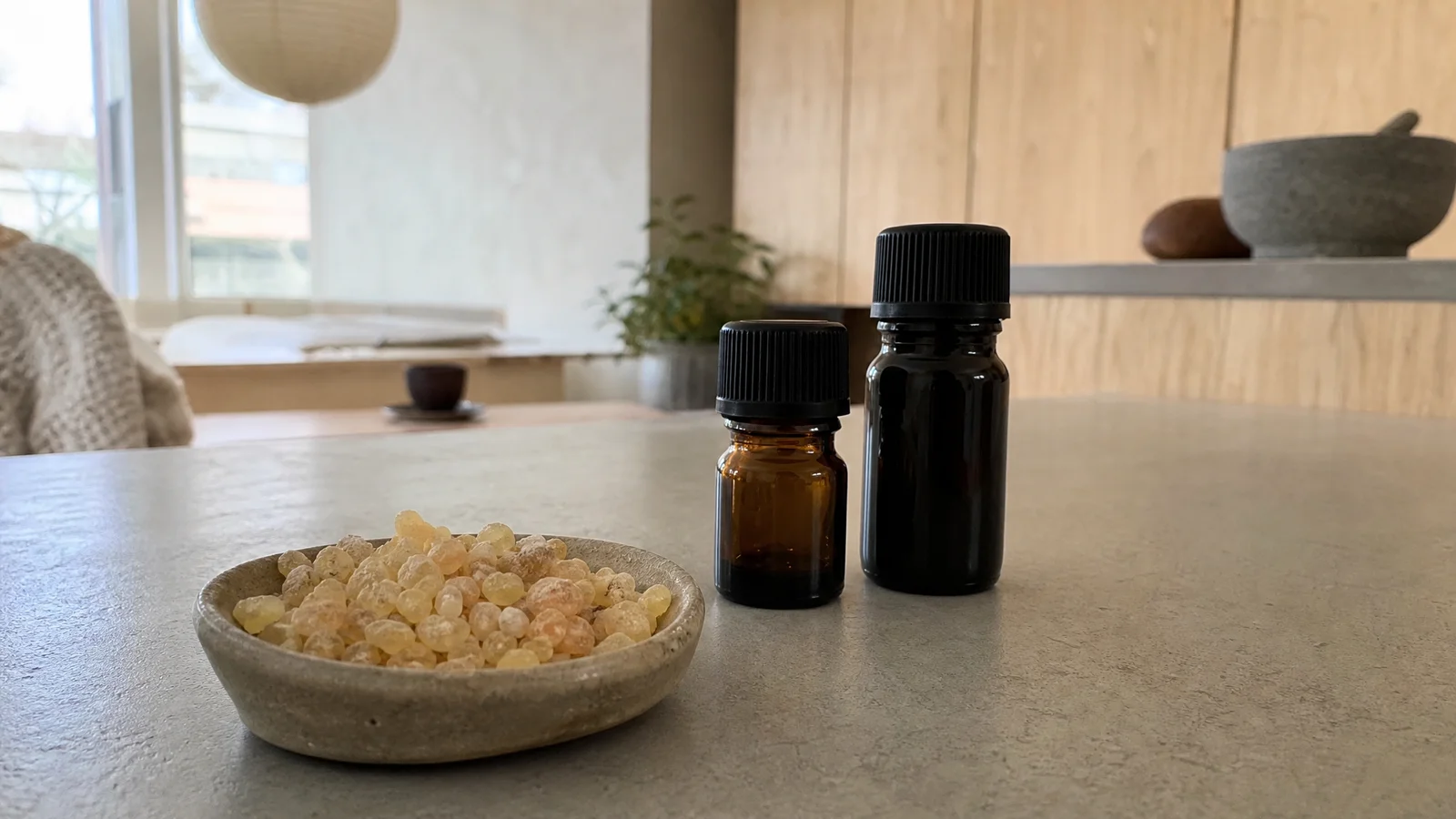
Two dropper bottles can look nearly identical on a shelf, so read the label before you read anything else. Check the plant name, the ingredient list and whether the product calls itself an essential oil or a CBD product. Those words tell you what category you are holding, and with it what rules and cautions apply.
If both end up in your home, keep them apart and label them clearly. Store every oil out of sight and reach of children and pets, and never decant one into an unlabeled container.
Sorting aroma oils from health products at home
Anyone who keeps several bottles at home knows how fast a drawer fills up. Once a year, or whenever you notice, take everything out, read each label, and put it back where it belongs: aroma oils with aroma oils, anything you take for health with the things your clinician knows about. It is a ten-minute job and it prevents the kind of muddle that this whole article is about.
A small seller's reason for clear labels
We are a small business that sells one kind of thing, aroma oils made from frankincense. We would rather you leave this page knowing exactly which is which than leave with a vague sense that one might do the other's job.
When should new or severe pain go to a physician?
- Pain that is new, severe or unexplained. Neither oil is the next step. A physician is, because a web page cannot tell you why something hurts.
- Weighing CBD for long-standing pain. Talk to a physician or pharmacist, particularly if you take other medicines, since the FDA says CBD can change how they work.
- Weighing a Boswellia supplement. That is an extract and a question for a physician or pharmacist. We do not sell supplements, and our oil should never be swallowed as a substitute.
- Wanting the scent while you stretch or rest. That is a fair use for an aroma product, diluted. The Tisserand Institute lists 1% to 3% for body oils and lotions and 0.2% to 1% for sensitive or impaired skin. Those are that source's general ranges, not instructions from us. Our balm formulation article works through the arithmetic as an example.
Can CBD users also apply frankincense oil?
We have no data on frankincense oil used alongside CBD, so we will not guess. If you use CBD under a doctor's care, mention anything else you apply regularly, scented oils included.
The simplest way to hold the two apart is by purpose: CBD is a compound studied as a drug, and our frankincense is an oil we love for its warm, resinous aroma.
Frankincense Essential Oil
Serrata, carterii, sacra, frereana, neglecta and rivae: steam-distilled, GC/MS verified, in sizes from 0.5 oz to bulk.
From $12.99 $10.40 with code BLACKFRIDAY
Sources & Further Reading
- What You Need to Know (And What We're Working to Find Out) About Products Containing Cannabis or Cannabis-derived Compounds, Including CBD (FDA)
- Cannabis (Marijuana) and Cannabinoids: What You Need To Know (NCCIH)
- Frankincense: systematic review (Ernst, BMJ, 2008)
- Boswellia: Usefulness and Safety (NCCIH)
- Does Frankincense oil contain boswellic acid? (Tisserand Institute)
- Dilution for essential oils (Tisserand Institute)
- Aromatherapy (FDA)