Frankincense Balm Recipe: Made by Weight
A good balm is mostly arithmetic. Oil, wax and a small amount of fragrance, weighed instead of eyeballed, give you a tin of something that smells like a church in the best way and leaves skin feeling soft. Frankincense is a natural fit for that role, and the whole formula fits on an index card.

Frankincense Essential Oil
Six single-origin frankincense varieties, steam-distilled and GC/MS verified.
From $12.99 $10.40 with code BLACKFRIDAY
Frankincense balm ingredients and weights per 100 g
For 100 g of finished balm:
| Ingredient | Weight | Where it comes from |
|---|---|---|
| Carrier oil (jojoba, sweet almond, olive or similar) | 79 g | Grocery, soap-supply or craft-supply shop |
| Beeswax pastilles | 20 g | A beekeeper or craft-supply shop |
| Frankincense essential oil | 1 g | The variety whose aroma you like best |
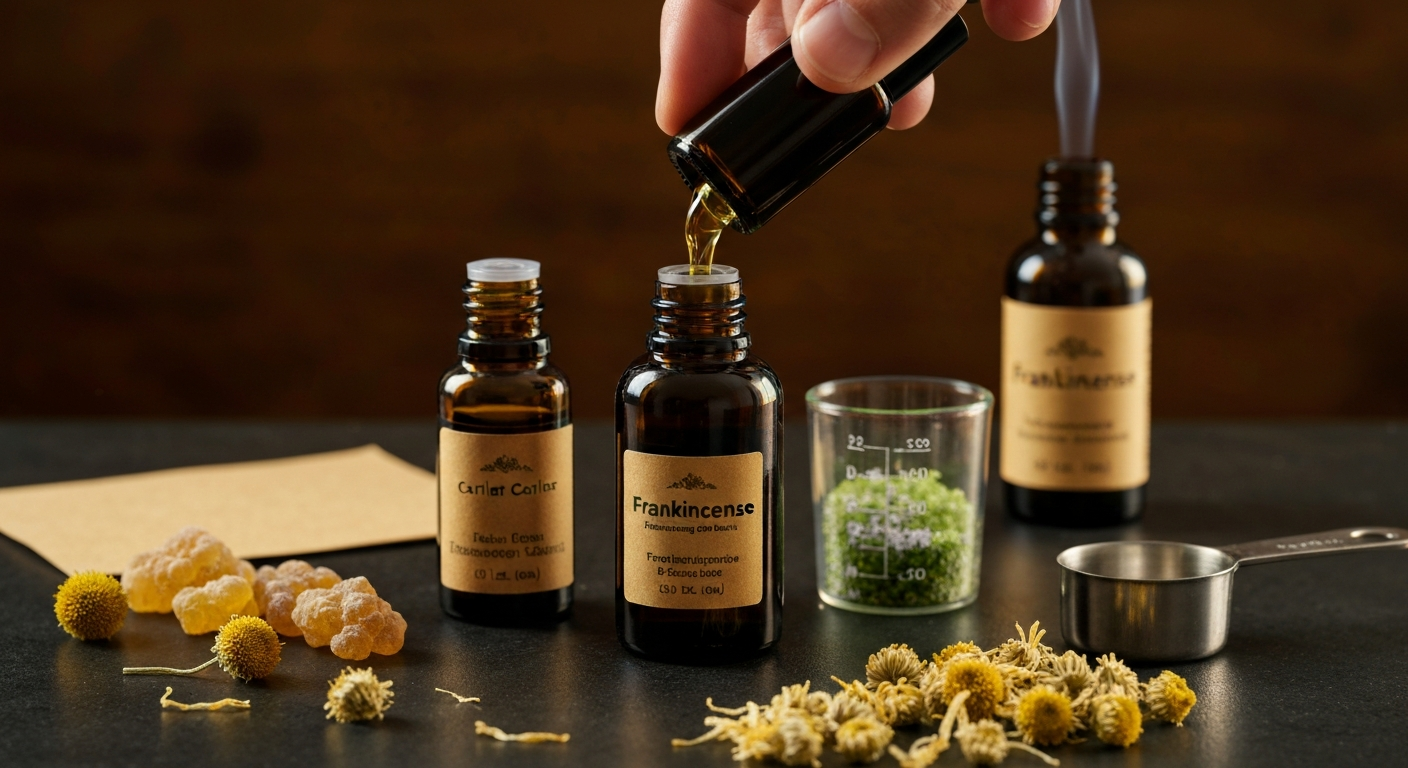
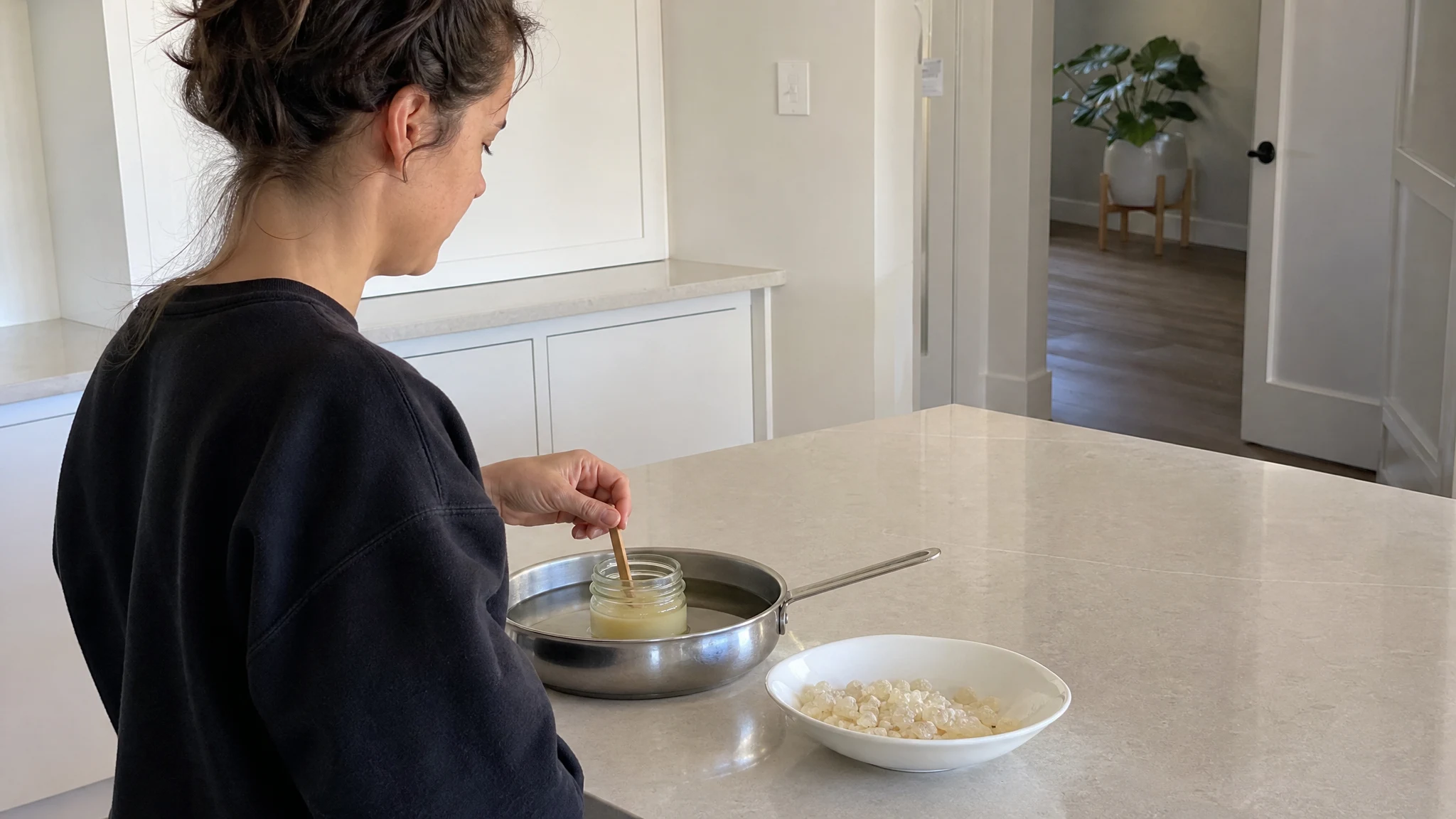
We sell the essential oil, so the carrier and wax come from elsewhere. Melt the wax into the carrier in a heatproof jar set in a pan of hot water, take it off the heat, let it cool until warm and still pourable, stir in the essential oil and pour into clean tins. Adding the oil late is reasoning from volatility, since aromatic oils evaporate faster from hot liquid, not a sourced rule.
What wax ratio gives a firm balm?
Deanna Talerico of Homestead and Chill gives wax-to-oil ratios by volume: 1 to 3 for a firm balm, 1 to 4 for a standard salve and 1 to 5 for a soft one. Our 20 g of wax against 79 g of oil sits close to 1 to 4, a standard texture. For a firmer balm, move to 25 g of wax and 74 g of oil. Wax and oil have similar densities, so converting a volume ratio to weight is a fair approximation, though it is our approximation. If your first tin sweats oil, remelt it with a little more wax; if it drags on the skin, add oil. The same guide warns that water or condensation spoils a balm, so keep the lid off while heating and dry every tool.
Why use 1% frankincense essential oil in balm?
The Tisserand Institute offers dilution ranges by use: 0.2% to 1% for sensitive or impaired skin, 0.5% to 1.2% for facial products, and 1% to 3% for body oils and lotions. These are general guides for essential oils as a group, not frankincense limits. We start at 1% because it sits at the low end of the body range and leaves room to adjust. If you prefer a stronger scent, 2% is still inside the body band, and anyone with reactive skin can go lower.
Drop counts are loose, as Tisserand notes, so weigh the oil. As a rough guide: the Certificate of Analysis we publish for one serrata batch gives a relative density of 0.838, so 1 g of that batch is about 1.2 ml, near 24 drops at the common 20 drops per ml convention. For the other five varieties, a scale reading to 0.1 g or better is the reliable way to measure.
The scale matters most in small batches. For a 50 g tin you need 39.5 g carrier, 10 g wax and 0.5 g oil, about 12 drops of the serrata batch. Add ten extra drops by accident and you have nearly doubled the dilution, to roughly 1.8%. That arithmetic is where many home batches end up stronger than planned.
Is frankincense balm a cosmetic or something else?
It is a scented, waxy skin product. As a cosmetic it makes skin feel soft and your hands smell like frankincense, and that is the job we would give it. The FDA's aromatherapy page explains that a product's regulatory status depends on its intended use, judged from labeling, websites and advertising, so if you ever plan to sell what you make, check your wording with a cosmetics-regulatory professional first.
The NCCIH says there is not enough evidence to show that topical boswellia is an effective treatment for conditions such as osteoarthritis or rheumatoid arthritis. The trials behind most headlines also used boswellia extract, not steam-distilled oil, and our post on frankincense and pain explains that difference. If something hurts, a physician or physical therapist is the right person to see, and a nice-smelling balm is not a stand-in.
Patch testing and skin cautions before applying balm
- Patch test. The American Academy of Dermatology suggests dabbing a small amount on the inner forearm twice a day for four to five days before using a new product elsewhere.
- Skin that is broken, sunburned or inflamed. Tisserand puts impaired skin in its lowest range, so we would leave the balm off it.
- Pregnancy, breastfeeding and children. General advice for these groups is more conservative than the adult figures here; our pregnancy and breastfeeding post is a starting point, and a physician, midwife or pediatrician has the final word.
- Past reactions to fragrance or essential oils. Skip this one.
Keep the tin away from eyes and out of reach of children.
Tins and labels for gifting homemade balm
A balm makes a tin you will want to look at, so choose a container you like. Small metal tins or little glass jars work well, and a handwritten label with the date makes it feel like yours. Let the tins cool undisturbed on the counter until they set, and resist the urge to move them while the surface is still soft.
Balm shelf life and choosing a frankincense variety
With no water in the formula it needs no preservative, but carrier oils can still go rancid, so make small batches, write the date on the tin and discard anything that smells off. Store it cool and dark, as in our storage post.
For aroma, we describe serrata as warm and slightly woody, frereana as bright and lemon-pine, and sacra as deep, balsamic and honeyed. Our carrier oil guide compares base oils, the dilution guide walks through more percentage sums, and the frankincense and myrrh salve takes a softer base.
Weigh everything, write the numbers down, and your second batch will be better than your first.
Frankincense Essential Oil
Serrata, carterii, sacra, frereana, neglecta and rivae: steam-distilled, GC/MS verified, in sizes from 0.5 oz to bulk.
From $12.99 $10.40 with code BLACKFRIDAY
Sources & Further Reading
- Homestead and Chill. How to Make Salve or Balms 101: Simple Flexible Recipe.
- Tisserand Institute. Dilution for essential oils.
- NCCIH. Boswellia: Usefulness and Safety.
- U.S. Food and Drug Administration. Aromatherapy.
- American Academy of Dermatology. Wrinkle remedies (advice on testing new products).