Baking Soda Free Frankincense Deodorant Balm Recipe
Many homemade deodorant recipes lean on baking soda, and plenty of people discover that their underarms disagree. This balm takes a gentler route: beeswax, shea butter, coconut oil and arrowroot, with a whisper of frankincense for a warm, resinous scent. The oil is there for its aroma, and it is a good reason to make the balm.

Frankincense Essential Oil
Six single-origin frankincense varieties, steam-distilled and GC/MS verified.
From $12.99 $10.40 with code BLACKFRIDAY
Deodorant versus antiperspirant and what balm does
The American Academy of Dermatology puts the distinction plainly: antiperspirants help reduce sweating, while deodorants do not, and deodorants are made to mask or stop body odor. A frankincense balm belongs to the deodorant family, so think of it as scent and a smooth glide. If you sweat heavily, a dermatologist can talk through antiperspirant options.
The odor itself is a product of skin bacteria. Researchers identified a bacterial enzyme in odor-forming staphylococci that cleaves odorless precursors in underarm secretions into the thioalcohols responsible for the pungent smell. That work was done on microbes and enzymes, and it is background for why a fragrance can only cover odor, not change where it comes from.
Who should skip a scented underarm balm?
- Reactive underarm skin or hidradenitis suppurativa. The AAD advises looking for products without alcohol, baking soda, parabens, dyes or fragrance. An essential oil is a fragrance, so for that skin we would leave it out and ask a dermatologist.
- Known fragrance allergy. Memorial Sloan Kettering lists case reports of allergic contact dermatitis after a boswellia oil and after a boswellia extract cream. Those are individual cases, but they are why a patch test belongs in every recipe.
Healthy skin and a fondness for the scent? Carry on.
Beeswax, shea and arrowroot balm formula by weight
| Ingredient | Grams per 100 g | Role |
|---|---|---|
| Beeswax | 18 | Sets the balm |
| Shea butter | 20 | Body and glide |
| Coconut oil, solid | 37.5 | Soft fraction that firms up when cool |
| Arrowroot starch | 24 | Dry, powdery feel |
| Frankincense essential oil | 0.5 | Fragrance, at 0.5% |
The wax-to-oil ratio follows Homestead and Chill's salve guide, which suggests 1 part wax to 3 parts oil for a firm balm and 1 to 4 for a standard salve, and notes that solid coconut oil adds firmness. Here 18 g of wax meets 57.5 g of butter and oil, about 1 to 3.2. That guide measures by volume, so treat our weights as a starting point and adjust after a first small batch. Beeswax, shea, coconut oil and arrowroot come from a cosmetic-ingredient or craft supplier; we sell only the essential oil.
Why use 0.5% frankincense essential oil in balm?
The Tisserand Institute lists 0.5% to 1.2% for facial cosmetics and deodorants, and 0.2% to 1% for sensitive or impaired skin. We start at the bottom of the deodorant range, so 100 g of balm holds 0.5 g of oil. As arithmetic only: the Certificate of Analysis we publish for one serrata batch lists a relative density of 0.838, which puts 0.5 g at about 0.6 ml, or roughly a dozen drops using the common 20 drops per ml convention. Tisserand points out that drop counts are approximate, so for the other five varieties, and really for any of them, weigh the oil on a gram scale.
For a 50 g tube, halve everything: 9 g beeswax, 10 g shea, 18.75 g coconut oil, 12 g arrowroot and 0.25 g oil. At that size a scale reading to 0.01 g is worth owning. If the scent seems faint, resist doubling the oil; the same Tisserand range tops out at 1.2%, so a small step up is the most it allows.
Melting wax and whisking arrowroot into balm
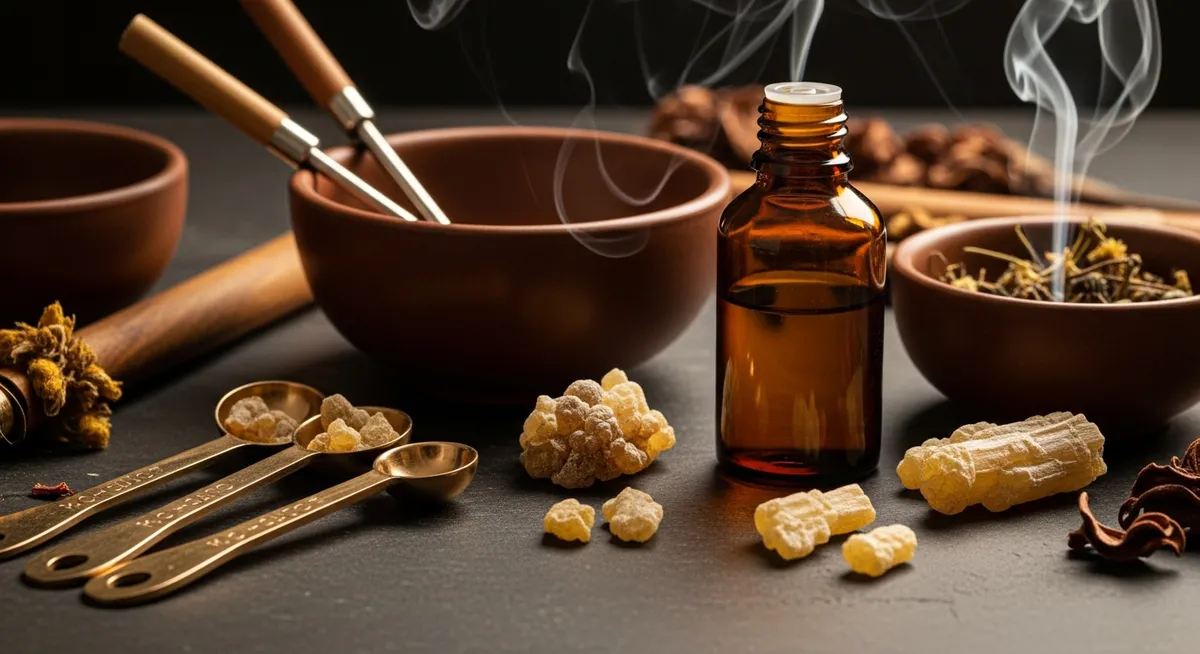
- Melt the beeswax, shea and coconut oil together in a heatproof bowl over simmering water, lid off, and keep condensation out of the bowl.
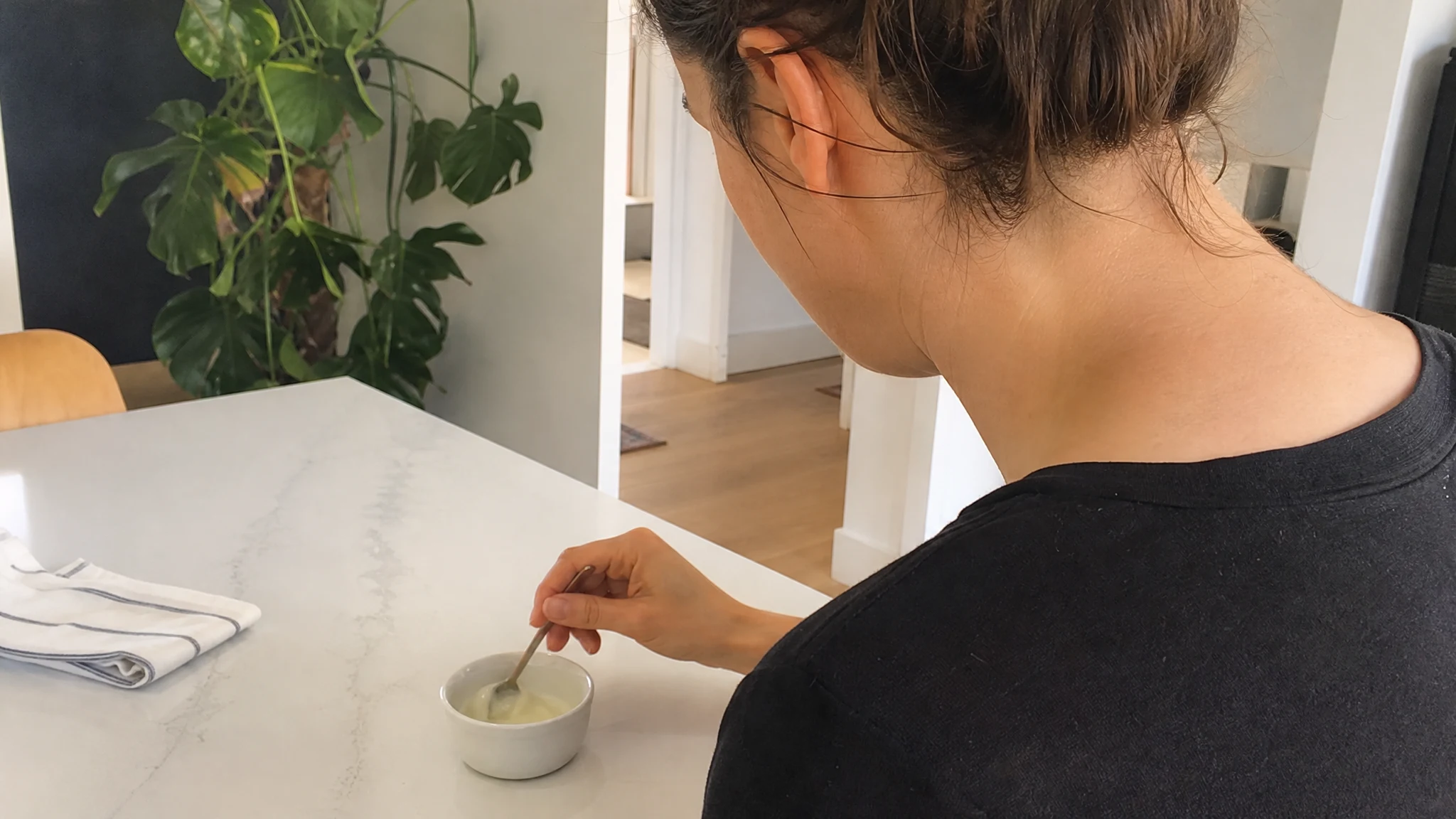
- Off the heat, whisk in the arrowroot until smooth.
- Let the mixture cool until it just starts to thicken, then stir in the essential oil. Adding it last keeps the aroma from sitting in hot liquid.
- Pour into a clean twist-up tube or small tin and let it set undisturbed.
Test a dab of the finished balm on your inner forearm first. The AAD suggests doing that twice a day for four to five days before using a new product elsewhere.
Frankincense essential oil scent choices and application
At 0.5%, the frankincense in this balm is a soft background note, not a perfume. Serrata, which we describe as warm and slightly woody with citrus and pine on top, is a friendly fit for the beeswax and shea; carterii leans warm and woody; neglecta is smoky and slightly fruity over a dry resinous base, so it gives the balm a very different personality. Open the bottles and smell them side by side before you choose.
When the balm is ready, a thin layer on clean, dry skin glides more evenly than a thick one, and a little goes a long way. Give it a minute before you dress so the balm can settle.
Does a water-free balm need preservatives?
With no water in the formula there is nothing to preserve, but the FDA still advises keeping cosmetics away from warm, damp storage and clean of dipping fingers. A tube or a small spatula is better than a jar, and a balm kept out of a steamy bathroom or hot bag will last better. Reasoning from the coconut oil content, a hot car will soften it, and a touch more beeswax stiffens it again. Make small batches.
If you notice stinging or redness, stop using it and see a dermatologist if it does not settle. For choosing a variety, go by aroma: we describe serrata as warm and slightly woody, sacra as deep, balsamic and honeyed, and frereana as bright, lemon-pine.
Our carrier oil guide helps with the base, the dilution guide shows the percentage sums, the salve post uses a similar water-free method, and storage advice keeps the oil in good shape.
Once you have a batch that glides well, the scent is the part that makes it yours.
Frankincense Essential Oil
Serrata, carterii, sacra, frereana, neglecta and rivae: steam-distilled, GC/MS verified, in sizes from 0.5 oz to bulk.
From $12.99 $10.40 with code BLACKFRIDAY
Sources & Further Reading
- American Academy of Dermatology. Hyperhidrosis: 6 tips dermatologists give their patients.
- American Academy of Dermatology. Hidradenitis suppurativa: Tips dermatologists give their patients.
- American Academy of Dermatology. Wrinkle remedies (advice on testing new products).
- Rudden M et al., 2020. The molecular basis of thioalcohol production in human body odour. Sci Rep.
- Memorial Sloan Kettering Cancer Center. Boswellia.
- Tisserand Institute. Dilution for essential oils.
- Homestead and Chill. How to Make Salve or Balms 101: Simple Flexible Recipe.
- U.S. Food and Drug Administration. Microbiological Safety and Cosmetics.