Somali Frankincense: Carterii, Frereana and the Harvest
Somali frankincense often arrives wrapped in superlatives: the finest, the oldest, the original. We would rather give you something more useful. The Somali region is home to two quite different frankincense species, we sell an oil of each, and the trees behind them are living through a stretch of real pressure. Knowing all three makes you a better buyer of Somali frankincense, from us or anyone else.

Frankincense Essential Oil
Six single-origin frankincense varieties, steam-distilled and GC/MS verified.
From $12.99 $10.40 with code BLACKFRIDAY
Carterii and frereana: two Somali Boswellia species
We list our carterii (Boswellia carterii) as coming from the Cal Madow mountains of Somalia. It is the classic of the range, the one we think of as church frankincense, and we describe the aroma as warm and woody, slightly citrusy, with that resinous depth people expect. Our frereana (Boswellia frereana) is listed as coming from the Maydi region of northern Somalia and sits in our rare tier. It smells like a different oil altogether: bright, fresh, lemon-pine.
The published chemistry backs up the idea that these are two different characters. A 2022 paper on frankincense authentication describes Boswellia carteri resins from Somaliland and Somalia as rich in alpha-pinene and limonene, and frereana from northern Somalia as rich in alpha-pinene, alpha-thujene and p-cymene. A 2016 survey of 46 mostly commercial samples found frereana's volatile profile distinct enough to tell it apart from sacra, serrata and papyrifera. Put plainly, "Somali frankincense" is a place, not a single scent.
How does Somali carterii compare with Omani sacra?
If you have read about Omani frankincense, you may wonder how Somali carterii compares with Dhofar's sacra. A 2012 study put them side by side. Somali carterii oils averaged 37.3% alpha-pinene against 68.2% for Omani and Yemeni sacra, and they pointed in opposite directions on optical rotation (-13.3 degrees against +30.1). The authors concluded the two are distinct species, even though major references of the time called them synonyms. That debate belongs to botanists, and it is why we list carterii and sacra as separate oils, each with its own aroma notes. Our piece on Omani names and grades covers the other side of the comparison.
Somaliland frankincense harvest under pressure
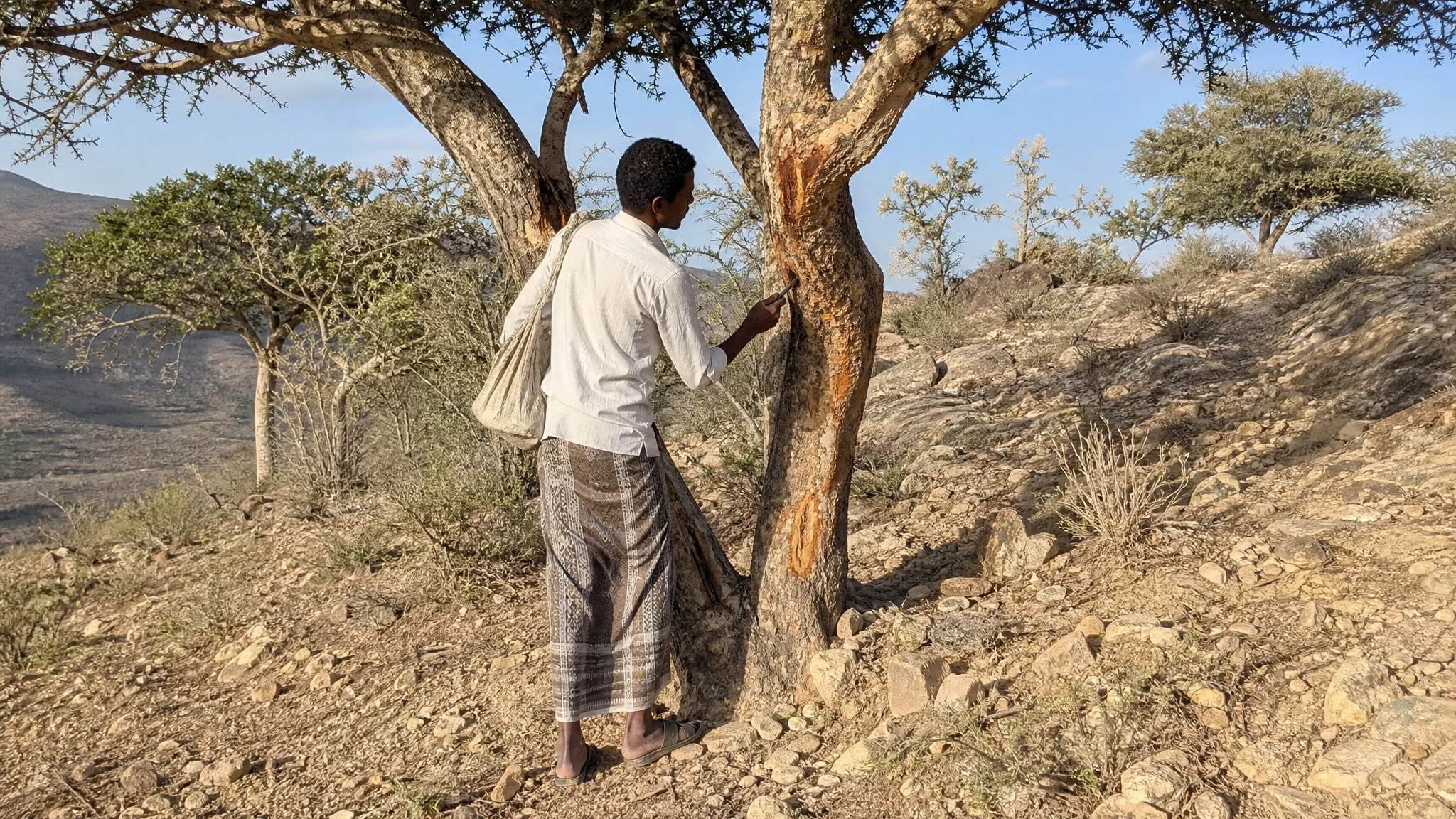
The most useful research on where Somali resin comes from is a 2020 field study in Somaliland. The authors combined interviews and observation in 2010 with a return visit in 2016 and 2017. Their central finding was significant overharvesting, driven by the breakdown of the traditional management system. Demand and resin prices rose dramatically over those years while tree populations were declining, the security of who could harvest which trees weakened, and the supply chain grew more complex. Those pressures together reward short-term tapping. The authors also point out that poor traceability means international buyers cannot see into the system well enough to reward good practice, and they are optimistic that new technologies will soon let buyers direct their purchasing toward sustainable harvests.
We take two things from that. A beautiful oil depends on a tree that needs time to recover, and the researchers also see a route in which buyers can help, with traceability as the lever. If sourcing matters to you, ask any seller what they can document, and ask us the same. You are welcome to write to us through the contact page with specific questions about a variety. For the wider picture across species, see our post on pressure on Boswellia trees.
It is easy to feel helpless reading about a strained harvest. A small thing any shopper can do is use an oil well: finish a bottle before opening another, store it carefully so none is wasted, and use a few drops where a few drops are enough.
Why chromatograms matter for Somali resin authenticity
High demand and a long supply chain create an opening for adulteration, which is why the authentication paper above exists. Its authors distilled oil themselves from Somaliland carterii resin and compared it with 21 oils bought online as Boswellia carteri. Six of the commercial oils had synthetic limonene, three had synthetic octyl acetate and three had castor oil, and a few were really other Boswellia species. They needed gas chromatography with a chiral column to catch some of it. That does not describe our oils, and it is not meant to. It is a reason to want a report for the exact variety and lot whenever you buy frankincense oil. The one Certificate of Analysis we publish is for a serrata batch, so for carterii or frereana, ask us in writing for what you need and get it in hand first. How to read a GC/MS report explains what you are looking at.
Smelling carterii and frereana together
If you can, smell them together. Carterii opens warm and woody with a slight citrus lift, the kind of scent that feels familiar even if you have never owned frankincense. Frereana is brighter and sharper, lemon-pine, and it can feel like opening a window. Taking them in turn, with a few minutes in between, is the simplest way to see why we count them as two oils and not one.
Carterii or frereana: which Somali oil to buy?
- Pick carterii if you want the traditional frankincense character, warm and woody with some citrus. We position it for meditative practice, classic incense pairings and room diffusion.
- Pick frereana if the bright, lemon-pine side of frankincense is what draws you. It is the lighter and fresher of the two, and the rarer.
Our species overview sets them next to the other four, and you can find carterii and frereana on their own pages. Either way, the best thing you can do with a superlative is to put a question mark after it and ask what stands behind it.
A small, honest wish: the next time someone hands you a superlative, smile, ask a question, and then enjoy the oil for what it is.
Frankincense Essential Oil
Serrata, carterii, sacra, frereana, neglecta and rivae: steam-distilled, GC/MS verified, in sizes from 0.5 oz to bulk.
From $12.99 $10.40 with code BLACKFRIDAY
Sources & Further Reading
- Ojha PK et al., 2022. Comparison of Volatile Constituents Present in Commercial and Lab-Distilled Frankincense (Boswellia carteri) Essential Oils for Authentication. Plants. PMC9415502
- Woolley CL et al., 2012. Chemical differentiation of Boswellia sacra and Boswellia carterii essential oils by gas chromatography and chiral gas chromatography-mass spectrometry. Journal of Chromatography A. PubMed 22835693
- DeCarlo A, Ali S, Ceroni M, 2020. Ecological and Economic Sustainability of Non-Timber Forest Products in Post-Conflict Recovery: A Case Study of the Frankincense (Boswellia spp.) Resin Harvesting in Somaliland (Somalia). Sustainability. mdpi.com/2071-1050/12/9/3578
- Niebler J, Buettner A, 2016. Frankincense Revisited, Part I: Comparative Analysis of Volatiles in Commercially Relevant Boswellia Species. Chemistry and Biodiversity. PubMed 27012219