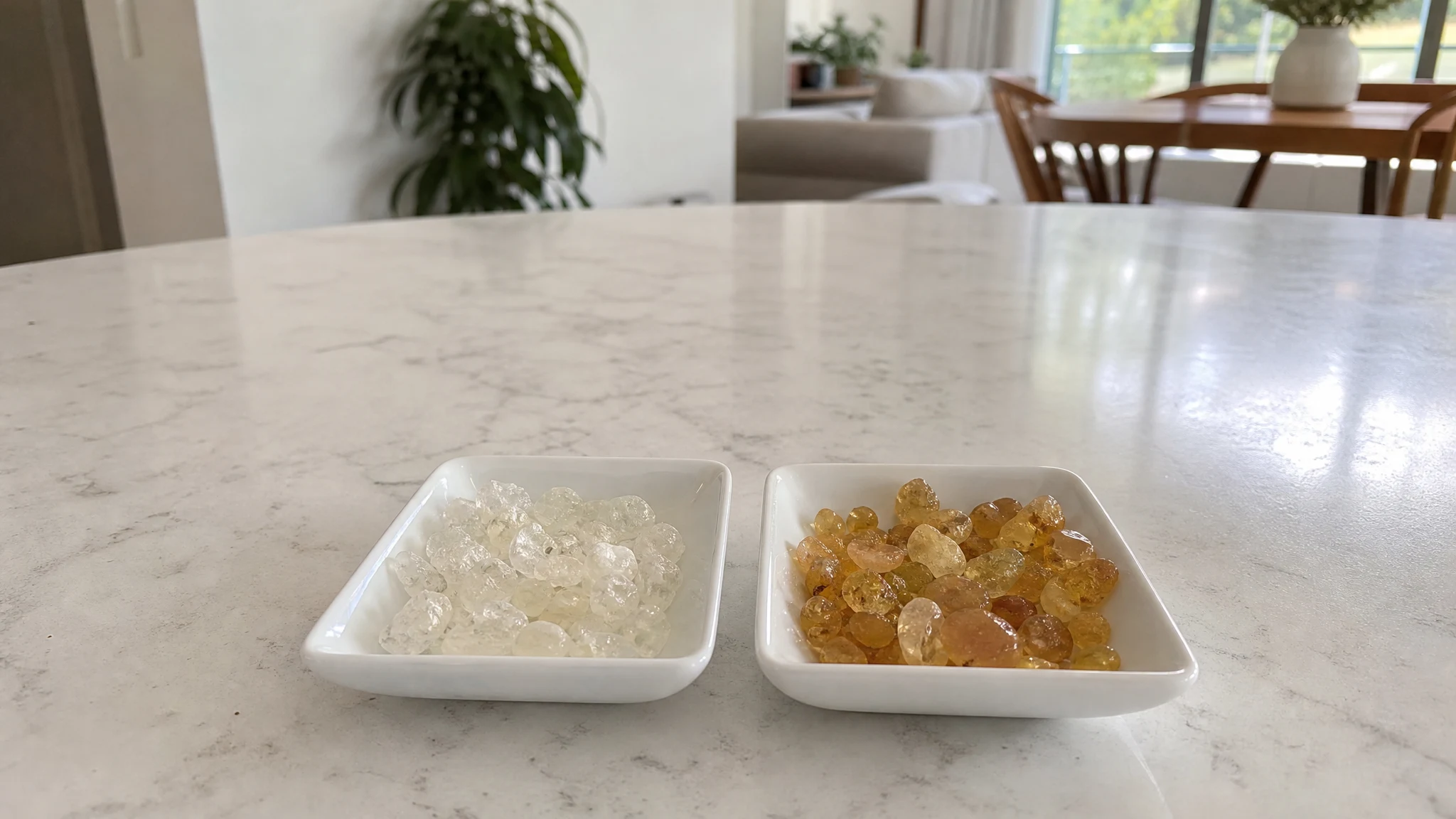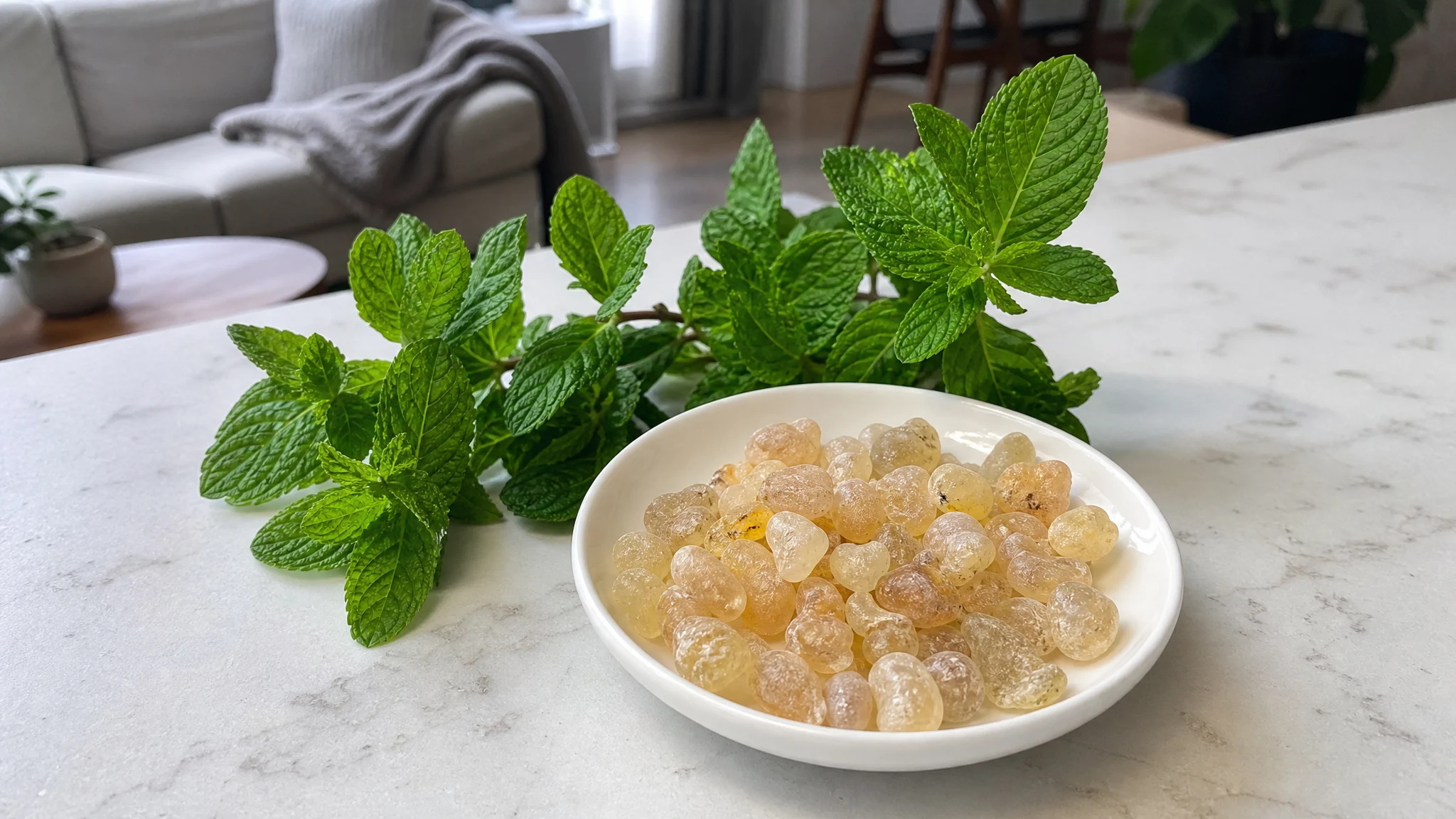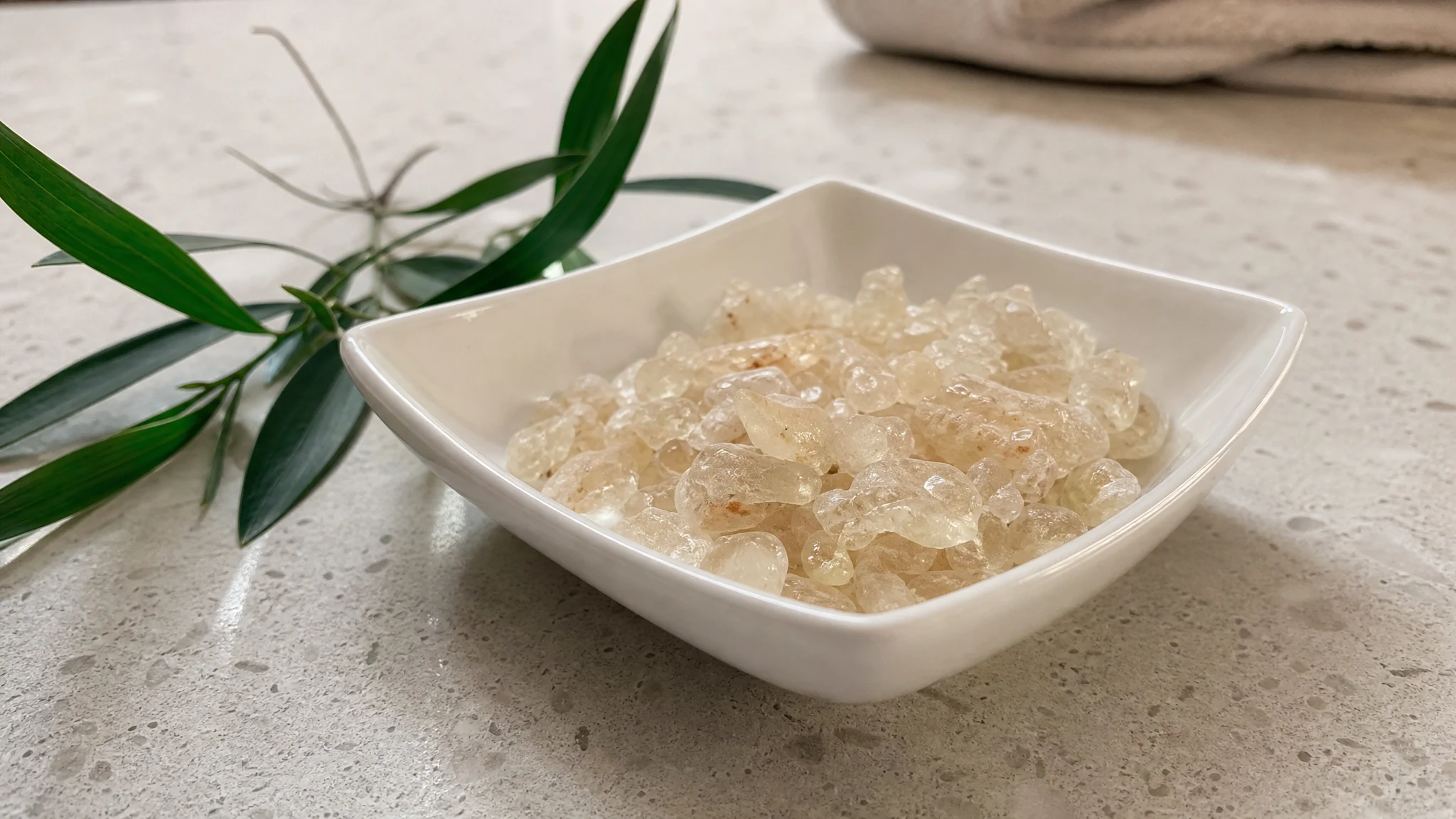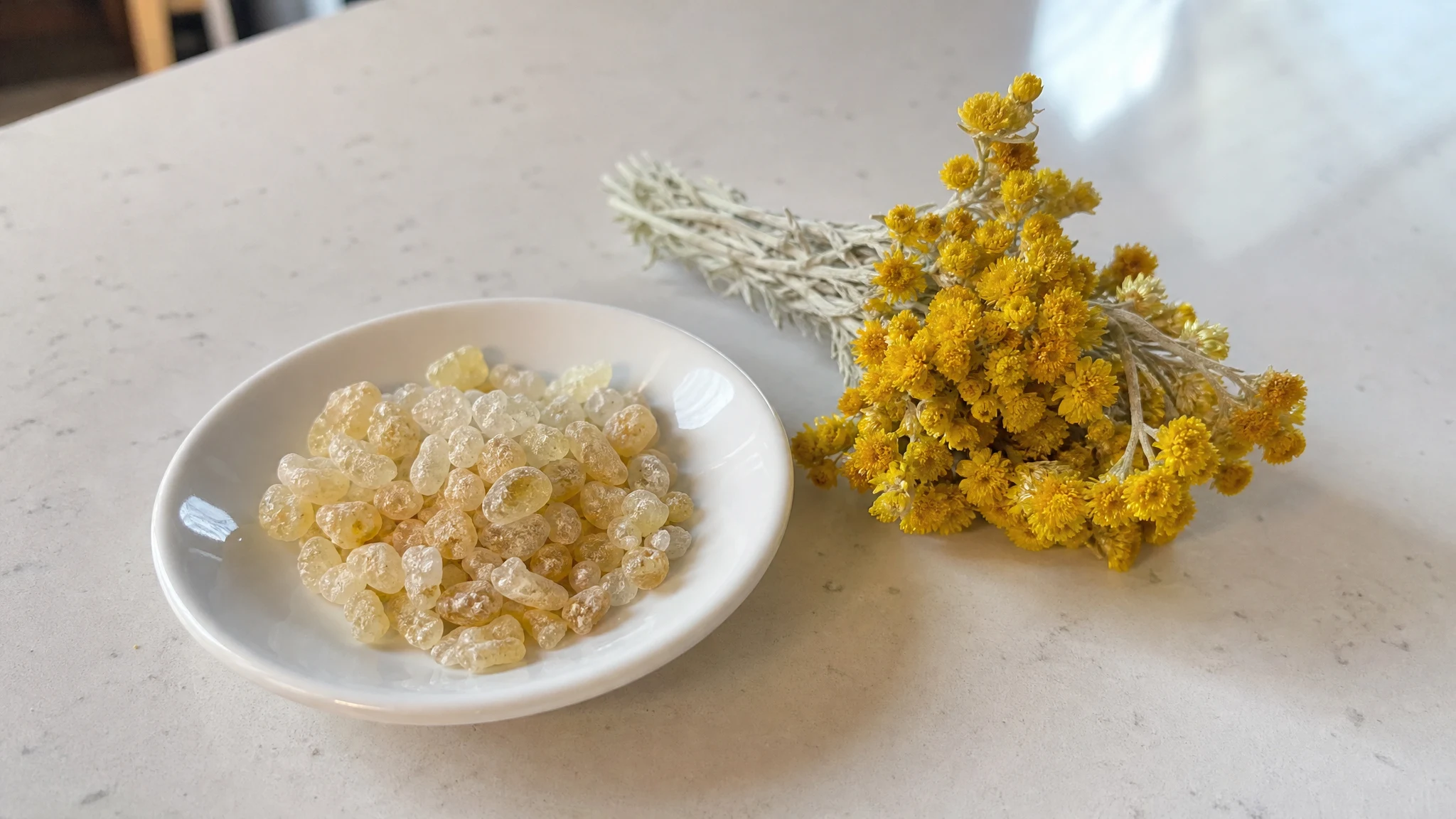
Helichrysum vs Frankincense: Reputation and Research
Helichrysum, also sold as immortelle or everlasting, arrives with a bigger skin-care reputation than almost any oil on the shelf. Frankincense has a famous name of its own. Put them next to each other and the interesting question is not which one wins, but what each reputation is actually built on.

Frankincense Essential Oil
Six single-origin frankincense varieties, steam-distilled and GC/MS verified.
From $12.99 $10.40 with code BLACKFRIDAY
Helichrysum hydrolate research and its early limits
The studies people point to are real, and they are also early. One 2024 study exposed scratched layers of skin stem cells and fibroblasts to helichrysum hydrolate, the water left over from distillation, in a bioreactor. The hydrolate is a by-product rather than the oil, and the cells produced more collagen. The authors describe the potential as translational, which means it has yet to be shown in people.
A 2021 study used the oil itself. Researchers put 0.5% helichrysum essential oil in an ointment or gel and applied it to full-thickness wounds in 48 diabetic rats. The treated wounds were significantly smaller and carried more hydroxyproline, a collagen marker. It is a careful piece of work, and it is also a rat wound with a formulation base, which is a long way from a person's skin routine. In both cases the honest reading is that helichrysum is an interesting plant for researchers, not that a bottle on your shelf will do any particular thing.
Does frankincense share helichrysum's evidence gap?
Frankincense's reputation comes mostly from boswellic acids, which sit in the resin and are not found in oil made by normal distillation, according to the Tisserand Institute. The National Center for Complementary and Integrative Health says most boswellia studies are small and of low quality, that there is not enough evidence to show that topical boswellia is an effective treatment, and that frankincense may be safe to use topically or for aromatherapy. So in both cases the research is about something other than the diluted oil you would actually use. We explain the resin-versus-oil split in our boswellic acids explainer.
That is why we keep our own claims to aroma. We describe our serrata as warm and slightly woody with subtle citrus and pine top notes, our sacra as deep, balsamic and honeyed, and our carterii as warm and woody with classic resinous depth. The FDA is clear that a product marketed for a therapeutic purpose is a drug, whatever plant it comes from. For the skin side of the frankincense conversation, our skin article sets out what exists.
Monoterpene chemistry of frankincense versus helichrysum
The two oils are unrelated. Steam-distilled frankincense is led by monoterpenes, alpha-pinene above all, which is why it smells resinous and bright. In one analysis of commercial carterii oils, alpha-pinene was the main component of most samples, at roughly a quarter to nearly half of the oil, although the authors also found many of those commercial oils were adulterated or contaminated. That finding is why we encourage anyone to ask for documentation for the exact oil they are buying, from us or from anyone. Our GC/MS guide explains what to look for.
Does a famous oil name beat the actual scent?
A famous name can make an oil feel special before you have even opened it. That is part of the fun, and we feel it too. It is worth giving the actual oil a fair hearing, though. Open the bottle, take a slow sniff, and ask yourself whether you would want this scent even if nobody had ever written about it.
When you read something that leans on a single study, ask whose skin it was, what form of the plant was used and whether it was a person, a rat or a dish of cells. Those three questions clear up a lot of excitement. They do not make a plant less interesting, they just keep the story honest.
Then do the plain things. Check the label for the Latin name, keep a note of what you bought, and add one new oil at a time, so you can tell which one you are enjoying.
Skin dilution ranges for essential oils generally
Oils for skin need a carrier. We sell our oils neat, so the dilution is yours to set, and the Tisserand Institute's ranges are a good guide: 0.2% to 1% for sensitive or reactive skin, 0.5% to 1.2% for the face, and 1% to 3% for body oils. Its dilution page also describes reports of reactions to helichrysum and frankincense oils on skin, which is a good argument for diluting both and for a patch test first. Poison Control adds that essential oils should not be used on damaged skin.
If you are looking to change something on your skin that bothers you, a dermatologist can tell you what has evidence behind it. Neither of these oils replaces that conversation. If what you want is a beautiful scent in a routine you already enjoy, then choosing between them comes down to taste. Helichrysum has its devotees. Frankincense is the one we know and sell, and our species overview will help you pick which of the six to try.
If you are collecting oils, a small notebook beside the shelf is worth more than it sounds. A line for each bottle, covering the name, the date you opened it and what you thought, turns a pile of bottles into something you actually know.
A reputation can be a lovely reason to try an oil, as long as we remember it is a reputation. The aroma, thankfully, is something you can judge for yourself.
Frankincense Essential Oil
Serrata, carterii, sacra, frereana, neglecta and rivae: steam-distilled, GC/MS verified, in sizes from 0.5 oz to bulk.
From $12.99 $10.40 with code BLACKFRIDAY
Sources & Further Reading
- Serra D et al. Effect of Helichrysum italicum in Promoting Collagen Deposition and Skin Regeneration in a New Dynamic Model of Skin Wound Healing. Int J Mol Sci, 2024.
- Andjić M et al. Formulation and Evaluation of Helichrysum italicum Essential Oil-Based Topical Formulations for Wound Healing in Diabetic Rats. Pharmaceuticals (Basel), 2021.
- Tisserand Institute. Does Frankincense oil contain boswellic acid?
- NCCIH. Boswellia: Usefulness and Safety.
- FDA. Aromatherapy.
- Ojha PK et al. Comparison of Volatile Constituents Present in Commercial and Lab-Distilled Frankincense (Boswellia carteri) Essential Oils for Authentication. Plants (Basel), 2022.
- Tisserand Institute. Dilution for essential oils.
- Poison Control. Essential oils: Poisonous when misused.