Peppermint vs Frankincense Oil: Who Has Been Tested?
"Which works faster" is a fair question to ask on a bad head day, but it assumes somebody has timed the two oils against each other. Nobody has. What exists is a body of research on one specific peppermint preparation, a single tiny report on a swallowed Boswellia extract, and nothing at all on frankincense oil. We sell frankincense essential oil for its aroma, so here is an honest map of who has been tested for what.

Frankincense Essential Oil
Six single-origin frankincense varieties, steam-distilled and GC/MS verified.
From $12.99 $10.40 with code BLACKFRIDAY
Headache red flags that need emergency care
The NHS says to call 999 or go to A&E for a headache that comes with a seizure, numbness or weakness in the body or face, a sudden and extremely painful onset, a head injury in the last three months, trouble speaking, balancing or remembering, drowsiness or confusion, loss of vision, a rash that does not fade, or a very high temperature with a stiff neck. It asks for an urgent GP appointment or a call to 111 when a headache brings eye problems, is set off by coughing or bending, comes with vomiting, or arrives with jaw pain when eating or a tender scalp. Its own self-care advice is simple: water, rest, relaxing, and paracetamol or ibuprofen. If your headache looks like any of those lists, that is where to turn, whatever is in your cabinet.
Topical peppermint oil trials in tension headache
Peppermint's reputation rests on a particular product. A review in the German journal Schmerz (Göbel and colleagues, 2016) concluded that topical peppermint oil beat placebo in controlled studies of tension-type headache, the common kind, and that its efficacy was comparable to aspirin or paracetamol. The same abstract notes that a 10% solution of peppermint oil in ethanol is licensed for tension-type headache in adults and in children over 6. Read that carefully: the studied product is a measured ethanol solution on the forehead, not a diffuser and not a few drops of oil, and the evidence concerns tension-type headache, not migraine.
An older crossover trial (Göbel, Schmidt and Soyka, 1994) is often quoted next to it. It used healthy volunteers and an experimental pain model, so it tells us about how a preparation affected induced sensitivity, not about people with headaches. If peppermint is on your mind, a pharmacist can talk you through the licensed product and its age limits. We do not sell peppermint oil.
Boswellia serrata cluster headache case series
The one headache report we found that involves Boswellia is a 2012 case series of four people with chronic cluster headache who took an oral Boswellia serrata extract. The authors themselves label the finding Class IV evidence, the lowest tier. Four people, no control group, a swallowed extract, and a different headache type altogether. It says nothing about a steam-distilled oil you smell. The reason is chemistry: the boswellic acids behind most Boswellia research are non-volatile, and the Tisserand Institute notes there is no reliable report of them in frankincense oil made by normal distillation. Our post on boswellic acids explains the resin-versus-oil gap, and our headaches post goes further into the question.
How do peppermint and serrata smell different?
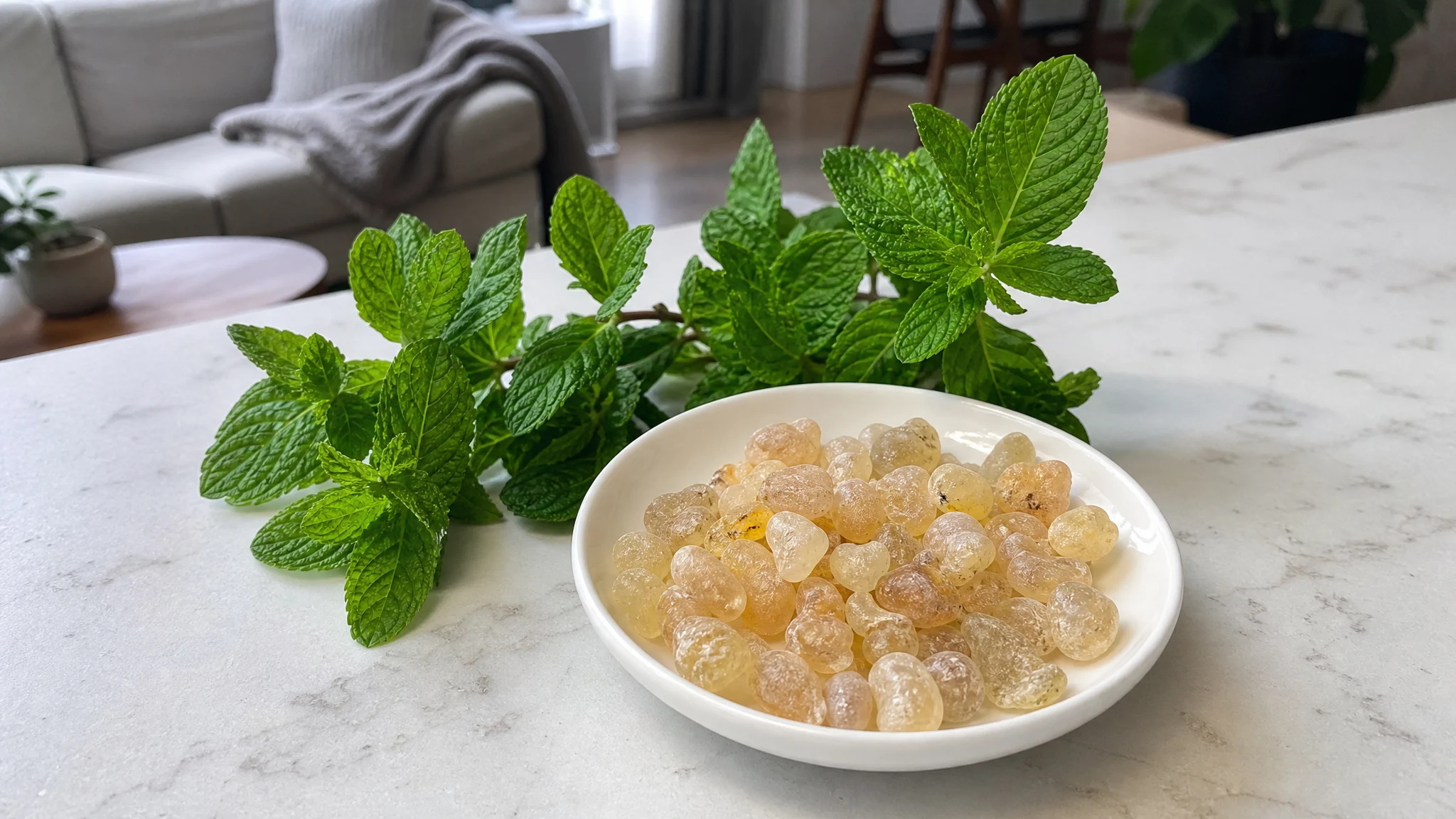
Open a bottle of peppermint and the scent arrives all at once, sharp and cool. Open our serrata and it takes its time: warm and slightly woody first, with subtle citrus and pine on top. Neither is better, they are simply different characters, and that is a matter of taste rather than anything we could measure or promise.
What is frankincense oil good for instead?
Scent. Our serrata oil has a warm, slightly woody aroma with subtle citrus and pine top notes, our sacra is deep, balsamic and honeyed, and our frereana is bright and lemon-pine. Choosing among them is a pleasure of the nose, and nothing in the research above lets us promise more than that. One practical note, which is reasoning rather than a study result: if strong smells are a nuisance when you are unwell, skip diffusing anything near you, peppermint and frankincense alike.
If you do enjoy an oil for its aroma, a few habits make it nicer. Smell it from a little way off the bottle neck rather than pressing it under your nose, keep sessions short, and give your nose a rest between oils. A strong scent that is lovely for ten minutes can turn wearing by the hour, and you are always allowed to put the cap back on.
As with any essential oil, dilute before skin use (the Tisserand Institute's general bands are 0.2 to 1% for sensitive skin and 0.5 to 1.2% for the face; see our dilution guide), patch test first, keep oils away from eyes, and ask a healthcare provider before use if you are pregnant, nursing, on medication or managing a condition. If headaches are frequent, a GP is the right next stop, and our anxiety and sleep post shows how thin the evidence is for oils in related territory.
If you are curious, start small
For anyone new to essential oils, we would suggest starting with one bottle, learning how it smells at different times of day, and getting to know your own reactions before adding another. It is tempting to collect, and a shelf of unfamiliar bottles is harder to keep fresh and harder to use well. One oil you know well beats six you have only sniffed once.
It is natural to want a winner in a comparison like this. We would encourage you to enjoy it as a nose game instead: two bottles, a few minutes, and an honest opinion of your own.
The short version is that peppermint has trials for one preparation and one headache type, frankincense oil has none, and no one has raced them. Enjoy each for what it is, and leave the headaches that worry you to someone qualified to examine you.
Frankincense Essential Oil
Serrata, carterii, sacra, frereana, neglecta and rivae: steam-distilled, GC/MS verified, in sizes from 0.5 oz to bulk.
From $12.99 $10.40 with code BLACKFRIDAY
Sources & Further Reading
- Headaches - NHS
- Peppermint oil in the acute treatment of tension-type headache (Göbel et al., Schmerz, 2016, PubMed)
- Effect of peppermint and eucalyptus oil preparations on neurophysiological and experimental algesimetric headache parameters (Göbel, Schmidt and Soyka, Cephalalgia, 1994, PubMed)
- Long-term efficacy of Boswellia serrata in four patients with chronic cluster headache (Lampl, Haider and Schweiger, Cephalalgia, 2012, PubMed)
- Does Frankincense oil contain boswellic acid? (Tisserand Institute)
- Dilution for essential oils (Tisserand Institute)