Facial Skin and Frankincense: What the Study Really Tested
Search for frankincense and facial skin and you will find one study quoted again and again. It is a good study, and it is also about something other than the essential oil in a bottle. Knowing what it actually tested makes you a sharper reader of every frankincense skincare claim, including ones on retail pages.

Frankincense Essential Oil
Six single-origin frankincense varieties, steam-distilled and GC/MS verified.
From $12.99 $10.40 with code BLACKFRIDAY
Pedretti 2010 split-face trial design
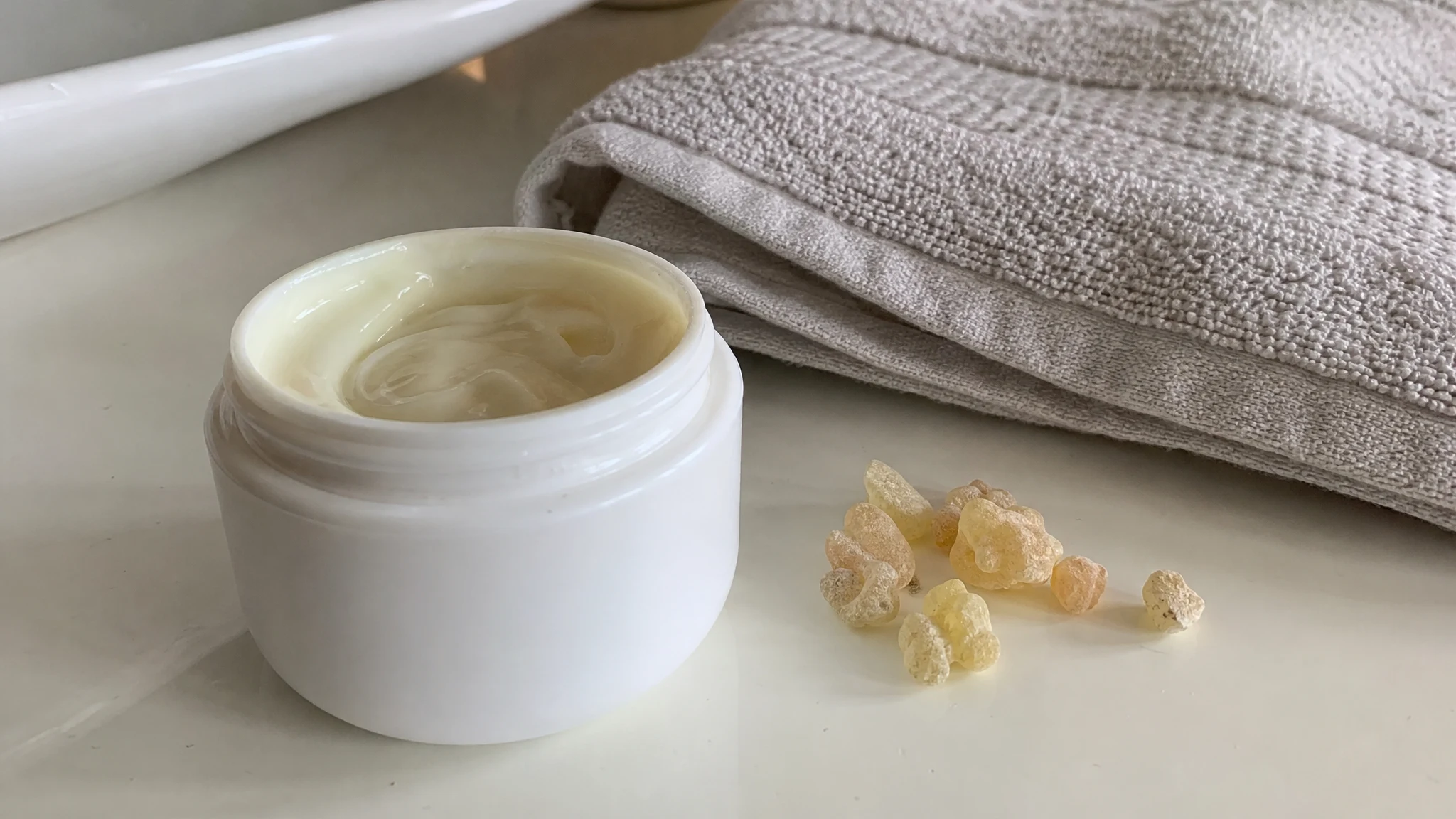
The study is Pedretti and colleagues, published in Planta Medica in 2010. It was a randomized, double-blind, split-face trial: 15 women applied a base cream with 0.5% boswellic acids to one side of the face and the same cream without them to the other, once daily for 30 days. The treated side showed a significant improvement in tactile roughness and fine lines, along with changes in elasticity and sebum measurements, and the cream was well tolerated. The authors concluded that topical boswellic acids may be a suitable option for selected features of photoaging.
That is a pleasing result, and the design is clever, since using the same cream on both halves of the face controls for the base itself. It is also small, short and a single group, which makes it a reason for a bigger trial rather than a promise from a bottle.
Are boswellic acids present in frankincense oil?
Boswellic acids are heavy, non-volatile molecules found in the resin and in resin extracts. The Tisserand Institute reports that there is no reliable report of boswellic acids in any frankincense oil made with normal distillation parameters, while extracts are sold with up to 60% of them. Reasoning from that, a cream built on boswellic acids and a steam-distilled essential oil are different materials, and the cream's result is not evidence for the oil. Our boswellic acids post goes deeper into the resin chemistry.
The NCCIH says much the same in broader terms: for topical use, there is not enough evidence to show that boswellia is an effective treatment. We found no human trial of frankincense essential oil on facial skin, which is a limit on what we can cite rather than a ruling that none exists.
What does a dermatologist suggest before facial oils?
The American Academy of Dermatology's advice on facial skin is refreshingly plain. Wear a broad-spectrum sun protection product every day on exposed skin. Give a moisturizer time, since most products take at least six weeks to work and sometimes up to three months, though a moisturizer can plump up fine lines straight away. Test new products before using them on the face, and see a board-certified dermatologist if you are not getting the results you hoped for. We sell an essential oil, and an oil is a complement to that routine, not a substitute for it.
Frankincense facial oil for scent and ritual
We want to be clear that wanting a scented facial oil is nothing to apologize for. Plenty of people enjoy the little ritual of a few drops pressed into the skin at the end of the day, and the aroma is a large part of the pleasure. The aim here is only to keep that pleasure well informed.
That is a reasonable choice if you enjoy the scent, and these points keep it pleasant:
- Dilute it. The Tisserand Institute's general ranges put facial products at 0.5% to 1.2% and reaction-prone or impaired skin at 0.2% to 1%, and it describes undiluted use as neither sensible nor necessary. These are guides for essential oils as a group. As arithmetic only: 1% in a 30 ml bottle of carrier oil is 0.3 ml, which is about six drops at the rough convention of 20 drops per ml. Our dilution post shows the sums.
- Patch test. The AAD suggests dabbing a small amount on your inner forearm twice a day for four to five days, and stopping if anything stings or burns.
- Use a fresh bottle. A 2021 review in Contact Dermatitis found that monoterpene hydroperoxides, formed when terpenes oxidize in air, are a common cause of contact allergy. It is about terpenes in general, so applying it to frankincense is our reasoning, but it is why we favor a bottle that has not been open for years. See our storage post.
- Introduce one new thing at a time. The AAD notes that using several products at once tends to irritate skin, so give the oil its own week.
For step-by-step technique, see how to apply frankincense oil to your face. Our skin guide covers the wider picture, and frankincense versus rosehip oil compares it with a familiar carrier oil.
A gentle first week
If you decide to go ahead, give yourself an unhurried start. Make a small blend, label the jar with the date and the strength, and keep it somewhere cool and dark. Use it first on a spot away from your eyes and mouth, such as along the jaw, and leave the rest of your routine alone while you see how things go. Pay attention to how your skin looks and feels in the morning, in daylight, and not just in the bathroom mirror at night. If your skin is happy after a few days, you can think about using it more widely. If it is not, that is useful information too, and the oil goes back on the shelf as an aroma.
Resist the urge to add a second new product the same week. When something does irritate, you want to know exactly which thing it was.
Choosing carterii, sacra or frereana for aroma
For a facial blend, we would choose on aroma. We describe carterii as warm, woody and slightly citrusy, sacra as deep, balsamic and honeyed, and frereana as bright and lemon-pine. The one Certificate of Analysis we publish is for a serrata batch and lists density, refractive index and optical rotation, with no compound data. If you want a lot-specific GC/MS report before you buy, ask us in writing through the contact page.
Frankincense makes a lovely, aromatic addition to a routine built on daily sun protection and a moisturizer you like, and that is the role we would give it.
A scented oil that fits into a simple, sensible routine is a small luxury worth having, and it asks very little of you beyond a little patience.
Frankincense Essential Oil
Serrata, carterii, sacra, frereana, neglecta and rivae: steam-distilled, GC/MS verified, in sizes from 0.5 oz to bulk.
From $12.99 $10.40 with code BLACKFRIDAY
Sources & Further Reading
- Pedretti A et al., 2010. Effects of topical boswellic acid on photo and age-damaged skin: clinical, biophysical, and echographic evaluations in a double-blind, randomized, split-face study. Planta Med.
- Tisserand Institute. Does Frankincense oil contain boswellic acid?
- NCCIH. Boswellia: Usefulness and Safety.
- American Academy of Dermatology. Wrinkle remedies.
- Tisserand Institute. Dilution for essential oils.
- Karlberg AT, Lepoittevin JP, 2021. One hundred years of allergic contact dermatitis due to oxidized terpenes: What we can learn from old research on turpentine allergy. Contact Dermatitis.