Frankincense Oil in Summer: Storage, Diffusing, Blends
Picture a bottle of frankincense oil on a warm windowsill in July, or riding in a beach bag, or rattling around a parked car. Summer changes how we scent our homes, and it changes the way an oil should be kept, diffused and blended. Frankincense itself is one of the easy members of a summer blend. The things around it are where a little knowledge pays off.

Frankincense Essential Oil
Six single-origin frankincense varieties, steam-distilled and GC/MS verified.
From $12.99 $10.40 with code BLACKFRIDAY
Keeping frankincense oil cool in summer heat
Essential oils are mostly terpenes, and terpenes react with oxygen. A 2021 review of contact allergy traced a century of patch-test work on oxidised terpenes and concluded that monoterpene hydroperoxides, which form when terpenes oxidise in air, are a common cause of contact allergy in the population. That research looked at turpentine and other terpene sources rather than frankincense, so what follows is our reasoning: frankincense oils are rich in monoterpenes, warmth is the last thing an opened bottle needs, and a bottle that spent a summer in a hot car is one to replace rather than put on your skin.
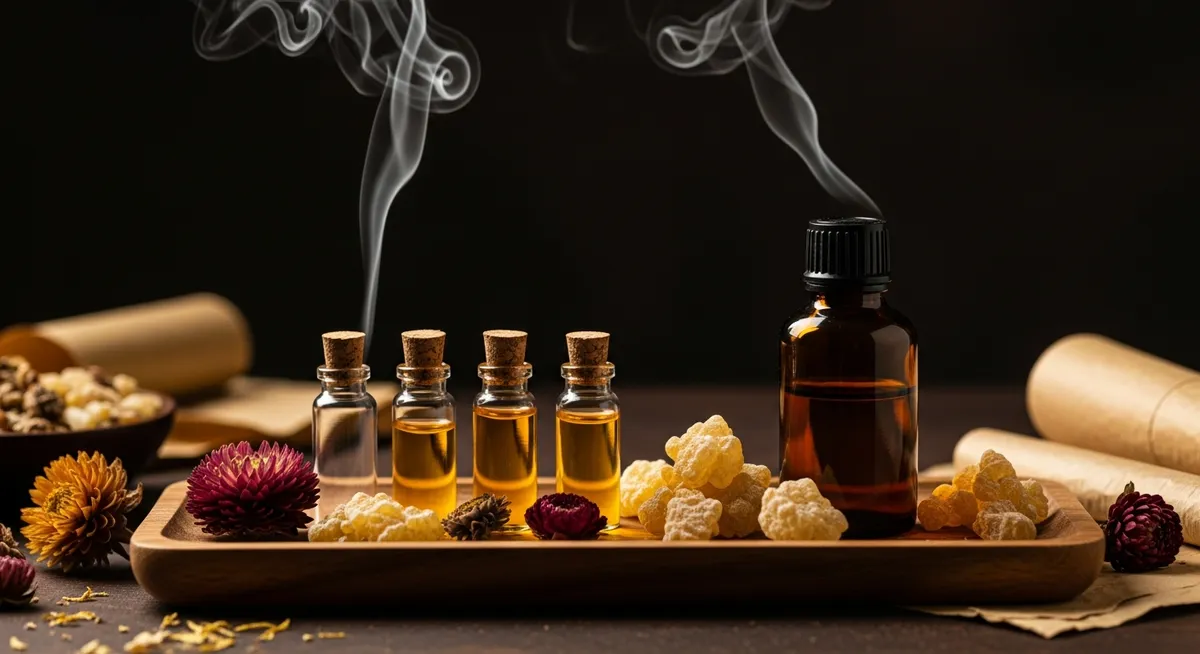
The easy habit is a cupboard or drawer, cap tightened, out of the light and away from sun-baked windowsills. Our amber glass bottles help with light, and the rest is up to where you put them. There is more in how to store frankincense oil.
Which diffuser suits a warm closed room?
Warm weather often means a closed bedroom with the air conditioning on, which is exactly when diffuser type starts to matter. In a 2025 pilot study of tea tree oil in a household setting, researchers compared an ultrasonic diffuser with a heat diffuser. Terpene concentrations from the heat diffuser were generally about ten times higher than from the ultrasonic one, and alpha-pinene exceeded the European long-term exposure limit in the heat case. That was tea tree oil and a small simulation, not frankincense. But frankincense oils are alpha-pinene-rich in the published analyses (averages of 68.2% for sacra and 37.3% for carterii in one study), so it is reasonable to prefer ultrasonic over heat for long sessions. Our diffuser guide compares the types.
The Tisserand Institute's safety guidelines suggest diffusing for 30 to 60 minutes on and 30 to 60 minutes off, and letting some fresh air in whenever you diffuse. Your diffuser's manual sets how many drops go in the water, and we would follow it.
Why check the label on citrus companions?
A summer frankincense blend almost always wants something bright beside it, and that is where a label deserves a second look. The FDA notes that certain citrus oils used safely in food can be harmful in cosmetics, particularly on skin exposed to the sun. Tisserand explains the mechanism: furanocoumarins such as bergapten are responsible for the phototoxicity of some expressed citrus oils, and in one comparison a distilled lemon oil carried 22 times less bergapten than an expressed lemon oil and was not phototoxic. The practical lesson is to read the label of whatever citrus oil you add. For a room diffuser the point barely matters. For anything that goes on skin, keep an expressed citrus out of the blend before you head outdoors, and remember we sell frankincense only, so citrus oils come from elsewhere.
Carrying a small bottle on day trips
If you want a bottle with you on a day trip, keep it small and keep it out of the sun. A zip bag with the cap tightened and the bottle standing upright protects the rest of your bag from leaks, and an inside pocket is a better spot than the top of a sunny dashboard. When you get home, put it straight back in its cupboard.
Warm air also carries scent more readily, so you will often need less in July than you did in January. A room that smells lightly of frankincense when you walk in is nicer than one where you can taste it. If you start small and add only when you cannot smell it, you will rarely overshoot.
Summer aroma pairings with frankincense blends
These are suggestions built from how we describe each oil, with the proportion given as a starting point, not a tested recipe:
- Light and lemony: our frereana is bright, fresh and lemon-pine, so a diffuser blend of about three parts frereana to one part distilled citrus oil only leans into what it already does.
- Warm and woody: carterii is warm and woody with a little citrus, and it sits comfortably with a conifer oil in roughly two parts to one for an evening on the patio.
- Smoky: neglecta is smoky and slightly fruity over a dry resinous base, which suits a late summer evening with the windows open.
For a longer map of what blends with what, see the blends guide.
Patch testing and sun-exposed summer skin
Our disclaimer asks for a patch test before topical use, to keep essential oils away from eyes and mucous membranes and out of children's reach, and to check with a healthcare provider first if you are pregnant, nursing, on medication or have a medical condition. Our own suggestion for summer is to use a diluted oil on intact skin only, and to leave burned or irritated skin alone. For anything about sunburn, a dermatologist or pharmacist is the right person, since we sell an aroma and cosmetic oil and make no claims about skin recovery.
Keep it simple: cool bottle, ultrasonic diffuser, a label check on the citrus. The scent does the rest, and frankincense is a lovely thing to have drifting through a warm room.
Frankincense Essential Oil
Serrata, carterii, sacra, frereana, neglecta and rivae: steam-distilled, GC/MS verified, in sizes from 0.5 oz to bulk.
From $12.99 $10.40 with code BLACKFRIDAY
Sources & Further Reading
- Karlberg AT, Lepoittevin JP, 2021. One hundred years of allergic contact dermatitis due to oxidized terpenes: What we can learn from old research on turpentine allergy. Contact Dermatitis. PubMed 34453446
- Zisook RE et al., 2025. Volatile organic compound and particle emissions from the use of tea tree oil in essential oil diffusers. Journal of Occupational and Environmental Hygiene. PubMed 41004428
- Woolley CL et al., 2012. Chemical differentiation of Boswellia sacra and Boswellia carterii essential oils by gas chromatography and chiral gas chromatography-mass spectrometry. Journal of Chromatography A. PubMed 22835693
- Tisserand Institute. Safety Guidelines. tisserandinstitute.org/safety-guidelines
- Tisserand Institute. Does Frankincense oil contain boswellic acid? tisserandinstitute.org/frankincense-boswellic-acid
- US Food and Drug Administration. Aromatherapy. fda.gov/cosmetics/cosmetic-products/aromatherapy