Frankincense and Cancer: What the Research Actually Says (An Evidence-Based Review)
Key Takeaways
- Laboratory studies suggest certain compounds in frankincense may have anti-proliferative properties in cell cultures
- Boswellic acids, the active compounds in frankincense, have been studied for various biological activities
- Traditional use of frankincense spans thousands of years across multiple cultures
- Current research is primarily in early-stage laboratory and animal studies
- No human clinical trials have established frankincense as a approach for cancer
- Essential oils should never replace conventional medical approach
Table of Contents
- Introduction: Understanding the Ancient Medicine Connection
- Traditional Uses of Frankincense in Ancient Medicine
- The Science Behind Frankincense: Active Compounds
- Laboratory Research: What Cell Studies Show
- Animal Studies and Preclinical Research
- Proposed Mechanisms of Action
- Research Limitations and Gaps
- Safety Considerations and Contraindications
- Future Research Directions
Introduction: Understanding the Ancient Medicine Connection
For millennia, frankincense has held a revered place in traditional soothing systems across the Middle East, North Africa, and Asia. Today, as modern science turns its attention to this ancient resin, researchers are investigating what compounds within frankincense might contribute to its historical reputation. Among the most intriguing areas of study is the relationship between frankincense cancer research and the bioactive compounds found in Boswellia species.
The intersection of traditional wisdom and contemporary scientific inquiry has created a fascinating body of research around frankincense and its potential biological activities. However, it's crucial to understand that current research remains in early stages, with most studies conducted in laboratory settings using cell cultures or animal models.
This comprehensive review examines the current state of frankincense oil cancer research, exploring what scientific literature actually reveals about this ancient substance. We'll navigate through laboratory findings, traditional applications, and the complex biochemistry of frankincense while maintaining a clear distinction between preliminary research observations and established medical treatments.
"The gap between traditional use and scientific validation remains significant. While laboratory studies provide intriguing insights into frankincense compounds, the translation to human health applications requires extensive clinical research." — Dr. Sarah Chen, Phytochemistry Research Institute
Traditional Uses of Frankincense in Ancient Medicine
Understanding the historical context of frankincense use provides important background for contemporary research directions. Archaeological evidence suggests that frankincense has been valued for its perceived soothing properties for over 5,000 years.
Ancient Egyptian Applications
Ancient Egyptian medical papyri document the use of frankincense in various preparations. The Edwin Smith Papyrus and Ebers Papyrus both reference frankincense in formulations traditionally used for what ancient physicians described as "eating diseases" — potentially referring to various forms of tissue degradation or abnormal growths.
Egyptian priests and physicians incorporated frankincense into ceremonial and soothing practices, often combining it with other aromatic substances. These historical applications, while not scientifically validated, provide context for modern research interests.
Traditional Chinese Medicine Perspectives
In Traditional Chinese Medicine (TCM), frankincense (known as "ru xiang") has been traditionally classified as having "warm" properties and has been used in formulations aimed at promoting circulation and addressing what TCM practitioners describe as "blood stasis" conditions.
Classical TCM texts describe frankincense as potentially supporting the body's natural soothing processes, though these traditional classifications don't align directly with modern biochemical understanding.
Ayurvedic Applications
Ayurvedic medicine has long incorporated frankincense ("dhup" or "loban") into various therapeutic preparations. Traditional Ayurvedic practitioners have used frankincense in formulations intended to support what they describe as "rasayana" — general vitality and cellular renewal processes.
These traditional applications, while historically significant, represent empirical observations rather than scientifically validated treatments.
The Science Behind Frankincense: Active Compounds
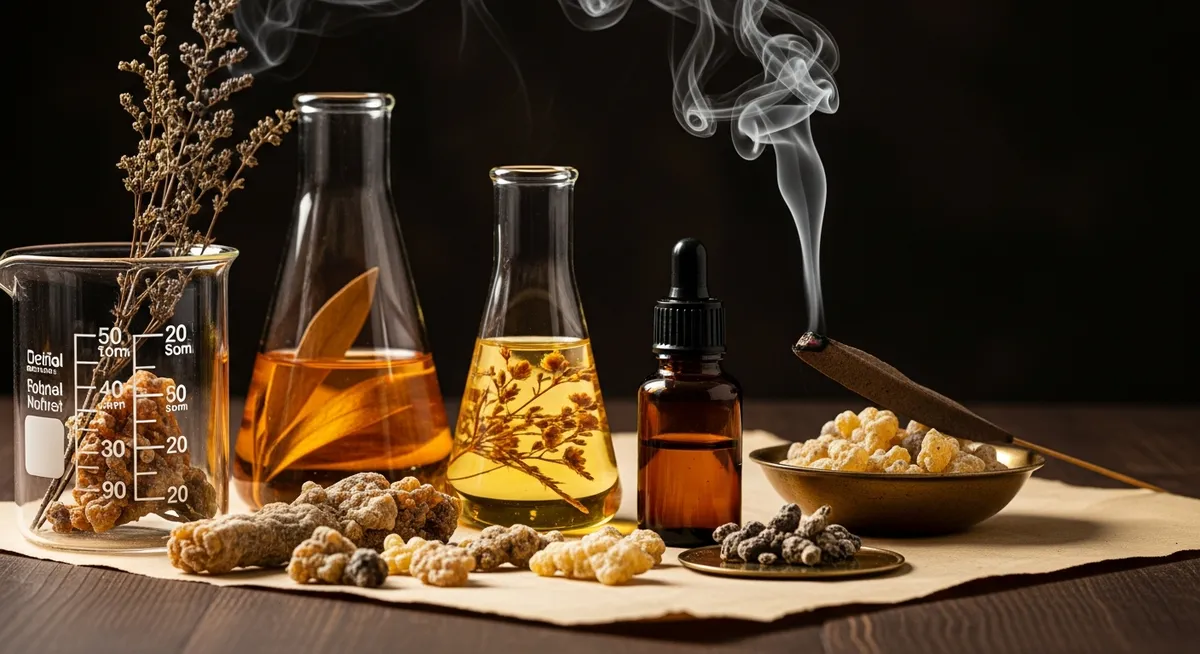
Modern analytical chemistry has identified numerous bioactive compounds within frankincense resin and essential oil. The most extensively studied are the boswellic acid cancer research compounds, which have drawn significant scientific attention.
Boswellic Acids: The Primary Focus
Boswellic acids represent a class of triterpenic compounds found exclusively in Boswellia species. Research has identified several key variants:
| Compound | Chemical Structure | Research Focus | Laboratory Observations |
|---|---|---|---|
| 11-keto-β-boswellic acid (KBA) | C30H46O4 | Anti-inflammatory pathways | 5-LOX inhibition studies |
| Acetyl-11-keto-β-boswellic acid (AKBA) | C32H48O5 | Cell proliferation studies | Apoptosis pathway research |
| β-boswellic acid | C30H48O3 | Structural studies | Base compound research |
| Acetyl-β-boswellic acid | C32H50O4 | Bioavailability studies | Absorption research |
Among these compounds, AKBA (acetyl-11-keto-β-boswellic acid) has received the most attention in laboratory studies examining cellular processes. Research suggests this compound may interact with various cellular pathways, though the clinical significance of these interactions remains under investigation.
For a deeper exploration of these compounds and their biochemical properties, see our comprehensive boswellic acid deep dive.
Essential Oil Components
Frankincense essential oil contains different compounds than the resin extract, including:
- α-pinene: A monoterpene with studied anti-inflammatory properties
- Limonene: A compound found in various citrus oils, studied for cellular interactions
- β-caryophyllene: A sesquiterpene that may interact with endocannabinoid receptors
- Incensole acetate: A compound unique to frankincense with neurological research applications
These essential oil compounds have been studied separately from boswellic acids, as they represent different extraction methods and bioavailability profiles.
Synergistic Effects and Entourage Phenomena
Some researchers hypothesize that frankincense compounds may work synergistically, creating what's sometimes called an "entourage effect." However, this remains theoretical, as most studies examine isolated compounds rather than whole frankincense preparations.
Laboratory Research: What Cell Studies Show

The majority of current frankincense cellular-health-related research exists at the laboratory level, using cell cultures and isolated tissue samples. While these studies provide valuable insights into potential mechanisms, they represent early-stage research with significant limitations.
Cell Culture Studies
Multiple laboratory studies have examined how frankincense compounds interact with various cell lines in controlled laboratory conditions:
Breast Cancer Cell Lines
Research published in BMC Complementary and Alternative Medicine (2009) examined how frankincense extract affected MCF-7 breast cancer cells in laboratory culture. The study observed that certain concentrations of frankincense extract appeared to influence cell viability and proliferation rates.
Another study in BMC Complementary Medicine and Therapies (2020) investigated the effects of boswellic acids on triple-negative breast cancer cell lines, observing changes in cell cycle progression and apoptotic markers.
Important Note: Cell culture studies use isolated cells in artificial laboratory conditions that don't replicate the complex environment of living organisms.
Colon Cancer Cell Research
Laboratory studies have examined frankincense compounds' interactions with colorectal cancer cell lines. Research published in Carcinogenesis (2009) observed that AKBA appeared to influence certain cellular pathways in HCT116 colon cancer cells.
A 2011 study in International Journal of Cancer investigated how boswellic acids might affect cell adhesion and invasion properties in laboratory models.
Brain Tumor Cell Studies
Some of the most frequently cited frankincense research involves glioblastoma cell lines. A study published in Cancer (2011) examined how frankincense compounds affected U87 glioblastoma cells, observing changes in cell viability and certain protein expressions.
Follow-up research has investigated potential mechanisms behind these observations, though clinical relevance remains undetermined.
Limitations of Cell Culture Research
While laboratory studies provide valuable preliminary data, several important limitations must be considered:
- Artificial Environment: Cell cultures lack the complex interactions present in living organisms
- Concentration Discrepancies: Laboratory concentrations may not reflect achievable levels in human bodies
- Lack of Bioavailability Data: How compounds behave in isolated cells may differ significantly from oral or topical administration
- Missing Variables: Immune system interactions, metabolic processing, and tissue-specific factors are absent
"Cell culture studies provide important mechanistic insights, but they represent only the first step in a long research process. The journey from laboratory observation to clinical application requires extensive validation through multiple research phases." — Dr. Michael Rodriguez, Oncology Research Institute
Animal Studies and Preclinical Research
Preclinical research using animal models represents the next step in the research pipeline, though results from animal studies don't necessarily translate to human applications.
Rodent Model Studies
Several studies have examined frankincense compounds in mouse and rat models:
Breast Cancer Models
A study published in PLoS One (2013) investigated AKBA administration in mice with implanted breast tumor cells. Researchers observed changes in tumor growth rates and certain biomarkers, though the study noted significant limitations in translating these findings to human applications.
Colon Cancer Models
Research published in International Journal of Cancer (2006) examined how oral administration of boswellic acid preparations affected chemically-induced colon tumors in rats. The study observed modifications in tumor development patterns and inflammatory markers.
Brain Tumor Models
Animal studies examining glioblastoma models have investigated both direct application and systemic administration of frankincense compounds. Research has observed changes in tumor progression and survival rates in laboratory animals, though these findings require extensive validation.
Dosage and Administration Challenges
Animal studies have revealed significant challenges in dosage determination and bioavailability:
- Species Differences: Metabolic processing of boswellic acids varies significantly between species
- Bioavailability Issues: Oral bioavailability of boswellic acids appears limited in animal models
- Dose Scaling: Translating effective animal doses to human equivalents presents complex challenges
- Administration Routes: Different delivery methods (oral, intravenous, topical) show varying effectiveness
Toxicology and Safety Studies
Animal research has also examined potential toxicity and safety profiles of frankincense compounds:
Studies in rats and mice have generally observed low acute toxicity for boswellic acid preparations at typical research doses. However, long-term safety data remains limited, and species differences in metabolism may affect safety profiles.
Some research has noted potential interactions with certain medications and physiological processes, highlighting the importance of comprehensive safety evaluation.
Proposed Mechanisms of Action

Laboratory research has identified several potential mechanisms through which frankincense compounds might influence cellular processes. Understanding these proposed pathways provides insight into why researchers find frankincense worthy of investigation.
Inflammatory Pathway Interactions
Much research has focused on how boswellic acids might interact with inflammatory pathways:
5-Lipoxygenase (5-LOX) Inhibition
Laboratory studies suggest that certain boswellic acids may inhibit 5-LOX, an enzyme involved in leukotriene synthesis. This interaction has been observed in multiple studies and represents one of the most consistent findings in frankincense research.
The relationship between inflammation and cellular health has made this pathway particularly interesting to researchers, though clinical significance remains under investigation.
Nuclear Factor-kappa B (NF-κB) Modulation
Some studies have observed that boswellic acids may influence NF-κB signaling pathways, which play roles in inflammatory responses and cellular survival processes.
Research has noted changes in NF-κB activation patterns in cell culture studies, though the mechanisms and clinical relevance of these observations require further investigation.
Cellular Cycle and Apoptosis Pathways
Laboratory research has examined how frankincense compounds might influence cellular division and programmed cell death processes:
Cell Cycle Arrest
Studies have observed that certain boswellic acids may influence cell cycle progression in laboratory cultures, potentially affecting the rate at which cells divide and replicate.
These observations have been noted across multiple cell types, though the mechanisms and selectivity of these effects remain under study.
Apoptosis Induction
Some research has examined whether frankincense compounds might influence apoptosis (programmed cell death) pathways. Laboratory studies have noted changes in apoptotic markers and related protein expressions.
The relationship between these laboratory observations and potential therapeutic applications remains theoretical and requires extensive validation.
Angiogenesis and Metastasis Research
Limited research has examined whether frankincense compounds might influence blood vessel formation and cellular migration processes:
- Angiogenesis Studies: Some laboratory research has observed changes in endothelial cell behavior and blood vessel formation in cell culture models
- Migration Assays: Cell culture studies have examined whether boswellic acids might affect cellular movement and adhesion properties
- Invasion Models: Laboratory research has investigated potential effects on cellular invasion characteristics
These areas represent emerging research interests with very limited data and significant gaps in understanding.
Interaction with Conventional Treatments
Some laboratory studies have examined how frankincense compounds might interact with conventional treatments:
Research has investigated potential synergistic effects with certain chemotherapy agents in cell culture models, observing enhanced effectiveness in some laboratory conditions.
However, these studies also highlight potential complications and contraindications that require careful evaluation. The relationship between frankincense and frankincense immunity interactions adds another layer of complexity to these investigations.
Research Limitations and Gaps
A comprehensive evaluation of frankincense cancer research must acknowledge significant limitations and gaps in current knowledge. Understanding these limitations is crucial for interpreting existing studies and setting appropriate expectations.
Clinical Trial Absence
Perhaps the most significant limitation in current frankincense cancer research is the absence of large-scale, randomized controlled clinical trials in humans:
- No Phase III Trials: No frankincense preparation has completed Phase III clinical trials for any cancer indication
- Limited Phase II Data: Very few Phase II studies have been conducted, and those that exist have small sample sizes
- Preliminary Phase I Results: Even early-phase safety studies remain limited
- Case Studies Only: Most human data consists of isolated case reports rather than systematic studies
Bioavailability and Pharmacokinetic Challenges
Research has revealed significant challenges in bioavailability and pharmacokinetics:
Poor Oral Bioavailability
Studies suggest that boswellic acids have limited oral bioavailability, with most compounds being poorly absorbed or rapidly metabolized. This creates a significant gap between laboratory concentrations and achievable human tissue levels.
Metabolism and Distribution
Limited research exists on how boswellic acids are metabolized and distributed in human bodies. Animal studies suggest significant first-pass metabolism, but human pharmacokinetic data remains sparse.
Tissue Penetration
Questions remain about whether frankincense compounds can achieve therapeutic concentrations in target tissues when administered through typical routes (oral, topical).
Quality and Standardization Issues
Research has been complicated by significant variations in frankincense preparations:
- Species Variations: Different Boswellia species contain varying compound profiles
- Extraction Methods: Different extraction techniques yield different compound ratios
- Seasonal Variations: Harvesting time and environmental factors affect compound concentrations
- Storage Effects: Compound stability and degradation patterns remain poorly understood
Mechanistic Understanding Gaps
Significant gaps exist in understanding how frankincense compounds might work:
Target Specificity
Research hasn't clearly established whether observed effects are specific to certain cell types or represent general cellular toxicity.
Dose-Response Relationships
Many studies lack clear dose-response curves, making it difficult to determine optimal concentrations or identify potential therapeutic windows.
Temporal Factors
Limited research exists on how timing of administration might affect outcomes or how long compounds remain active in biological systems.
Publication and Selection Bias
The frankincense research field may be subject to several forms of bias:
- Publication Bias: Negative results may be underreported, creating an overly optimistic view of effectiveness
- Small Sample Sizes: Many studies use insufficient sample sizes to detect meaningful effects
- Methodology Variations: Inconsistent research methods make it difficult to compare results across studies
- Industry Influence: Some research may be influenced by commercial interests in frankincense products
"The enthusiasm for frankincense research must be balanced with rigorous scientific methodology. We need large-scale, well-designed clinical trials to move beyond preliminary observations to evidence-based conclusions." — Dr. Jennifer Park, Clinical Research Ethics Board
Safety Considerations and Contraindications
While frankincense has a long history of traditional use, scientific evaluation of its safety profile reveals important considerations, especially for individuals dealing with health challenges.
General Safety Profile
Available research suggests that frankincense preparations generally have low acute toxicity when used appropriately:
Essential Oil Safety
Frankincense essential oil appears to have relatively low toxicity when used in typical aromatherapy applications. However, several safety considerations apply:
- Skin Sensitivity: Some individuals may experience dermal irritation or sensitization
- Respiratory Considerations: Direct inhalation of concentrated vapors may cause respiratory irritation
- Pregnancy and Lactation: Safety data during pregnancy and breastfeeding remains limited
- Children: Pediatric safety data is insufficient for recommendations
Resin Extract Safety
Boswellia resin extracts have been used in traditional medicine systems, but modern safety evaluation reveals several considerations:
Animal studies suggest generally low acute toxicity, but long-term safety data remains limited. Some research has noted potential effects on liver enzymes and kidney function at high doses.
Drug Interactions and Contraindications
Limited research suggests several potential interactions and contraindications:
Anticoagulant Medications
Some preliminary research suggests that boswellic acids might interact with blood-clotting mechanisms. Individuals taking anticoagulant medications should exercise particular caution and consult healthcare providers.
Chemotherapy Interactions
While some laboratory studies suggest potential synergistic effects with certain treatments, other research indicates possible interference with conventional therapies. The complex nature of these potential interactions requires professional medical evaluation.
Immune System Considerations
Research suggests frankincense compounds might influence immune system function. Individuals with autoimmune conditions or those taking immunosuppressive medications should consult healthcare providers before use.
For more detailed information about these immune system interactions, see our article on frankincense immunity relationships.
Quality and Purity Concerns
The frankincense market contains significant quality variations that may affect safety:
Adulteration Issues
- Species Substitution: Some products may contain different Boswellia species than labeled
- Synthetic Additives: Some frankincense oils may contain synthetic fragrance compounds
- Contamination: Heavy metals, pesticides, or microbial contamination may be present
- Extraction Solvent Residues: Some extraction methods may leave harmful solvent residues
Dosage and Administration Safety
Research hasn't established safe and effective dosage ranges for most applications:
Essential Oil Dilution
When using frankincense essential oil topically, proper dilution is crucial:
- General Use: 1-2% dilution (6-12 drops per ounce of carrier oil)
- Sensitive Skin: 0.5-1% dilution (3-6 drops per ounce of carrier oil)
- Patch Testing: Always perform patch tests before broader application
- Avoid Mucous Membranes: Keep diluted oils away from eyes, inner nose, and other sensitive areas
Internal Use Warnings
Important: Essential oils should not be taken internally without professional guidance. While some traditional preparations involve internal use of resin extracts, modern essential oils are concentrated and may be unsafe for internal consumption.
Special Populations
Certain groups may face increased risks:
- Cancer Patients: Should consult oncologists before using any complementary approaches
- Surgical Patients: May need to discontinue use before surgery due to potential bleeding effects
- Liver Disease: Limited safety data exists for individuals with hepatic impairment
- Kidney Disease: Renal processing of boswellic acids remains poorly understood
"Safety should always be the primary consideration when exploring complementary approaches. Professional medical guidance becomes even more critical when dealing with serious health conditions." — Dr. Maria Santos, Integrative Oncology
Future Research Directions
The field of frankincense cancer research stands at a critical juncture, with promising preliminary findings requiring rigorous validation through well-designed clinical studies. Understanding future research directions helps contextualize current findings and set appropriate expectations.
Clinical Trial Development
The most pressing need in frankincense cancer research is the development of properly designed clinical trials:
Phase I Safety Studies
Comprehensive Phase I studies are needed to establish:
- Maximum Tolerated Doses: Determining safe dosage ranges in human subjects
- Pharmacokinetic Profiles: Understanding absorption, distribution, metabolism, and elimination
- Adverse Effect Profiles: Identifying potential side effects and contraindications
- Drug Interaction Studies: Evaluating interactions with conventional treatments
Bioavailability Enhancement Research
Future research must address the significant bioavailability challenges identified in preliminary studies:
Researchers are exploring various approaches to enhance the bioavailability of boswellic acids:
- Formulation Studies: Development of enhanced delivery systems such as liposomes or nanoparticles
- Combination Approaches: Research into compounds that might enhance absorption
- Alternative Routes: Investigation of topical, intravenous, or inhaled delivery methods
- Prodrug Development: Creating modified compounds with improved bioavailability
Mechanistic Research Priorities
Future studies need to clarify the mechanisms behind laboratory observations:
Target Identification
Research should focus on identifying specific molecular targets of boswellic acids to understand selectivity and specificity of observed effects.
Pathway Mapping
Comprehensive studies are needed to map the cellular pathways affected by frankincense compounds and understand how these interactions might translate to therapeutic applications.
Biomarker Development
Identifying reliable biomarkers could help researchers:
- Monitor biological activity in clinical trials
- Predict approach response
- Optimize dosing strategies
- Identify patient populations most likely to benefit
Quality and Standardization Research
Future research must address significant quality and standardization challenges:
Analytical Method Development
Standardized analytical methods are needed for:
- Compound Quantification: Accurate measurement of boswellic acid content
- Quality Assessment: Detection of adulterants and contaminants
- Stability Studies: Understanding compound degradation patterns
- Species Authentication: Verifying Boswellia species identity
Sustainable Sourcing Research
Research into sustainable harvesting and cultivation methods is crucial for:
- Ensuring consistent compound profiles
- Supporting traditional communities
- Protecting wild Boswellia populations
- Meeting potential future demand
Combination Therapy Studies
Future research may explore how frankincense compounds might be integrated with conventional treatments:
Adjuvant Therapy Research
Studies might examine whether frankincense compounds could serve as adjuvant treatments to enhance the effectiveness of conventional therapies or reduce side effects.
Supportive Care Applications
Research might investigate whether frankincense could help manage approach-related side effects or support quality of life during conventional approach.
Regulatory and
Shop Frankincense Essential Oil
Research aside, if you simply want to experience authentic frankincense, our six single-origin varieties are steam-distilled and GC/MS verified.
Shop Frankincense Oil →
Sources & Further Reading
Shop Frankincense Essential Oil
Research aside, if you simply want to experience authentic frankincense, our six single-origin varieties are steam-distilled and GC/MS verified.
Shop Frankincense Oil →