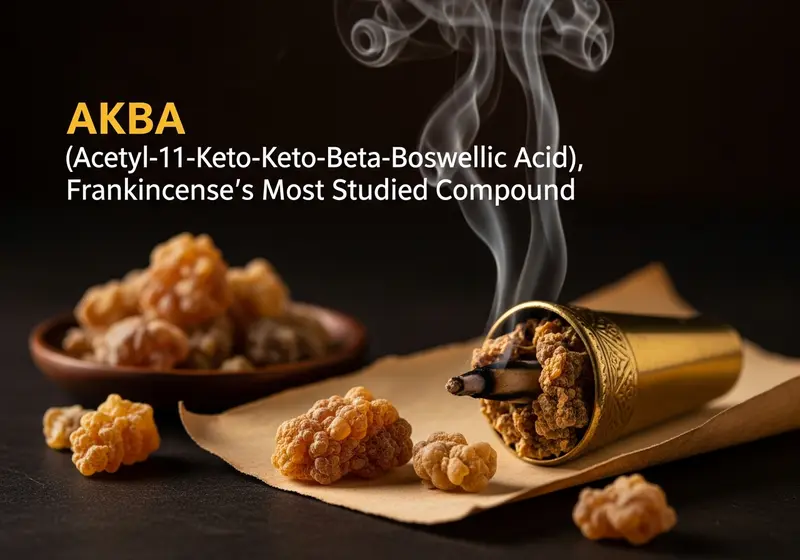
AKBA (Acetyl-11-Keto-Beta-Boswellic Acid): Frankincense's Most Studied Compound
Among the numerous bioactive compounds found in frankincense resin, one stands distinctly apart in terms of scientific attention: AKBA, or Acetyl-11-keto-beta-boswellic acid. This pentacyclic triterpene has captured the interest of researchers worldwide, becoming the most extensively studied component of Boswellia species and establishing itself as a key marker of frankincense quality and potency.
While frankincense has been revered for millennia in traditional wellness practices, modern analytical chemistry has revealed AKBA as potentially one of the most significant contributors to the resin's observed properties. Understanding this compound's structure, research profile, and quality indicators offers valuable insights for anyone seeking to appreciate the complexity and sophistication of authentic frankincense.
The Chemistry Behind AKBA
Molecular Structure and Classification
AKBA belongs to the family of boswellic acids, a group of pentacyclic triterpenes unique to Boswellia species. Its molecular formula, C32H48O5, reflects a complex structure featuring five interconnected carbon rings with specific functional groups that distinguish it from other boswellic acids found in frankincense.
The compound's full chemical name—3-O-acetyl-11-keto-β-boswellic acid—describes its key structural features: an acetyl group attached at the 3-position and a keto group at the 11-position of the basic boswellic acid backbone. These specific modifications appear to significantly influence its bioactivity profile compared to other boswellic acids.
Biosynthesis in Boswellia Trees
AKBA forms through the tree's natural metabolic processes as part of its defense mechanisms. The compound develops through a series of enzymatic reactions that convert simpler precursor molecules into increasingly complex boswellic acids. Environmental factors such as seasonal stress, temperature fluctuations, and soil conditions may influence AKBA production levels in the resin.
Research observations suggest that AKBA concentrations can vary significantly between different Boswellia species, with Boswellia serrata (Indian frankincense) typically showing higher levels compared to other species like Boswellia carterii or Boswellia sacra.
Research Landscape: What Studies Have Observed
Laboratory Research Findings
The scientific literature contains extensive documentation of AKBA's behavior in laboratory settings. Research into frankincense and inflammation has frequently focused on AKBA due to its observed interactions with various cellular pathways.
In vitro studies have observed that AKBA may interact with multiple enzymatic systems. Some research suggests the compound shows selective activity toward 5-lipoxygenase (5-LOX), an enzyme involved in inflammatory cascade processes. These laboratory observations have led researchers to investigate AKBA's potential role in various biological processes.
Cell culture studies have noted interesting behavioral patterns when AKBA is present. Some research suggests the compound may influence cellular communication pathways, though researchers emphasize that laboratory conditions don't necessarily translate to effects in living organisms.
Animal Model Observations
Animal studies have provided additional insights into AKBA's biological behavior. Research using various animal models has observed different responses to AKBA administration, though scientists consistently note that animal studies cannot predict human responses.
Some studies have documented changes in inflammatory markers when animals receive AKBA-containing extracts. Other research has noted behavioral and physiological observations in animal models, though researchers caution against extrapolating these findings directly to human applications.
Human Studies and Clinical Observations
Human research involving AKBA remains more limited compared to laboratory and animal studies. Small-scale clinical trials have examined frankincense extracts standardized for AKBA content, observing various outcomes in different populations.
Some clinical research suggests that standardized frankincense extracts containing significant AKBA levels may be associated with certain subjective reports from study participants. However, researchers consistently emphasize that these studies often involve small sample sizes and short durations, limiting the strength of conclusions.
Research into frankincense's broader applications has also examined AKBA's role, though this remains an area requiring extensive additional investigation.
AKBA Content Across Frankincense Varieties
Species Variations
Different Boswellia species demonstrate varying AKBA concentrations, which has significant implications for both quality assessment and commercial applications:
- Boswellia serrata (Indian Frankincense): Research suggests this species typically contains the highest AKBA levels, often ranging from 1-10% of total boswellic acids
- Boswellia carterii (Somali Frankincense): Generally shows lower AKBA concentrations, with some studies noting levels below 1%
- Boswellia sacra (Omani Frankincense): AKBA content appears highly variable depending on specific chemotype and harvesting location
- Boswellia frereana (Maydi Frankincense): Limited research suggests relatively low AKBA levels in this species
Factors Affecting AKBA Concentration
Several variables may influence AKBA levels in frankincense resin:
Geographic Origin: Trees growing in different regions, even within the same species, may produce resin with varying AKBA concentrations due to environmental factors such as soil composition, altitude, and climate patterns.
Seasonal Harvesting: Some research suggests that resin collected during different seasons may show varying boswellic acid profiles, potentially affecting AKBA levels.
Tree Age and Health: The age and physiological condition of frankincense trees may influence their biochemical output, though research in this area remains limited.
Post-Harvest Processing: Storage conditions, temperature exposure, and processing methods may affect AKBA stability and concentration in finished products.
Analytical Methods and Quality Assessment
HPLC Analysis Standards
High-Performance Liquid Chromatography (HPLC) represents the gold standard for AKBA analysis in frankincense products. This sophisticated analytical technique can precisely identify and quantify AKBA content, providing reliable data for quality assessment.
Professional HPLC analysis typically measures multiple boswellic acids simultaneously, creating a complete chemical profile that includes:
- AKBA (Acetyl-11-keto-beta-boswellic acid)
- KBA (11-keto-beta-boswellic acid)
- ABBA (Acetyl-beta-boswellic acid)
- BBA (Beta-boswellic acid)
Quality Indicators and Standardization
AKBA content serves as a primary quality marker for frankincense products, particularly extracts and supplements. However, quality assessment should consider multiple factors beyond AKBA concentration alone.
Total Boswellic Acid Content: While AKBA receives significant attention, the complete boswellic acid profile provides more comprehensive quality information.
Extraction Method Impact: Different extraction techniques may preferentially concentrate certain compounds while reducing others, affecting the final AKBA percentage.
Standardization Approaches: Commercial products may be standardized to contain specific AKBA percentages, though this standardization doesn't necessarily indicate superior quality if other important compounds are reduced.
Safety Profile and Considerations
General Safety Observations
Research examining AKBA safety profiles has generally noted good tolerance in most study populations. However, as with any bioactive compound, individual responses may vary, and certain considerations apply.
Clinical studies involving frankincense extracts with known AKBA content have typically reported minimal adverse effects, though researchers note that long-term safety data remains limited. (See: NIH — Boswellia Research.) Most reported side effects in studies have been mild and transient.
Potential Interactions and Contraindications
While specific interaction studies for isolated AKBA remain limited, research suggests several important considerations:
Medication Interactions: Some research suggests that boswellic acids, including AKBA, may influence certain enzymatic pathways. Individuals taking medications should consult qualified healthcare providers before using AKBA-containing products.
Pregnancy and Nursing: Limited safety data exists regarding AKBA use during pregnancy or lactation. Healthcare provider consultation is particularly important for these populations.
Surgery Considerations: Due to observed effects on inflammatory pathways, some researchers suggest discontinuing boswellic acid supplements before scheduled surgical procedures.
Dosage Considerations in Research
Clinical studies have employed varying approaches to AKBA administration, making direct comparisons challenging. Research doses have typically involved standardized extracts containing specific AKBA percentages rather than isolated AKBA compounds.
Study protocols have generally used conservative approaches, often starting with lower doses and monitoring participant responses. Researchers consistently emphasize that effective dosing likely depends on multiple factors including individual physiology, product formulation, and intended applications.
Commercial Applications and Market Trends
Supplement Industry Standards
The dietary supplement industry has increasingly focused on AKBA content as a differentiating factor for frankincense products. Many manufacturers now specify AKBA percentages on product labels, though standardization approaches vary significantly between companies.
Common commercial standardizations include:
- Extracts standardized to 10% total boswellic acids with specified AKBA minimums
- Products claiming 2-5% AKBA content specifically
- Whole resin products with natural AKBA levels (typically lower than extracts)
Quality Verification Challenges
The increasing commercial focus on AKBA has created both opportunities and challenges in the frankincense market. While AKBA quantification provides useful quality metrics, it has also led to oversimplification of frankincense's complex chemistry.
Some manufacturers have prioritized AKBA content over other quality factors such as sustainable sourcing, proper storage, or complete chemical profiles. This narrow focus may not necessarily result in superior products, as frankincense's traditional uses likely involve synergistic effects among multiple compounds.
Future Research Directions
Mechanistic Studies
Current research suggests several promising directions for future AKBA investigation. Scientists are particularly interested in understanding the precise molecular mechanisms through which AKBA may exert its observed effects.
Advanced research techniques such as proteomics and metabolomics may provide deeper insights into AKBA's interactions with cellular systems. These sophisticated analytical approaches could reveal previously unknown aspects of how AKBA functions at the molecular level.
Clinical Research Gaps
While laboratory research on AKBA has advanced significantly, clinical studies remain relatively limited. Researchers have identified several areas where additional human studies could provide valuable insights:
- Long-term safety profiles in various populations
- Optimal dosing strategies for different applications
- Bioavailability and absorption characteristics
- Individual variation in response patterns
Sustainable Sourcing Research
As demand for AKBA-rich frankincense products increases, researchers are examining sustainable harvesting practices that maintain both AKBA quality and ecological balance. This research may lead to improved cultivation techniques and harvesting schedules that optimize both compound production and tree health.
Practical Considerations for Consumers
Evaluating AKBA-Containing Products
Consumers interested in AKBA-containing frankincense products should consider multiple quality factors beyond AKBA percentage alone. Comprehensive evaluation should include:
Third-Party Testing: Products with independent laboratory analysis provide more reliable AKBA content verification than manufacturer claims alone.
Complete Chemical Profiles: Quality products often provide information about total boswellic acid content, not just AKBA levels.
Extraction Method Transparency: Understanding how AKBA was concentrated can provide insights into product quality and potential effectiveness.
Sourcing Information: Knowledge of geographic origin and harvesting practices may indicate product authenticity and sustainability.
Storage and Handling
AKBA stability may be influenced by environmental factors, making proper storage important for maintaining product quality. Research suggests that exposure to heat, light, and moisture may affect boswellic acid concentrations over time.
Optimal storage practices typically include:
- Cool, dry storage conditions
- Protection from direct sunlight
- Sealed containers to prevent oxidation
- Attention to expiration dates and quality indicators
The Broader Context of Frankincense Chemistry
While AKBA has rightfully received significant research attention, it represents just one component of frankincense's incredibly complex chemical makeup. The resin contains hundreds of identified compounds, including volatile oils, other boswellic acids, and various secondary metabolites that may contribute to its traditional uses.
Understanding AKBA within this broader context helps maintain perspective on frankincense's holistic nature. Traditional use systems rarely isolated individual compounds but instead employed whole resin preparations that provided complex mixtures of bioactive substances.
Modern research on AKBA offers valuable insights into one aspect of frankincense's properties, but the complete picture likely involves intricate interactions among multiple compounds. This complexity underscores both the sophistication of traditional knowledge systems and the challenges facing modern research attempting to understand ancient materials.
As research continues to explore AKBA and other frankincense compounds, the ancient wisdom surrounding this remarkable resin gains new dimensions of scientific appreciation. Whether approaching frankincense from traditional or modern perspectives, AKBA represents a fascinating bridge between historical use and contemporary understanding, offering insights into the molecular basis of one of humanity's most enduring natural treasures.
Important Note: This article provides educational information about AKBA research and chemistry. It is not intended to provide medical advice or suggest treatments for any health conditions. Individuals considering frankincense products containing AKBA should consult with qualified healthcare providers, especially if taking medications or managing health conditions.
Shop Frankincense Essential Oil
Chemistry this precise deserves oil to match — every bottle in our shop ships with GC/MS verification so you can read the numbers yourself.
Shop Frankincense Oil →