Frankincense vs Patchouli: Two Ancient Oils Compared
Few pairings in the world of earthy essential oils compared carry quite the same mystique as frankincense and patchouli. Both have wound their way through centuries of human ritual, trade, and daily life — one rising from the sun-scorched resin of African and Arabian trees, the other distilled from the broad, fragrant leaves of a tropical shrub. Both are deep, complex, and unmistakably ancient. Yet despite sharing a certain rich, grounding character, they are profoundly different in almost every meaningful way.
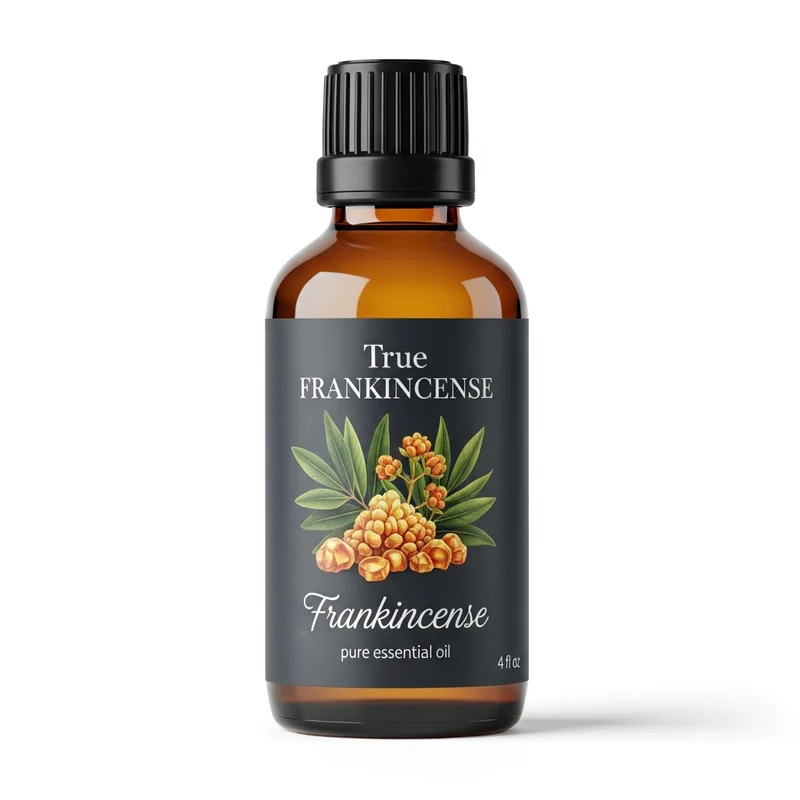
Frankincense Essential Oil
Six single-origin frankincense varieties, steam-distilled and GC/MS verified.
From $10.99
Shop Frankincense Oil →Whether you are trying to decide between patchouli or frankincense for your wellness rituals, building a home fragrance collection, or simply deepening your knowledge of botanical oils, this detailed comparison will guide you through everything from botanical origins and aromatic character to blending potential and traditional applications. Consider this your definitive guide to the frankincense vs patchouli conversation.
Origins: Where These Oils Come From
Frankincense — The Sacred Resin of Ancient Trade Routes
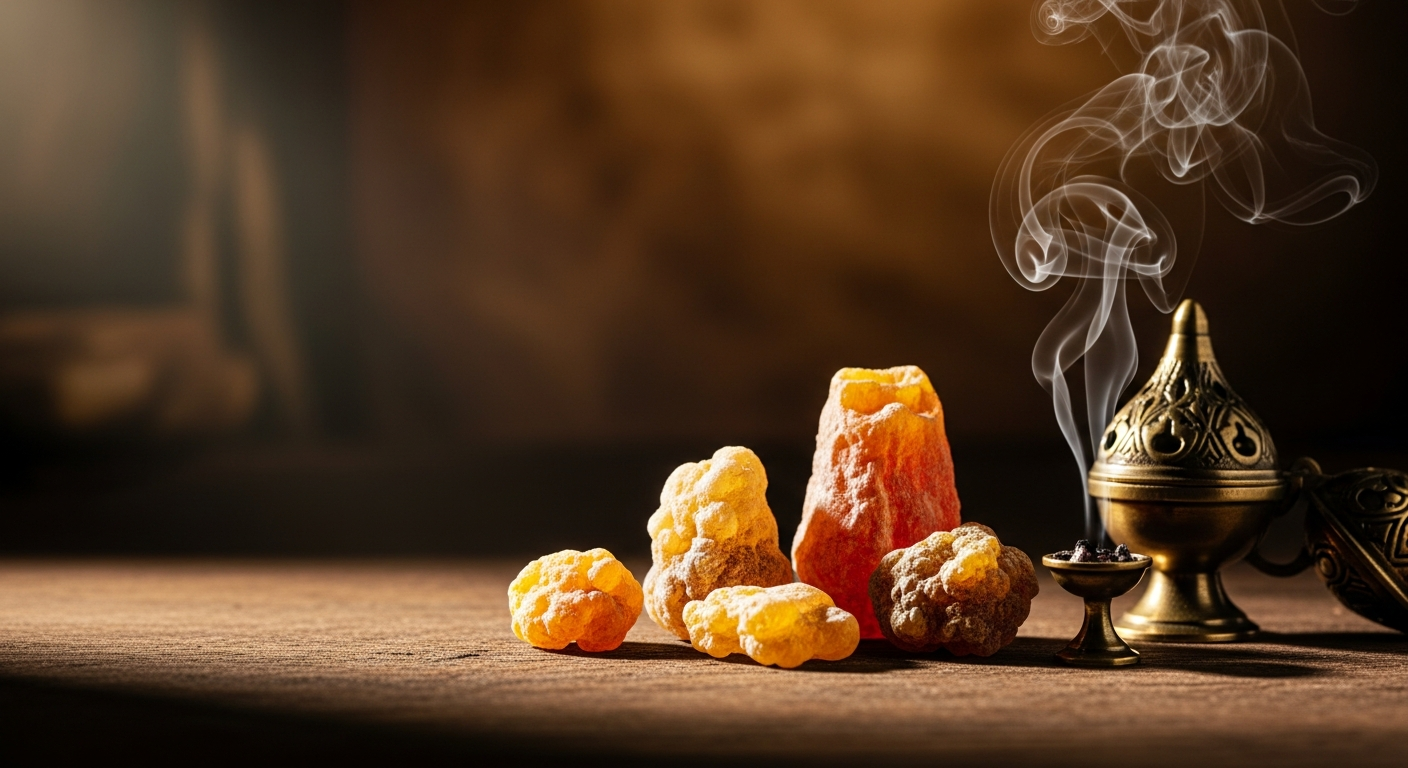
Frankincense essential oil is steam-distilled from the hardened resin tears of trees in the Boswellia genus — most notably Boswellia sacra, Boswellia carterii, and Boswellia serrata. These slow-growing, drought-resistant trees cling to the rocky hillsides of Oman, Somalia, Ethiopia, and Yemen, tapped by skilled harvesters who score the bark and collect the milky sap that oozes out and solidifies into pale golden nodules.
The trade in frankincense resin stretches back more than five thousand years. It traveled the ancient Incense Route from southern Arabia to the Mediterranean world, appearing in Egyptian embalming rites, Ayurvedic texts, and the Christian scriptures as one of the gifts brought to the infant Jesus. Few natural substances have carried such consistent reverence across so many distinct civilisations.
Patchouli — The Traveller's Leaf
Patchouli essential oil is steam-distilled from the dried and fermented leaves of Pogostemon cablin, a leafy shrub in the mint family (Lamiaceae) native to tropical Asia — particularly Indonesia, the Philippines, India, and Malaysia. Unlike frankincense, which requires a wounded tree and patient collection, patchouli is a relatively fast-growing crop, and its leaves are harvested several times per year.
Patchouli's path into Western consciousness is a fascinating one. Indian and Chinese textile merchants discovered that tucking dried patchouli leaves among silk and cashmere shielded fabrics from moths during long sea voyages. European traders came to associate the distinctive musky scent with the luxury goods themselves — so much so that European consumers began to distrust fabrics that didn't smell of patchouli. Centuries later, the oil became emblematic of the 1960s counterculture, cementing a polarising reputation that it has never entirely shaken.
Scent Profiles: Understanding the Aroma
This is perhaps where the frankincense vs patchouli comparison becomes most immediately useful in practical terms. These two oils share an earthy, resinous gravity — but they diverge dramatically in character.
The Scent of Frankincense
Frankincense is often described as the more ethereal of the two. Its aroma opens with a bright, slightly citrusy, almost piney top note — a liveliness that surprises many first-time users who expect something heavier. As it dries down, it reveals a warm, balsamic, softly sweet heart with a clean, incense-like depth. There is a certain luminosity to frankincense; it smells simultaneously ancient and fresh, earthy yet uplifting.
The specific aroma varies meaningfully by species. Boswellia sacra from Oman tends to be the most prized, with a particularly clear, almost meditative quality. Boswellia serrata from India carries a slightly more robust, spicier character. Boswellia carterii from Somalia sits somewhere between the two.
The Scent of Patchouli
Patchouli is earthier, darker, and more tenacious. Its base notes dominate — a rich, musky, slightly fermented quality with undertones of wet soil, aged wood, and sweet spice. Quality patchouli, particularly aged Indonesian patchouli, develops an almost chocolatey, wine-like smoothness that bears little resemblance to the sharp, camphorous note of inferior or very fresh oil.
Patchouli is one of the most powerful fixatives in natural perfumery, meaning it slows the evaporation of other aromatic compounds in a blend. This longevity is both its greatest strength and the source of its notoriety — a little goes a very long way.
| Characteristic | Frankincense | Patchouli |
|---|---|---|
| Top Notes | Citrusy, fresh, slightly piney | Minimal — base-dominant |
| Heart Notes | Warm, balsamic, incense-like | Earthy, musky, fermented |
| Base Notes | Soft resin, gentle sweetness | Rich earth, aged wood, spice |
| Longevity | Moderate | Exceptional (excellent fixative) |
| Intensity | Medium | High — use sparingly |
Traditional Uses Through History
Examining traditional uses helps illuminate why both oils remain so culturally significant — and it is important to note that these applications reflect historical and traditional practices, not modern medical claims.
Frankincense in Tradition
- Sacred ceremony: Burned as incense in temples, churches, and mosques across Egypt, Greece, Rome, the Islamic world, and beyond. The smoke was believed to carry prayers skyward and purify sacred spaces.
- Ayurvedic practice: The resin of Boswellia serrata, known in Ayurveda as Shallaki, has been traditionally used in Indian herbal preparations for centuries.
- Ancient Egyptian rituals: Used in kohl eye preparations, embalming compounds, and as an offering to deities including Ra.
- Meditation and contemplation: Across many traditions, the smoke and scent of frankincense has been associated with mental stillness and spiritual focus.
Patchouli in Tradition
- Textile preservation: Dried leaves packed among Asian silks and cashmeres to deter moths during long trade voyages — giving those fabrics their characteristic scent.
- Traditional Asian medicine: Used in various folk and traditional medicine systems across Southeast Asia, India, and China, though always within their specific cultural and philosophical frameworks.
- Perfumery and incense: A cornerstone of South Asian incense traditions, and later a defining note in numerous classic Western fragrances, from Chypres to Orientals.
- Counterculture symbol: In the 1960s and 1970s, patchouli became synonymous with the back-to-nature movement, worn as a personal fragrance and burned in communal spaces.
What Modern Research Observes
Both oils have attracted genuine scientific curiosity in recent decades. It is important to present this context carefully: the research is ongoing, findings are preliminary in many cases, and neither oil should be regarded as a substitute for professional medical care.
Frankincense: Areas of Research Interest
The primary active compounds in frankincense resin are boswellic acids (present in the raw resin but minimally in steam-distilled essential oil) and a range of terpene molecules including alpha-pinene, limonene, and incensole acetate. Some research suggests that inhaling frankincense may help promote a sense of calm and may support a relaxed mental state — a finding that aligns with its millennia-long use in contemplative traditions. Researchers have also observed that incensole acetate may interact with ion channels in the brain, though the mechanisms and implications of this are still being studied.
The boswellic acids in the resin extract (distinct from the essential oil) have been an area of particular scientific interest in relation to inflammation pathways. However, consumers should note that steam-distilled frankincense essential oil contains little to no boswellic acid — these large molecules do not survive distillation — so the research on resin extracts does not directly translate to the essential oil.
Patchouli: Areas of Research Interest
Patchouli oil is rich in sesquiterpene compounds, including patchoulol (also called patchouli alcohol), alpha-bulnesene, and norpatchoulenol. Some research suggests that patchouli's aroma may help promote a sense of relaxation and grounding. Its reputation as a skin-supportive oil has also attracted some research attention, with certain studies observing potential properties of interest in topical applications — though it is important to note that these are preliminary observations, not clinical evidence of efficacy for treating any condition.
Always consult a qualified healthcare provider before using any essential oil as part of a health-related practice, and never use essential oils as a replacement for prescribed medical treatment.
Blending: Patchouli or Frankincense — Or Both?
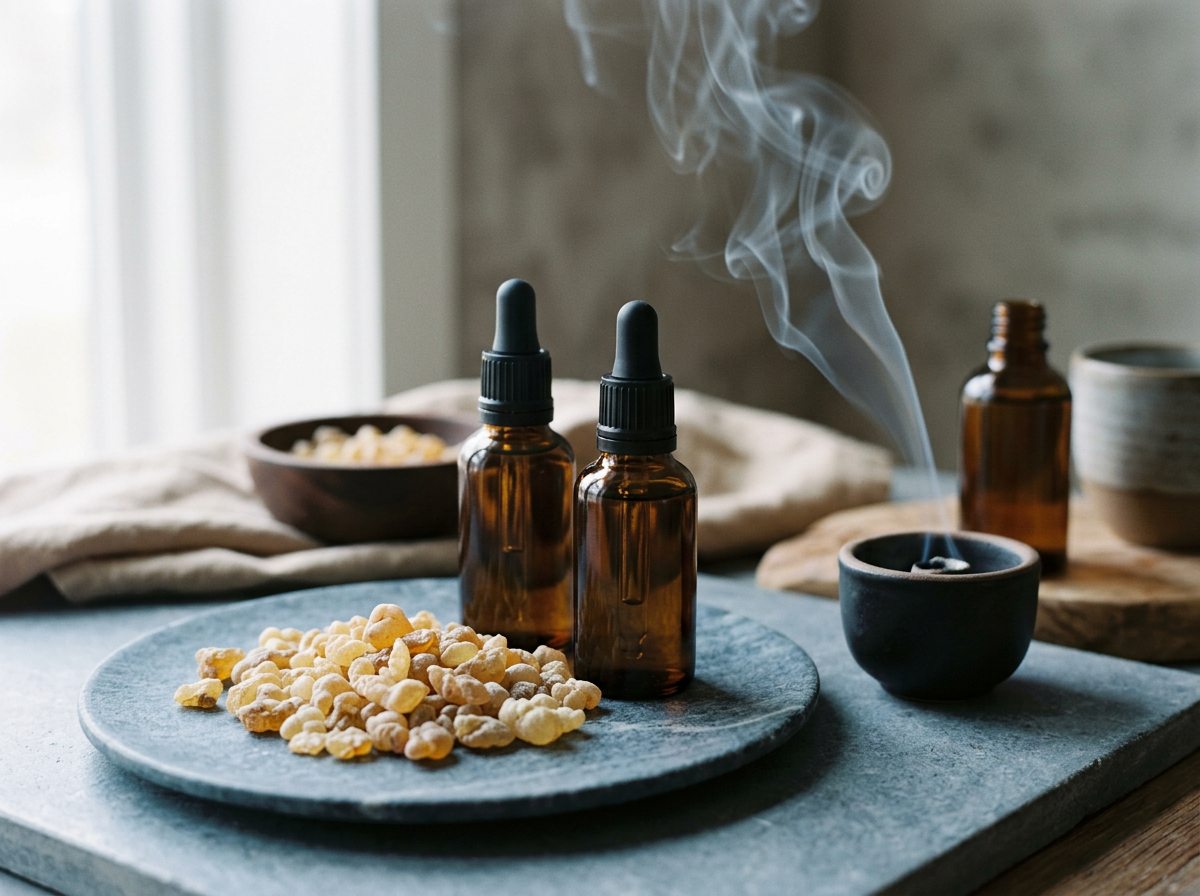
In the world of natural perfumery and aromatherapy blending, this is where the comparison becomes genuinely exciting — because frankincense and patchouli are not simply competing choices. They are remarkably complementary.
Frankincense as a Blending Note
Frankincense occupies the middle and base registers of a fragrance while retaining a brightness that prevents blends from becoming too heavy. It pairs beautifully with citrus oils (bergamot, wild orange, lemon), with other resins and woods (cedarwood, sandalwood, myrrh), with florals (rose, lavender, geranium), and with spice oils (black pepper, cardamom, ginger).
Patchouli as a Blending Note
Patchouli functions primarily as a deep base note and fixative. Its role in a blend is often architectural — it anchors other notes and extends their longevity. It pairs exceptionally well with vetiver, cedarwood, sandalwood, bergamot, clary sage, and jasmine. Because of its intensity, most experienced blenders recommend starting with a ratio of no more than 5–10% patchouli in a blend and adjusting from there.
Blending Them Together
Frankincense and patchouli together create a rich, grounding, deeply meditative accord that has been used in incense and perfumery for centuries. The clarity of frankincense lifts and illuminates what patchouli's darkness might otherwise obscure, while patchouli gives frankincense a depth and longevity it would not have on its own. A simple starting blend of 4 drops frankincense, 1 drop patchouli, and 3 drops bergamot in a diffuser illustrates this dynamic beautifully.
Safety Considerations and Dilution Guidelines
Important Safety Notice: Essential oils are highly concentrated botanical extracts and must be used responsibly. Always dilute essential oils in an appropriate carrier oil before skin application. Never apply undiluted (neat) essential oils directly to skin. Perform a patch test before first use. Keep out of reach of children and away from eyes and mucous membranes. If you are pregnant, nursing, or managing a health condition, consult a qualified healthcare provider before use. Essential oils are not a substitute for professional medical advice or treatment.
Frankincense Safety Profile
- Dilution: For topical use, dilute to 1–2% in a carrier oil for facial application; 2–3% for body use (approximately 1–2 drops per teaspoon of carrier oil).
- Skin sensitivity: Generally considered well-tolerated, but patch testing is always recommended.
- Pregnancy: Some practitioners advise caution during the first trimester; consult a qualified healthcare provider.
- Phototoxicity: Steam-distilled frankincense is not considered phototoxic, but quality and species variation apply — always review your specific product's safety data.
Patchouli Safety Profile
- Dilution: Dilute to 1–2% for topical use; its potency means less is genuinely more.
- Skin sensitivity: Generally considered well-tolerated, though its intensity can occasionally cause sensitivity reactions in some individuals — patch testing is essential.
- Pregnancy: Consult a qualified healthcare provider before use.
- Oxidation: Unlike many oils, patchouli actually improves with age and is not a significant oxidation concern in the way that citrus oils are — but storing in a cool, dark place in a sealed amber bottle remains best practice.
Value, Sourcing, and Sustainability
When comparing earthy essential oils from a sourcing perspective, frankincense raises more acute sustainability concerns. Wild Boswellia populations are under significant pressure from over-tapping, habitat loss, and climate change. Responsible sourcing — choosing suppliers who work directly with harvesting communities, support sustainable tapping practices, and provide transparent supply chain information — is not merely a luxury consideration but an ethical imperative for any serious frankincense user.
Patchouli, as a cultivated crop with relatively fast growth cycles, presents fewer acute sustainability concerns, though as with all agricultural products, fair trade practices and responsible farming methods matter.
Both oils vary substantially in quality based on botanical species, geographic origin, distillation method, and age. In both cases, investing in high-quality, responsibly sourced oils from reputable suppliers will deliver a profoundly different — and superior — experience compared to commodity-grade alternatives.
The Verdict: Frankincense vs Patchouli
There is no universal winner in the frankincense vs patchouli comparison — only the right choice for your particular purpose, preference, and practice.
- Choose frankincense if you are drawn to a luminous, contemplative aroma with deep spiritual resonance; if you want a versatile middle-to-base note that blends with almost everything; or if you are building a meditation or mindfulness practice around scent.
- Choose patchouli if you want a powerful, deeply earthy base note with exceptional fixative properties; if you are blending perfumes and need longevity and depth; or if you are drawn to its rich, complex, almost fermented character.
- Choose both if you want to explore one of natural perfumery's most time-honoured and rewarding pairings — a combination that has graced incense burners, temples, and perfume compositions for centuries with good reason.
These two oils are not competitors so much as complementary voices in the grand conversation of aromatic tradition. Understanding each on its own terms — its origins, its character, its strengths — is the first step toward using both with the intention and respect they deserve.