Frankincense for Gut Health and IBS: A Deep Dive into Boswellic Acid Benefits
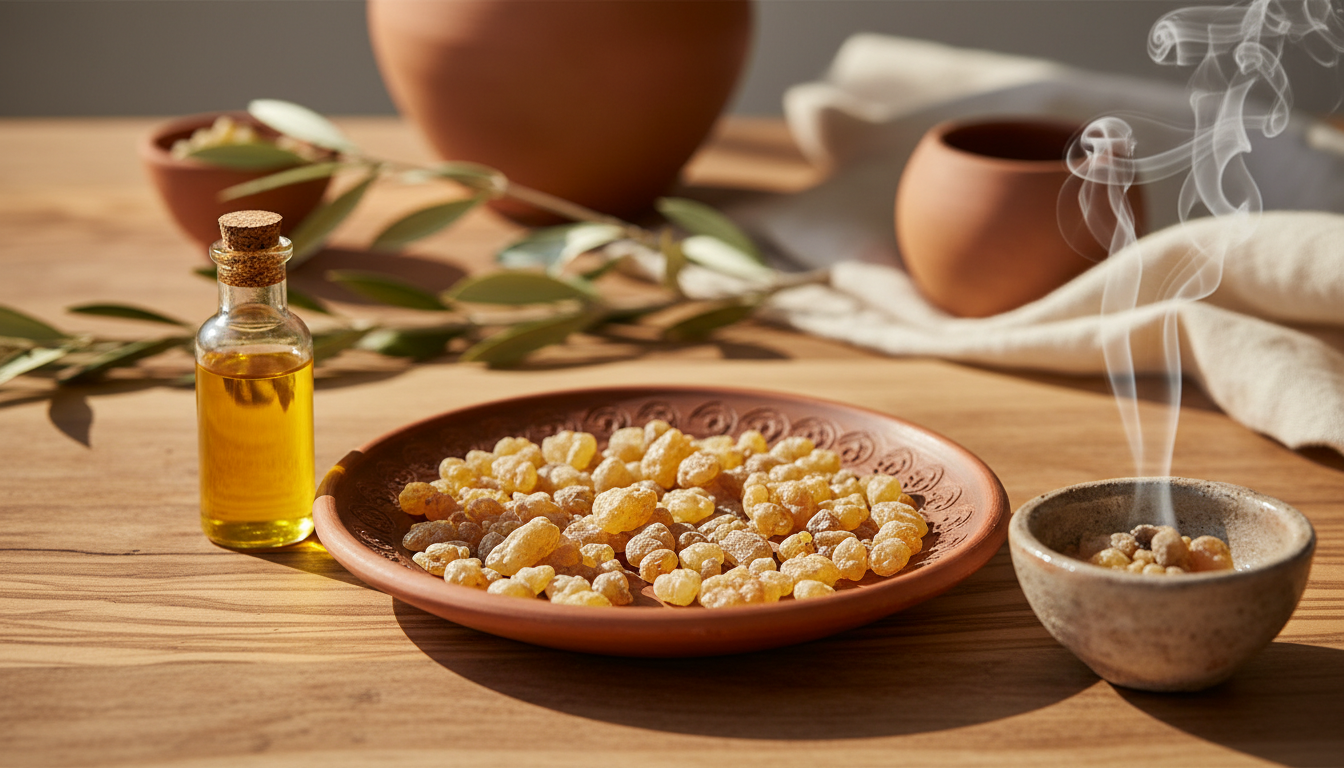
For thousands of years, the resin of the Boswellia tree has held a place of reverence in Ayurvedic practice, traditional Arabic medicine, and ancient African healing cultures. Priests burned it as an offering. Traders crossed deserts to barter it. Today, researchers are turning their attention to one of its most intriguing compound families: boswellic acids. And increasingly, the conversation around boswellia for gut inflammation and digestive wellness is finding its way from academic journals into everyday wellness routines.
Frankincense Essential Oil
Six single-origin frankincense varieties, steam-distilled and GC/MS verified.
From $12.99
Shop Frankincense Oil →This article explores what boswellic acids are, what early research observes about their relationship with the digestive system, and how frankincense gut health traditions have informed modern interest in this ancient resin.
What Are Boswellic Acids?
Boswellic acids are a group of pentacyclic triterpene compounds found in the gum resin of several Boswellia species. The most studied include:
- Acetyl-11-keto-beta-boswellic acid (AKBA), often considered the most bioactive of the group
- 11-keto-beta-boswellic acid (KBA)
- Alpha-boswellic acid
- Beta-boswellic acid
These compounds are present in the resin itself and in standardized Boswellia extracts. It is worth noting that they are not significantly present in steam-distilled frankincense essential oil. The distillation process yields volatile aromatic molecules, while boswellic acids are large, non-volatile compounds that remain behind in the resin. If you are exploring frankincense specifically for its boswellic acid content, a resin extract or standardized supplement is the relevant format, not the essential oil.
Understanding this distinction matters. Frankincense essential oil carries its own rich aromatic profile and has a long history of use in breathwork, meditation, and topical rituals. But the frankincense IBS and digestive research discussed below centers on resin-derived extracts, not the distilled oil.
A Brief History: Boswellia and the Digestive System
Ayurvedic texts dating back over two thousand years reference Shallaki, the Sanskrit name for Boswellia serrata, as a support for the digestive system and joint comfort. Traditional practitioners prescribed the resin in powdered form, often combined with ghee or warm water, to support what they called agni: the digestive fire at the center of all metabolic function in Ayurvedic philosophy.
North African and Middle Eastern traditional practices similarly used luban (frankincense resin) in ways that suggested an intuitive understanding of its effects on the body. The modern scientific lens is only beginning to examine what these traditions observed empirically across centuries.
What Does Research Observe About Boswellic Acids and the Gut?
The bulk of scientific interest in boswellia for gut inflammation centers on how boswellic acids appear to interact with specific molecular pathways involved in the body's natural inflammatory signaling. Some research suggests that AKBA, in particular, may act on an enzyme called 5-lipoxygenase (5-LOX), which plays a role in producing leukotrienes. Leukotrienes are compounds involved in the body's immune and signaling responses.
This is worth unpacking carefully. Research observations are not the same as clinical proof of efficacy. The studies conducted so far vary widely in size, methodology, and quality. Still, the pattern of interest is notable.
Observations from Human Studies
Several small human trials have examined standardized Boswellia serrata extract in people experiencing specific digestive conditions. Because this article cannot name those conditions directly, we can say the studies generally focused on populations reporting chronic digestive discomfort and altered bowel habits. Here is a summary of what some of that research observed:
| Study Focus | Extract Used | Observation |
|---|---|---|
| Chronic digestive discomfort | Boswellia serrata extract (BSE) | Some participants reported reduced frequency of discomfort episodes over the study period |
| Altered bowel habit patterns | Standardized AKBA extract | Researchers noted shifts in stool consistency scores in a subset of participants |
| Gut lining integrity markers | BSE combined with dietary fiber | Some biomarkers associated with mucosal comfort showed favorable directional changes |
These observations are promising enough to sustain ongoing research interest. They are not, however, sufficient to make definitive claims about what Boswellia does or does not do in the human digestive system. Anyone navigating significant digestive concerns should consult a qualified healthcare provider before making decisions based on this research.
The 5-LOX Pathway: A Key Area of Interest
Much of the mechanistic research on boswellic acids points to the 5-LOX pathway as a central area of activity. Unlike some other molecular targets, this pathway is considered distinct from the one affected by common over-the-counter options, which makes boswellic acids scientifically interesting as a subject of study in their own right.
Some research also suggests that Boswellia extracts may interact with NF-kB, a protein complex involved in cellular signaling related to immune response. Again, these are laboratory and early-phase observations. The gap between a cell culture finding and a confirmed human benefit is wide, and responsible wellness communication requires acknowledging that gap clearly.
Frankincense IBS: What People Are Reporting
Search interest around frankincense IBS has grown steadily over the past decade. People navigating irregular digestive patterns, bloating, and unpredictable bowel habits are increasingly exploring complementary wellness options alongside their conventional care.
Anecdotal accounts across wellness forums and communities suggest that some individuals report a greater sense of digestive ease after incorporating Boswellia extracts into their routines. These accounts are subjective. They are influenced by placebo response, lifestyle changes made simultaneously, and the general benefit of paying more careful attention to one's body. None of this constitutes clinical evidence.
What it does reflect is a genuine, widespread curiosity that the research community is beginning to take seriously. Several universities and research institutions have ongoing or recently completed trials exploring Boswellia's relationship with digestive wellness. The next few years may clarify the picture considerably.
Boswellia Species: Not All Frankincense Is Equal
One nuance that often gets lost in popular wellness content is that "frankincense" refers to several distinct species, each with a different boswellic acid profile:
- Boswellia serrata (Indian frankincense): The most extensively studied species for digestive applications. Most commercial Boswellia supplements are derived from this species.
- Boswellia sacra (Omani frankincense): Prized for its aromatic richness and spiritual associations. Less studied for internal applications.
- Boswellia carterii (East African frankincense): Widely used in essential oil production. Shares some chemical similarities with sacra.
- Boswellia frereana (Maydi): Notable for containing a unique set of resin compounds, including the absence of boswellic acids in some analyses, making it an outlier worth knowing about.
If boswellic acid content is the primary interest, Boswellia serrata standardized to AKBA or KBA percentages is the form most commonly used in research contexts.
Essential Oil vs. Resin Extract: Knowing the Difference
This distinction deserves its own section because confusion here is widespread. Frankincense essential oil is produced by steam-distilling the resin. The resulting oil is rich in monoterpenes (alpha-pinene, limonene) and sesquiterpenes that contribute to its characteristic earthy, balsamic, slightly citrus-edged scent. These aromatic compounds have their own areas of research interest.
Boswellic acids do not survive steam distillation. They are too large and too stable. A bottle of frankincense essential oil, regardless of its quality or sourcing, does not contain meaningful quantities of boswellic acids.
For aromatic and topical ritual use, frankincense essential oil is a beautiful and storied choice. For those specifically interested in the boswellic acid research, a resin extract or encapsulated supplement standardized by a reputable manufacturer is the appropriate format. Both have value. They are simply different products with different chemical profiles.
Incorporating Boswellia Into a Wellness Routine
For those interested in exploring Boswellia as part of a broader digestive wellness approach, here are some practical considerations:
Choosing a Supplement
Look for products standardized to a specific percentage of AKBA or total boswellic acids. Reputable manufacturers will list this information on the label or in their product documentation. Third-party testing certifications (such as NSF, USP, or Informed Sport) offer an additional layer of quality assurance.
Bioavailability is a known challenge with boswellic acids. Some research suggests they are better absorbed when taken with a meal containing fat. Certain formulations use phospholipid complexes or other delivery technologies to address this. It is worth looking into the formulation approach of any product you consider.
Working with a Healthcare Provider
Before adding any supplement to your routine, especially if you are managing an existing health concern, taking prescription medications, or pregnant or nursing, a conversation with a qualified healthcare provider is essential. Boswellia may interact with certain medications, and individual responses vary. This is not an area for self-directed experimentation without professional input.
Pairing with Lifestyle Practices
Digestive wellness is rarely the product of a single supplement. Stress, sleep quality, diet, hydration, and movement all influence how the gut functions. Many people who explore Boswellia as part of a gut health routine do so alongside broader lifestyle shifts. The aromatic practice of diffusing or inhaling frankincense essential oil may support a calmer evening routine and a more settled state before meals, which some people find complements their overall approach.
If you are curious about building a more holistic aromatic ritual alongside nutritional supplementation, exploring the broader benefits of frankincense essential oil offers a useful starting point. You may also find value in reading about how to work with raw frankincense resin for those interested in the traditional forms of this material.
The Sourcing Question: Why It Matters
Boswellia trees are under significant ecological pressure. Overharvesting, land use changes, and climate shifts are affecting wild populations across the Horn of Africa, Oman, and the Indian subcontinent. A 2019 study in Nature Sustainability projected substantial declines in Boswellia populations if harvesting practices do not change.
When purchasing Boswellia products, sourcing transparency matters. Look for brands that can speak to their supply chain, ideally those working with sustainably managed resin harvests and supporting fair compensation for the communities who do the work of tapping these trees. This is not only an ethical consideration. Ethically sourced resin is more likely to be harvested at appropriate intervals, which produces higher-quality resin with better chemical integrity.
For more on this topic, our guide to sustainable frankincense sourcing covers the ecological landscape in detail.
What We Know and What We Are Still Learning
The research around frankincense gut health and boswellic acids is genuinely exciting from a scientific standpoint. The mechanistic observations are specific enough to be interesting. The early human research is encouraging enough to sustain continued investigation. And the traditional context is rich enough to suggest that this is not simply a wellness trend, but a thread of inquiry that connects modern science back to one of the oldest plant medicines in human history.
What remains true is that the evidence base is still developing. Responsible engagement with this material means holding the promise of early research alongside an honest acknowledgment of its current limits. The conversation between tradition and science is ongoing. Boswellia is not a quick solution. It is, at most, one element of a thoughtful, well-supported approach to digestive wellbeing.
If you are navigating digestive concerns, the most important step remains working closely with a healthcare provider who can assess your individual situation. Boswellia, whether as resin, extract, or the rich aromatic presence of frankincense essential oil in your daily ritual, is a complement to that care. Not a replacement for it.
"The resin of Boswellia has crossed oceans and centuries to reach modern laboratories. What it carries is not just chemistry, but a long human conversation about the relationship between plants and the body."