Boswellia Serrata vs. Carterii vs. Sacra: A Comprehensive Species Guide for Frankincense Buyers
\n\nKey Takeaways
\n- \n
- Boswellia serrata is the Indian variety, most commonly studied in research and widely available \n
- Boswellia carterii is the Somali/Ethiopian species, known for its classic frankincense aroma profile \n
- Boswellia sacra is the Omani \"sacred\" frankincense, considered the most premium and historically significant \n
- Each species has distinct chemical compositions, aromatic profiles, and traditional applications \n
- Geographic origin, harvesting methods, and seasonal variations significantly impact quality and characteristics \n
- Understanding species differences helps buyers make informed decisions based on intended use and budget \n
Table of Contents
\n- \n
- Understanding Frankincense Species: The Foundation \n
- Boswellia Serrata: The Indian Powerhouse \n
- Boswellia Carterii: The Classic African \n
- Boswellia Sacra: The Royal Omani \n
- Chemical Composition: What Makes Each Unique \n
- Aromatic Profiles and Sensory Differences \n
- Quality Factors and Sustainable Sourcing \n
- Choosing the Right Species for Your Needs \n
 \n\n
\n\nUnderstanding Frankincense Species: The Foundation
\n\nThe world of frankincense encompasses a remarkable botanical diversity that has captivated humanity for millennia. While the aromatic resin we know as frankincense comes from several Boswellia species, three stand as the most significant in both historical importance and modern commerce: Boswellia serrata, Boswellia carterii, and Boswellia sacra.
\n\nUnderstanding the distinctions between these species is crucial for discerning buyers seeking to navigate the complex frankincense market. Each species represents not merely a different variety, but an entirely unique expression of terroir, chemistry, and cultural heritage.
\n\nThe Boswellia Genus: A Brief Overview
\n\nThe Boswellia genus comprises approximately 18 species of small to medium-sized trees and shrubs, predominantly found in the arid regions of Africa, the Arabian Peninsula, and the Indian subcontinent. These hardy plants have evolved remarkable adaptations to survive in harsh, drought-prone environments, developing the ability to produce protective resins that have become some of humanity's most treasured aromatics.
\n\nThe resin production serves as a natural defense mechanism for the tree, sealing wounds and protecting against insects and pathogens. When harvested and steam-distilled, these resins yield the precious essential oils that have been revered across cultures for their distinctive aromatic profiles and traditional applications.
\n\nGeographic Distribution and Climate Influence
\n\nThe geographic distribution of frankincense species creates a fascinating tapestry across some of the world's most challenging landscapes. Boswellia serrata thrives in the dry deciduous forests of central and northern India, adapting to monsoonal patterns and varied elevations. Boswellia carterii dominates the Horn of Africa, particularly Somalia and parts of Ethiopia, where it endures extreme aridity and temperature fluctuations. Boswellia sacra claims the mountainous regions of Oman and southern Arabia, where it clings to limestone cliffs and rocky outcrops in one of the world's harshest environments.
\n\nThese distinct geographic origins profoundly influence not only the chemical composition of each species but also their availability, harvesting traditions, and cultural significance in their respective regions.
\n\n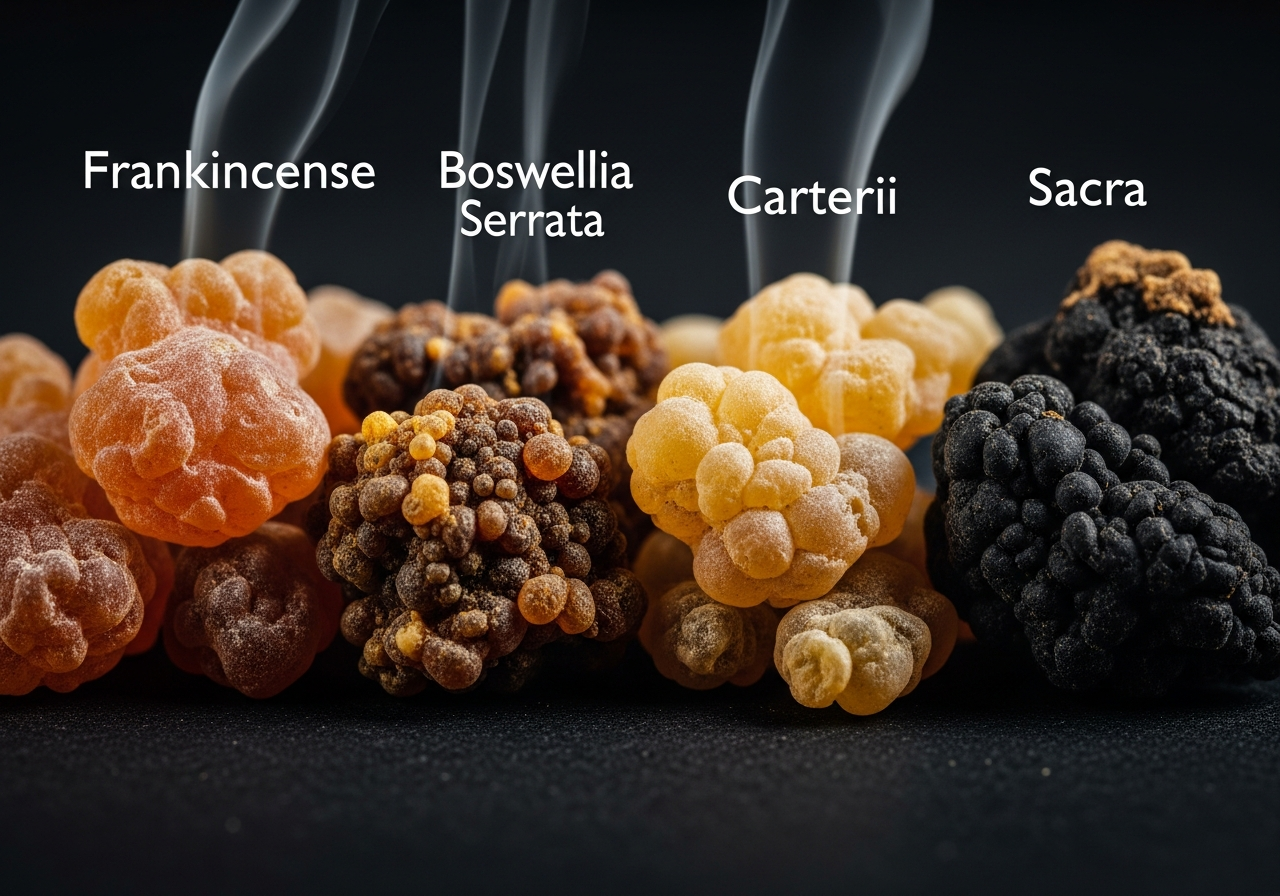 \n\n
\n\nBoswellia Serrata: The Indian Powerhouse
\n\nBoswellia serrata stands as perhaps the most extensively studied and commercially available frankincense species, earning recognition for its robust chemistry and consistent quality. Native to the Indian subcontinent, this species has been deeply integrated into Ayurvedic traditions for over 3,000 years, where it's known as \"Shallaki\" or \"Salai guggul.\"
\n\nBotanical Characteristics and Habitat
\n\nThe Boswellia serrata tree typically reaches heights of 3-5 meters, characterized by its compound leaves with serrated edges—hence the species name \"serrata.\" The bark appears papery and peeling, revealing layers of different colors beneath. These trees thrive in the dry deciduous forests of Madhya Pradesh, Rajasthan, Orissa, and other central and northern Indian states.
\n\nThe species demonstrates remarkable resilience, capable of surviving in poor soils with minimal water. During the dry season, the trees may shed their leaves entirely, conserving energy and moisture for resin production. This adaptation results in the highest resin yields during periods of environmental stress, typically coinciding with traditional harvesting seasons.
\n\nHarvesting and Processing Methods
\n\nTraditional harvesting of Boswellia serrata follows time-honored methods passed down through generations of tribal communities. The process typically begins with careful incisions made in the bark using specialized tools. These wounds stimulate the tree's natural defense response, causing resin to exude and harden over several weeks.
\n\nThe quality of Boswellia serrata resin varies significantly based on several factors:
\n\n- \n
- Seasonal timing: Prime harvesting occurs during dry months when resin production peaks \n
- Tree maturity: Older trees generally produce higher quality resin with more complex aromatic profiles \n
- Incision technique: Skilled harvesters know precisely where and how deep to cut for optimal yield without damaging the tree \n
- Collection timing: Multiple collections over several weeks allow for grade sorting based on clarity and color \n
Chemical Profile and Research
\n\nBoswellia serrata has attracted significant scientific attention, with researchers identifying numerous bioactive compounds within its resin and essential oil. The species contains notable concentrations of boswellic acids, particularly those unique to the Indian variety. Some research suggests that these compounds may support various physiological processes, though more studies are needed to fully understand their mechanisms.
\n\nThe essential oil typically contains:
\n- \n
- α-pinene (8-15%) \n
- β-pinene (2-8%) \n
- Limonene (3-8%) \n
- p-cymene (2-6%) \n
- Various sesquiterpenes and oxygenated compounds \n
For those interested in exploring this species further, our comprehensive Indian frankincense guide provides additional insights into traditional applications and sourcing considerations.
\n\n \n\n
\n\nBoswellia Carterii: The Classic African
\n\nBoswellia carterii represents what many consider the archetypal frankincense, embodying the classic aromatic profile that has defined this precious resin throughout history. Native to Somalia and parts of Ethiopia, this species has been the backbone of frankincense trade for over 4,000 years, shipped from ancient ports along the Horn of Africa to civilizations across the known world.
\n\nHistorical Significance and Trade Legacy
\n\nThe story of Boswellia carterii is inextricably linked with the ancient frankincense trade routes that connected Africa with Egypt, Rome, Greece, and beyond. Somali frankincense commanded premium prices in ancient markets, often worth more than gold by weight. The species earned its reputation through consistent quality and the distinctive aromatic profile that became synonymous with sacred and ceremonial applications.
\n\nArchaeological evidence suggests that Boswellia carterii was the primary species used in ancient Egyptian religious ceremonies, including the famous temple incenses described in hieroglyphic texts. The quality and characteristics of Somali frankincense made it the preferred choice for the most sacred applications, establishing a legacy that continues to influence modern perceptions of frankincense quality.
\n\nEnvironmental Adaptations and Sustainability Challenges
\n\nThe harsh landscape of Somalia presents both opportunities and challenges for Boswellia carterii cultivation. These trees have evolved to thrive in extremely arid conditions, often growing in areas receiving less than 200mm of annual rainfall. They demonstrate remarkable drought tolerance, capable of remaining dormant for extended periods during severe dry spells.
\n\nHowever, this same harsh environment that produces such high-quality resin also makes the species vulnerable to overexploitation and climate variations. Political instability in the region has complicated conservation efforts, while increased global demand has put pressure on wild populations. Sustainable harvesting practices have become crucial for ensuring the long-term viability of this precious resource.
\n\nQuality Grades and Commercial Classifications
\n\nBoswellia carterii resin is traditionally classified into several quality grades based on color, clarity, size, and aromatic intensity:
\n\n| Grade | \nColor | \nCharacteristics | \nTraditional Use | \n
|---|---|---|---|
| Hojari/Royal | \nPale yellow to white | \nLarge tears, high clarity | \nCeremonial, premium | \n
| Superior | \nLight golden | \nMedium tears, good clarity | \nReligious, therapeutic | \n
| Commercial | \nAmber to brown | \nMixed sizes, some opacity | \nGeneral incense, trade | \n
| Dust/Powder | \nVarious | \nSmall fragments | \nBulk applications | \n
Aromatic Characteristics
\n\nThe essential oil derived from Boswellia carterii exhibits the classic frankincense aroma profile that many consider the \"gold standard.\" The scent opens with fresh, citrusy top notes, transitions through warm, balsamic middle notes, and settles into deep, woody base notes with hints of spice and honey.
\n\nThis complex aromatic journey makes Boswellia carterii particularly prized for perfumery and aromatherapy applications. The oil blends exceptionally well with other premium aromatics, serving as both a standalone fragrance and a sophisticated base note in complex compositions.
\n\nTo learn more about the cultural and historical significance of this remarkable species, explore our detailed guide on Somali frankincense traditions and modern sourcing practices.
\n\n\n\nBoswellia Sacra: The Royal Omani
\n\nBoswellia sacra holds the distinction of being perhaps the most revered and historically significant frankincense species. Known as \"Luban\" in Arabic and often called \"sacred frankincense,\" this Omani native has been treasured for over 6,000 years as the ultimate expression of frankincense quality and spiritual significance.
\n\nThe Sacred Landscape of Dhofar
\n\nThe southern Omani region of Dhofar represents one of the world's most extraordinary botanical environments, where Boswellia sacra grows in seemingly impossible conditions. These remarkable trees cling to steep limestone cliffs and rocky outcrops, surviving on minimal rainfall supplemented by seasonal mists from the Indian Ocean monsoon.
\n\nThe UNESCO World Heritage site of the Frankincense Trail in Oman recognizes not only the cultural importance of the ancient trade routes but also the unique ecosystem that produces this precious species. The combination of geological, climatic, and geographical factors in Dhofar creates conditions found nowhere else on Earth, resulting in frankincense of unparalleled quality and character.
\n\nTraditional Grades and Royal Classifications
\n\nOmani frankincense has been classified according to traditional grading systems that date back centuries. These classifications reflect both quality characteristics and historical usage patterns:
\n\n- \n
- Hojari (Royal Grade): The finest quality, traditionally reserved for royal courts and the most sacred ceremonies \n
- Najdi: Premium grade known for its exceptional clarity and aromatic intensity \n
- Shathari: High-quality grade with distinctive golden coloration \n
- Shaabi: Commercial grade suitable for general incense applications \n
The Hojari grade, in particular, commands extraordinary prices in international markets, often selling for several thousand dollars per kilogram for the finest specimens. This premium reflects not only rarity but also the exceptional aromatic profile and cultural significance of the highest-quality Boswellia sacra resin.
\n\nChemical Uniqueness and Aromatic Complexity
\n\nBoswellia sacra exhibits perhaps the most complex chemical profile among frankincense species, containing unique compounds not found in other varieties. Research has identified distinctive terpenic profiles that contribute to its legendary aromatic characteristics.
\n\nThe essential oil composition typically includes:
\n- \n
- High concentrations of α-pinene (20-35%) \n
- Significant levels of limonene (15-25%) \n
- Unique sesquiterpene profiles \n
- Rare oxygenated compounds specific to the Dhofar region \n
- Complex aromatic esters contributing to longevity and depth \n
These chemical distinctions create an aromatic profile of extraordinary sophistication, characterized by an initial burst of bright, almost ethereal top notes, followed by layers of complexity that can evolve over hours when properly appreciated.
\n\nCultural and Spiritual Significance
\n\nThe cultural importance of Boswellia sacra extends far beyond its commercial value. In Omani tradition, frankincense burning is an integral part of daily life, used to welcome guests, purify spaces, and mark important occasions. The practice of \"bakhoor\" (incense burning) using sacred frankincense remains deeply embedded in Gulf Arab culture.
\n\nHistorical texts describe Boswellia sacra as the frankincense of choice for the most sacred applications, including temple ceremonies in ancient civilizations and royal courts throughout the Middle East. This sacred association continues to influence modern perceptions and usage patterns, with many considering it the ultimate frankincense experience.
\n\nFor deeper insights into the spiritual and cultural dimensions of this remarkable species, our guide to sacred frankincense explores the traditions and contemporary applications that make this variety so extraordinary.
\n\n\n\nChemical Composition: What Makes Each Unique
\n\nThe chemical differences between Boswellia serrata, carterii, and sacra extend far beyond mere aromatic variations, representing distinct evolutionary adaptations to their respective environments. Understanding these compositional differences provides insight into why each species exhibits unique characteristics and traditional applications.
\n\nMonoterpene Profiles: The Aromatic Foundation
\n\nMonoterpenes form the aromatic backbone of frankincense essential oils, contributing to the immediate olfactory impact and many of the volatile characteristics. Each species exhibits distinctive monoterpene profiles that reflect their environmental pressures and genetic heritage.
\n\n| Compound | \nB. serrata (%) | \nB. carterii (%) | \nB. sacra (%) | \nAromatic Note | \n
|---|---|---|---|---|
| α-Pinene | \n8-15 | \n15-25 | \n20-35 | \nFresh, piney | \n
| β-Pinene | \n2-8 | \n3-8 | \n5-12 | \nWoody, resinous | \n
| Limonene | \n3-8 | \n8-15 | \n15-25 | \nCitrusy, bright | \n
| p-Cymene | \n2-6 | \n1-4 | \n1-3 | \nHerbal, spicy | \n
| Camphene | \n1-4 | \n2-6 | \n3-8 | \nCamphoraceous | \n
The higher α-pinene and limonene concentrations in Boswellia sacra contribute to its renowned clarity and ethereal quality, while the more balanced profile of B. carterii creates its classic, well-rounded character. B. serrata shows greater variability in monoterpene composition, reflecting the diverse environmental conditions across its Indian range.
\n\nSesquiterpene Complexity: The Signature Notes
\n\nSesquiterpenes provide the deeper, more complex aromatic notes that distinguish fine frankincense from simpler aromatics. These compounds also contribute to the longevity and evolution of the scent over time.
\n\nBoswellia sacra exhibits the most sophisticated sesquiterpene profile, including rare compounds like incensole and incensole acetate that are found in minimal quantities in other species. These unique molecules may contribute to the distinctive spiritual and meditative associations historically attributed to sacred frankincense.
\n\nBoswellia carterii shows consistent sesquiterpene patterns that create its reliable, classic frankincense character. The presence of compounds like β-caryophyllene and α-humulene adds depth and complexity while maintaining the species' reputation for balance and harmony.
\n\nBoswellia serrata contains unique sesquiterpene profiles that don't occur in the African or Arabian species, reflecting its distinct evolutionary pathway and environmental adaptations. Some research suggests these compounds may contribute to the traditional applications that have made Indian frankincense particularly valued in Ayurvedic practices.
\n\nBoswellic Acids: The Research Focus
\n\nWhile essential oils capture the volatile aromatic compounds, the resin itself contains numerous non-volatile constituents, including the famous boswellic acids. These triterpenic compounds have attracted significant scientific interest, with different species showing varying concentrations and types.
\n\nBoswellia serrata contains particularly high levels of specific boswellic acids, including 3-O-acetyl-11-keto-β-boswellic acid (AKBA), which has been the subject of numerous research studies. Some research suggests these compounds may support various physiological processes, though more clinical trials are needed to fully understand their potential.
\n\nBoswellia carterii and B. sacra show different boswellic acid profiles, with unique compounds that reflect their distinct genetic heritage and environmental influences. These differences may partially explain the varying traditional applications and cultural preferences associated with each species.
\n\nEnvironmental Influence on Chemistry
\n\nThe harsh environments where frankincense trees thrive create significant stress that influences chemical composition. Trees growing in more challenging conditions often produce resins with higher concentrations of protective compounds, resulting in more complex and potentially more valuable aromatics.
\n\nSeasonal variations also play crucial roles, with resin produced during periods of maximum stress typically showing the most concentrated and complex chemical profiles. This relationship between environmental challenge and chemical richness helps explain why the finest frankincense often comes from the harshest landscapes.
\n\n\n\nAromatic Profiles and Sensory Differences
\n\nThe sensory experience of frankincense represents one of humanity's most sophisticated aromatic relationships, with each species offering distinctive olfactory journeys that have influenced cultures, religions, and personal practices for millennia. Understanding these aromatic differences enables buyers to make informed choices based on their specific preferences and intended applications.
\n\nBoswellia Serrata: The Gentle Complexity
\n\nBoswellia serrata presents an aromatic profile characterized by gentle complexity and approachable warmth. The initial impression typically opens with soft, green notes reminiscent of fresh pine needles and citrus zest, but without the sharp intensity found in other species.
\n\nTop Notes (0-15 minutes):
\n- \n
- Fresh, green opening with subtle pine characteristics \n
- Gentle citrus undertones \n
- Clean, almost medicinal quality without harshness \n
- Slight herbal aspects reminiscent of traditional preparations \n
Middle Notes (15-60 minutes):
\n- \n
- Warm, woody development with resinous depth \n
- Soft balsamic qualities emerge \n
- Subtle spice notes, particularly black pepper and cardamom hints \n
- Smooth, rounded character without sharp edges \n
Base Notes (1-6 hours):
\n- \n
- Deep, woody foundation with amber-like warmth \n
- Gentle smokiness without overwhelming intensity \n
- Subtle honey and vanilla undertones \n
- Long-lasting but never cloying or heavy \n
The overall impression of B. serrata is one of gentle sophistication, making it particularly suitable for daily use, meditation practices, and blending with other aromatics. Its approachable character makes it an excellent introduction to frankincense for newcomers.
\n\nBoswellia Carterii: The Classic Expression
\n\nBoswellia carterii embodies what many consider the quintessential frankincense experience, offering a perfectly balanced aromatic journey that has defined frankincense appreciation for thousands of years.
\n\nTop Notes (0-15 minutes):
\n- \n
- Bright, crystalline opening with distinct lemony freshness \n
- Clean pine and juniper characteristics \n
- Slight camphoraceous quality adding clarity \n
- Immediately recognizable \"frankincense\" signature \n
Middle Notes (15-60 minutes):
\n- \n
- Rich, resinous heart with perfect balance \n
- Warm spice development including cinnamon and clove hints \n
- Honeyed sweetness without excessive richness \n
- Classic incense character that defines the category \n
Base Notes (1-8 hours):
\n- \n
- Deep, woody foundation with amber complexity \n
- Sophisticated smokiness with ceremonial associations \n
- Hints of leather and ancient wood \n
- Exceptional longevity and gradual evolution \n
The aromatic profile of B. carterii represents perfect harmony between all elements, creating an experience that satisfies both casual users and serious connoisseurs. Its classic character makes it ideal for traditional ceremonial uses, high-end perfumery, and sophisticated aromatherapy applications.
\n\nBoswellia Sacra: The Transcendent Experience
\n\nBoswellia sacra offers perhaps the most complex and ethereal aromatic experience in the frankincense family, justifying its reputation as the ultimate expression of this precious resin.
\n\nTop Notes (0-20 minutes):
\n- \n
- Extraordinary brightness with almost electric intensity \n
- Pure, crystalline citrus notes of exceptional clarity \n
- Ethereal, almost spiritual quality that seems to transcend physical aroma \n
- Unique \"lifting\" sensation that distinguishes it from all other species \n
Middle Notes (20-90 minutes):
\n- \n
- Unprecedented complexity with layers revealing over time \n
- Royal, ceremonial character with regal depth \n
- Exotic spice notes including rare aromatics \n
- Perfect balance between power and refinement \n
Base Notes (1-12+ hours):
\n- \n
- Extraordinary longevity with continuous evolution \n
- Deep, ancient character evoking historical significance \n
- Complex wood notes including precious varieties \n
- Sacred, meditative quality that inspires contemplation \n
The aromatic journey of B. sacra represents the pinnacle of frankincense experience, offering complexity and depth that can provide new discoveries even after years of appreciation. Its exceptional character makes it ideal for the most important ceremonies, luxury perfumery, and serious aromatic study.
\n\nComparative Intensity and Projection
\n\nEach species exhibits different characteristics in terms of aromatic intensity and projection, influencing their suitability for various applications:
\n\n| Characteristic | \nB. serrata | \nB. carterii | \nB. sacra | \n
|---|---|---|---|
| Initial Impact | \nGentle to Moderate | \nModerate to Strong | \nStrong to Intense | \n
| Projection | \nIntimate | \nModerate | \nExcellent | \n
| Longevity | \n4-6 hours | \n6-8 hours | \n8-12+ hours | \n
| Evolution | \nGradual | \nBalanced | \nComplex | \n
| Suitable Space | \nSmall to Medium | \nMedium to Large | \nLarge Spaces | \n
Quality Factors and Sustainable Sourcing
\n\nThe quality of frankincense essential oil depends on a complex interplay of factors that begin with the health of the source tree and extend through every stage of harvesting, processing, and storage. Understanding these quality determinants empowers buyers to make informed decisions and support sustainable practices that ensure the long-term availability of these precious aromatics.
\n\nTree Health and Environmental Factors
\n\nThe foundation of exceptional frankincense quality lies in the health and maturity of the source trees. Several environmental and botanical factors significantly influence resin quality:
\n\nTree Age and Maturity: Mature trees, typically over 10-15 years old, produce the most complex and valuable resins. Young trees may produce resin, but it generally lacks the depth and sophistication found in specimens from older, well-established trees. The most prized frankincense often comes from trees that are 30-50 years old or more.
\n\nEnvironmental Stress: Paradoxically, trees growing in challenging conditions often produce superior resin. Limited water availability, extreme temperatures, and poor soils force trees to develop more concentrated protective compounds, resulting in more complex and valuable aromatic profiles.
\n\nSeasonal Timing: The timing of resin collection dramatically impacts quality. Most species produce their finest resin during periods of environmental stress, typically the dry season when trees concentrate their energy into protective resin production.
\n\nGenetic Diversity: Wild populations with greater genetic diversity tend to produce more varied and complex aromatics compared to cultivated or genetically uniform plantations. This diversity creates the subtle variations that make wild-harvested frankincense particularly prized.
\n\nHarvesting Methodology and Timing
\n\nTraditional harvesting techniques, refined over millennia, remain superior to modern mechanical methods for producing the highest quality frankincense:
\n\nIncision Techniques: Skilled harvesters understand precisely where and how to make incisions that maximize resin flow without damaging the tree. Different species require different approaches, and the depth, angle, and location of cuts significantly influence both yield and quality.
\n\nCollection Frequency: The best resin comes from multiple collections over several weeks or months. The first tears are often discarded or graded lower, as subsequent collections typically yield clearer, more aromatic resin as the tree's defensive response reaches peak efficiency.
\n\nSeasonal Considerations: Each species has optimal harvesting periods based on local climate patterns:
\n- \n
- B. serrata: Peak season typically falls during the dry months from November to April \n
- B. carterii